Merry Christmas from the middle of Avenida Paseo de la Refroma, which is ironic for reasons below
Church and State are legally separated in Mexico. When that happened during the Reforma period after the revolution, it resulted in repression of the Church and the resulting Cristero war. In the end, the government seized all Church property. Which means that in a land where Church and State are legally separated, the government owns and maintains all Church properties! And Christmas shows up all over the place, from official squares to nativity scenes to toll booths (festooned with garland and “Feliz Navidad” written on the windows).
The Zócalo during the late afternoon, Christmas eveLater in the evening…The Zócalo after Christmas eve mass at the CathedralChristmas tree next to the monument to the Mexican Revolution
Feliz Navidad remains a common greeting, although a few “feliz fiestas” or “happy holidays” have crept into Méxican culture. Since “feliz fiestas” sounds so weird (are there any unhappy fiestas?) it may not catch on.
Mexico has a tortured history of religious involvement in political affairs. For a long time, all citizens had to be Catholic. The call for independence came under a banner of the Virgin of Guadalupe. Still, México seems to have come to terms with a way to be officially secular without renouncing the essence of religious belief, which is after all communal and “other” facing.
The Cardinal Archbishop of Mexico City presiding at the Christmas eve vigil mass
Winston Churchill once commented that the Balkans were so violent because they “produce more history than they consume.” CDMX produces a lot of history, too, and sometimes it is very concentrated. We visited two of its most densely packed historical sites today: Three Cultures Square and Tepeyac.
I expected the visit to Three Cultures Square to be a simple photo op: yes, you can grab an image with pre-modern (Aztec), modern (Spanish colonial) and post-modern (1960’s) structures in it. But as we toured the site, I came to realize just how much history was jam-packed into it.
First, it was the site of the Aztec town of Tlatelolco, where Moctezuma appeared before his people begging them not to attack the conquistadores. Instead, the Aztecs turned on Moctezuma and stoned him, resulting in his eventual death. There also the final Aztec chief, Cuauhtémoc fought and lost the final battle against Cortés, resulting in the end of the Aztec empire.
When the Spanish built this church there, it was the site of the baptism of a indigenous man who took the Christian name Juan Diego…more on him later.
Church of Santiago
Juan Diego’s baptismal fount
In 1968, students and workers protested against the corruption evident in the run-up to the 1968 Olympics in Mexico City. Military and police opened fire on them in this same square, killing between 300-400 on the eve of the opening ceremonies.
Tragedy in 1521, 1968, 1985
Finally, the apartment blocs lining the square collapsed during the 1985 earthquake, again killing hundreds in the neighborhood.
Quite a lot of history in a space a little larger than a soccer pitch. Its like the Boston Tea Party, Gettysburg, and Kent State all happened on the same spot.
Later in the morning we went to Tepeyac, better known as the hill on which the Virgin Mary (our Lady of Guadalupe) appeared to Juan Diego (yes, that Juan Diego), which I covered here. Now we’ve been to Rome, Jerusalem, Lourdes, and Fatima, and we have never seen a denser pack of churches than around the grounds of the Basilica of Our Lady of Guadalupe.
yes, its sinking
The new & old basilicas
The Indians’ Church
The Church of the well
A Chapel just to “swear off” something
The original church on the hill
What can one say?
One cannot overstate the Mexican people’s deep devotion to this Marian apparition. As our tour guide put it, not all Mexicans are Catholic (80% are), but all Mexicans are Guadalupanos (or devotees of Our Lady). Any time of day or night, you’ll find common folk working their way across the central plaza of the Basilica…on their knees. During the days immediately before the annual feast of La Guadalupana (12 December), almost 11 million people visited the shrine, again in a space about the size of your average mall in the States.
I counted seven different churches, including the original chapel directed to be built by Our Lady, and the second, larger church which is sinking into that soft lake bed which underlies most of CDMX. Mexican families come for the day: there is always a Mass underway, there were long lines for confessions, and people celebrating marriages, good fortunes, or just giving thanks.
Look closely & you can see the cracks
Church of the well is…
moving away
One can always visit the famous tilma, the cloak on which the image of the Virgin appeared, by standing on a series of motorized walkways that take you slowly past; there is always a short line. The tilma is out of reach, as it has already survived an acid attack and 29 sticks of dynamite!
The tilma
A candle stand after 29 sticks of dynamite
Close up
The grounds of the Basilica are not large, but they are full of churches, chapels, images to place votive candles, and a few tastefully obscured shops. Of course, just outside the grounds are all the plastic religious gee-gaws one could want. Looking at the various sculptures and watching Mexican families enjoy their visits, you can see just how much this particular icon means to all of them.
Juan Diego, in roman garb…doesn’t he look classical?
Another Juan Diego, with tilma
A pictorial representation of the peoples and their Mother
Teotihuacan was on the agenda for today. It is hard to grasp the size and scope of this development, but I hope these pics and video give some perspective.
Temple ornamentation
Perhaps the most interesting thing about Teotihuacan is how little we really know about it. We don’t know it’s name; Teotihuacan is just what the Aztecs called it. It means “city of the gods” since the Aztecs found it abandoned and assumed the gods must have built it. We don’t know who really built it, as it predates the Meso-american societies we have named but is more advanced than the unidentified ones. We know the Aztecs came from Tenochtitlan to hold religious services in Teotihuacan, and we know the conquistadors named one area “the citadel” because they thought it resembled a ready-made fort.
Archaeologists thought Teotihuacan had astronomical associations based on its location and orientation, so they called the largest pyramid the temple of the sun and the next largest the temple of the moon. Once excavated, they determined both were dedicated to Meso-american gods: Tlaloc and some unknown female counterpart. They estimate one-quarter of a million people lived in and around the complex, but we don’t know what happened to them.
View from atop the temple of the sun, the largest pyramid
The pyramid steps are highly irregular and steep. Most have no handrails; some have a steel cable on which to grab hold. At various levels there are plateaus, where the lines to climb snake back and forth. There are no guardrails. I saw whole families, from grandparents to small children, clambering up the pyramid. From the video, you get a sense of the crowds. There are no signs, no park rangers, no one overseeing safety. Yet I saw no one fall, and everybody seemed to be looking out for everyone else. One way to ensure safety is to make more rules, emplace more equipment, hire more inspectors. Another is to make people responsible for themselves.
As to the title of this post? Well you’ll recall President Obama’s comment that ‘if you own a business, you didn’t build that.’ In the case of the Aztecs and Teotihuacan, it’s true!
We visited the National Museum of Anthropology; random thoughts follow:
Mexico does a good job of memorializing its distant past. The story of the Olmecs, Toltecs, Aztecs, Maya, and others are all captured in a single museum, with each culture given its own hall tracing its origins, rise, and destiny.
Tláloc, reclining, with the pumping station/gallery behind
Likewise, Mexico City made a major effort to add art to its public spaces in the past twenty years, and art drawing on its indigenous roots is featured. One great example of this is Diego Rivera’s statute of the rain god Tláloc, which is situated at the mouth of the Lerma river up on the Chapultepec heights overlooking the city. The pumping station there is set up like a mini-gallery of Rivera’s work, along with a chime system whereby the wind, the water, and pumps all combine to make music.
The Anthropology museum is huge. The central atrium contains this stunning pillar which uses rain water to generate a continuous fountain. The pillar is full of symbols celebrating the merger of Mexico’s indigenous and Spanish past.
While the vast majority of the artifacts on display are originals, there are recreations of some of the temples done is actual size.
Maya temple re-creationActual jade burial mask of Mayan ruler PakalRe-creation of Aztec temple decoration (life size)
There was no sugar coating, and the museum is constantly updating its displays based on new research. For an example of the former, the blood-thirsty nature of Meso-american culture is on full display, from skeletons of human sacrifice victims to discussions about the importance of slavery to the growth of these empires. There is none of the noble savage gloss which sometimes colors other North American histories of the Amerindian cultures.
Not a calendar!
As for keeping up-to-date, the museum noted new research which shows the Maya were quite adept at human sacrifice (a recent change, whereas previously they were considered more humane), and that the Aztec calendar we have all seen is not a calendar, but an Aztec representation of the universe. The museum is yet to capture some of the interesting, very recent finds in the Yucatán about the size and spread of the Mayan empire. But that is very recent, and we don’t really know how much will change as a result of the LIDAR (Laser Imaging Detection and Ranging) of the Yucatán, although it looks like our previous estimates on the Mayan population were off by a factor of ten.
More from what the Aztecs called “the city of the gods” tomorrow.
Live blogging from the Mexican capital, Ciudad de México, or México City as you know it. We’ll be here all week, and I will try to give you a sense of this massive, historical, and vibrant city.
But first, let’s clear up some confusion. All over México, you will see signs–along the highway, in the airport–pointing you toward…México! You may ask yourself, “how did I get here?” and you may say to yourself “this is not my casa!” (Apologies to the Talking Heads).
Here is the short answer: México is the name of a city, and a state, and a country. Ciudad de México is the capital of the country of Mexico. It is surrounded by the state of México, but is not within it. In fact, the capital of the state of Mexico is Toluca. Got that?
Mexicans refer to the capital as just “México” but they mean the city. The city used to be in something called the Distrito Federal or DF, which was akin to DC in the States. So old-timers may call it the DF, but the new appellation is CDMX.
CDMX is the political, historical, and cultural center of the nation and an overwhelming influence on México. At between 25 and 30 million people, it dwarfs Guadalajara, México’s second city, and is either the largest or second largest in the western hemisphere (Sao Paulo, another uncountable metropolis, is the competitor).
The city was built (literally) on the ruins of the Mexica (Aztec) capital Tenochtitlan. I’ll cover all this in more detail as we visit, but one amazing point is Tenochtitlan was built on a man-made series of islands in a great freshwater lake. Practically nothing of the original lake remains, but the unsteady foundations of a lake bed remain a challenge to the skyscrapers that increasingly mark the CDMX skyline.
Not bad for a hotel room view
Did I mention the volcanos and earthquake faults? More on that later!
Simply “the animals of lakeside, ” if you’ve forgotten your high school Spanish.
Living in a relatively rural area, you become accustomed to the presence of animals. After a while. you don’t notice even the largest animals, or animals in the most unusual of places. So I made an effort to capture photos of the many animals I would otherwise not even notice because, well, they’re everywhere.
No turn signals or back-up lights!
Horses (and donkeys) must be first on the list, as vaqueros (cowboys) originated in Mexico and are still seen throughout the countryside and small towns. They handle the local traffic very well, and generally yield the right-of-way. Sometimes you’ll see distracted riding (with cell phone), but if you want to avoid driving under the influence, just ride your horse to the beer store!
And a Miller lite, for my horse, por favor!I’ll just tuck my horse behind the tuba in the parade, and no one will ever notice!Waiter, there’s a donkey at my lunch…
Dogs show up everywhere. This little guy has been holding down guard next to my development for several weeks now. They also show up on local roofs, and of course in front of the meat market!
“what you lookin’ at?”“Don’t make me come down there…”
Goats make less regular appearances. Most often you find them grazing beside the road, but several times a year they are headed to (well, be) lunch (i.e., birria).
Crossed the road, but refused to explain why…
Chickens here are really tough. There’s a flock out front of our development along the carretera (main road). They co-exist peacefully with the street dogs, who learned long ago that while a dog may win a one-on-one battle with a rooster, the prize isn’t worth the fight.
We have a large selection of literal snow-birds, in this case Pelicans. Thousands over-winter at the town of Petatán on the other side of the lake. This small pod (collective noun for pelicans) chose to stay at our club, which is less crowded and far more posh!
You can find more exotic birds, too. Here are some roof Peacocks: not very good as guard birds, but beautiful nonetheless.
Cows playing king of the hill
Finally, you see plenty of cows. Like NOB, they are generally behind fences, but the median strip and road sides are public right-of-ways, full of grass. So it is not uncommon to find cows adjacent to, in the middle of, or crossing busy roads. This is especially true in the early morning, and at night. Which is why the expat lore is “never drive at night in Mexico.” Some think that’s because of the danger of criminal or gang violence; au contraire, the danger is several tons of Mexican beef ambling across your lane in the dark!
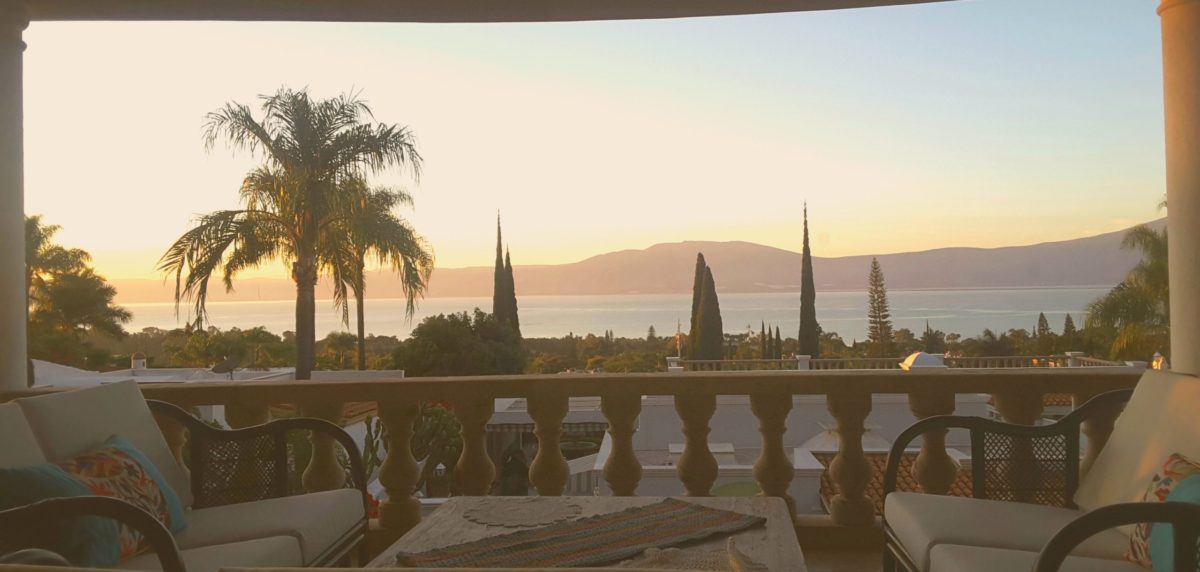
Watching the change of seasons NOB, I was getting ready to make my annual “*sigh*, it’s so boring lakeside, what with the warm dry weather, sunlight, and tropical flora” post. I still may post that eventually, along with an appropriate pool shot (over my feet) with a margarita. But as I prepared to write it, I thought about the fact I live on Lake Chapala, and rarely ever mention it.
That is not unusual, as Judy & I are not “active water people.” If we go to a beach, it’s to lie under a palapa, drink margaritas, and read books. If we go to a pool, we mill about in the water for a few minutes to cool off. We don’t swim laps, we don’t tan. If we visit a lake or stream, we take some photos, but we don’t fish or go swimming. We did win–during a charity auction–a small-boat lunch cruise on Lake Chapala, so sometime soon we’ll report back on that.
Still the lake has a major effect on us (Note: it affects us. It has an effect on us. It does not impact us, unless someone drops a meteor into the lake, whereupon waves would then wash over our house. Sorry, the use of “impact” in TV English, to the detriment of affect/effect, drives me to distraction). The lake has a moderating influence on our climate: we’re generally 5-10 degrees (F) warmer than Guadalajara in the winter, and the same but cooler in the summer. Essentially, the lake creates the micro-climate which makes living lakeside so pleasant, year-round.
There is a running debate about the quality of the lake’s water. Locals swim and boat and fish in it: that much is clear. Some expats are outraged when they see sewage runoff entering the lake, but perhaps they don’t know that that happens in every body of water. Routine testing of the lake’s quality shows it to be above the standards set by the US EPA. Still, there’s little recreational boating, so what’s with that?
The level of Lake Chapala varies greatly. It is fed by the Rio Lerma (to the east), where a series of upstream dams sequester water for agricultural uses. So the lake only gains water when the farms already have enough and/or the levees are full. We can tell when the levees release water, as the amount of lirio, a freshwater aquatic weed, increase rapidly. Many years past, the lake also drained out via the Rio Santiago, but I am told the lake level no longer supports such drainage. Instead, the main loss of lake water comes from pipes which feed the growing demand of Guadalajara, or simple evaporation, which is a major source of loss in a such a hot, dry environment. On any normal day, you can see a haze hovering over the lake which is simply the amount of water vapor leaving it. The shallow and wide nature of the lake contribute to this effect.
In Mexico, land recovered when water recedes is public land: it belongs to the government. When the lake is particularly low, large swaths of fertile land appear. Of course, the government is unprepared to claim such land, so enterprising Mexicans do so. Farmers plant on it; cattlemen place herds on it. Locals create walking trails which provide a glimpse of the houses of the rich and famous from an unusual angle (lakeside) where there generally are no privacy walls. I’m told someone even built a off-road, dirt racing strip on a sizable patch of muddy shore, once. Folks fence their efforts in, run bootleg power lines, even build small structures.
Then the lake rises, and all this is inundated. You might even say, “impacted.” Would you swim/water ski/sail over shallows which might contain, oh, power lines? barbed wire? a roof? Locals do, but must most expats shy away.
We had a strong rainy season this year, meaning Lake Chapala is at a 40 year high. The strange thing is, the rainy season ended back in October, and we’ve had several rain storms since. We even had some cloudy days, and the temperature hit (dramatic drum roll please) 59 degree F. Locals were wearing ski jackets, stocking caps, and gloves. Expats were fully dressed, (¡Gracias a Dios!) for a change. I even saw a Canadian wearing long pants!
My development has a boat dock and a seawall which measures about 15 feet. Usually, the lake is off the seawall during the dry season, although it sometimes climbs on to the seawall during the rainy season.
As you can see, the seawall has been over-topped!
The gates on the boat ramp are mostly underwater, too.
My own dog photo-bombed me. You can’t trust anyone!
The lirio show how high the water gets when a wind creates some waves. The lake appears to be at or near a 40 year high, which is all to the good.
Since you suffered through all this, here’s a musical interlude to see you off, courtesy of Led Zeppelin (very bluesy):
Back last millennium, when I was at West Point, the cadet who graduated last in our class was called “the goat.” The goat won a bounty of $1 per member of the class in recognition of the achievement. It came to over $700 dollars, as I recall; not a bad reward for sustained performance!
Now I see references in sports to “the G.O.A.T.” or “the greatest of all time.” I oppose making acronyms just for their own sake. This one confuses, too, because in general being the goat is not a good thing.
We spent our time this weekend with some real goats. The four-legged kind. We visited Gallo de Allende, a new family-owned business along the lake. Juan Diego and his wife Laura have a hillside goat farm above the town of Mezcala, and they are offering tours in addition to selling goat cheese and milk at local markets.
Mountains tower over the parking area and pasture
The couple has taken the property from a scrub-covered, rocky field into a cleared and cultivated farmstead with amazing views. While they are focusing in the near term on growing their herd (32 head), they are also considering eventual expansion which could include a guest house, a cellar for aging cheeses, maybe even a place to host weddings. Juan Diego and Laura emphasize the quality of the natural feedstock their goats consume and the resulting quality of their milk and cheese.
Juan Diego and his goats take in the view
During the tour, we had a great breakfast of Mexican coffee, fresh fruit, goat-milk yogurt, and homemade granola. We got a chance to feed the goats and take a little tour.
Judy wanted to adopt the littlest one, but I don’t thing our dog Tucker would have approved.
We finished off with a nice little picnic consisting of wine, various cheeses, chimichurri, and plum jam. Delicious!
We had a great Sunday afternoon, leaned a lot about goats, and ate well. You can buy the farm’s products at the Tuesday market (Ajijic), take the tour (which starts at the bus stop in front of WalMart), or visit their FaceBook site.
Mexican independence day, that is. September 16th is the annual fiesta for el Dia de Independencia; let’s see how it compares and contrasts to the 4th of July.
It must be that time of year!
First, historically, there is a major difference. In the US, independence day celebrates the declaration by the Continental Congress establishing the necessity of independence (“When in the Course of human events, it becomes necessary for one people to dissolve the political bands which have connected them with another…”), some fourteen months after the first shots were fired at Lexington and Concord. Mexico celebrates its independence day on the anniversary of the day its war of independence began, when Catholic priest Miguel Hidalgo rang the church bells in the city of Dolores as a call to arms against the corrupt Spanish colonial government. His cry is known as “el Grito de Dolores”, although if you Google El Grito in English you might get this result:
The Scream, but not El Grito
The city is now called Dolores Hidalgo in his honor. El Grito began the insurrection in 1810, and it ended ten years later with Mexican independence. The exact words of Padre Hidalgo are lost to history. Almost certainly he did NOT say “Viva Mexico!” as the province was known as Nuevo España and the term Mexico only later derived. Most historians agree he did call on the people to support Our Lady of Guadalupe, the revered Catholic icon, which also explains the close connection between Mexicans of all persuasions and la Guadalupana. As an interesting historical aside, Padre Hidalgo also called out Napoleon, as the French Emperor had recently conquered Spain and was responsible for Nuevo España when el Grito was made.
El Grito, then
In terms of a party, there is much similarity to the US 4th of July. There are bands and parades, lots of flags, fireworks and military displays. Everything seems to be in Red, White & Green, the colors of the Mexican flag. Most towns re-enact el Grito around midnight on September 15th; the biggest celebration is in the Zocalo or main square in Mexico City, where el Presidenté reads el Grito then leads the enormous crowd in a series of ¡Vivas! followed by hours of fiesta.
El Grito, now
We went out for dinner last night, and of course one course was the dish Mexicans associate with their independence day, chiles en nogada. As I said, everything is the colors of the Mexican flag! Viva!
Last weekend was the beginning of college football season, so I dutifully sat on my couch and watched every single game that was available from Thursday through Monday. Actually, I will do that most of the rest of college football season…just until January. My dear wife Judy has no such affliction, so she decided to go on a tour of Guadalajara. But her trip did give me an excuse to insert one of my favorite Mariachi tunes:
Our Spanish language teacher, Gabriel González, is starting a new tour business called Mexplore (note to local expats: check out their Facebook page for further info. His first trial-run was a day tour of Guadalajara. The tour did the greatest hits of the Centro (downtown) area of Guadalajara, including:
This church which features a continuous exposition of the (huge) Blessed Sacrament above the altar;
A park honoring “illustrious citizens of Jalisco” (the Mexican state in which Guadalajara resides), which includes a rotunda where the ashes of some these citizens are interred;
This bronze relief representing the original settlers of Guadalajara;
The original Cathedral of Guadalajara from 1549;
The Museum Cabañas, a former orphanage which is now decorated full of stunning murals by José Clemente Orozco, a unique artist known for his mix of stark realism and visionary symbolism;
and the iconic current Cathedral. This walking tour also took time out for a lunch break at a typical local restaurant, and visited the literally endless Mercado Libertad, which could easily take a day by itself!
That said, the tour took all of nine hours, including travel time to/from lakeside, and was a big hit. I hope to make a future tour, perhaps for an evening of Lucha Libre!


 We had a great Sunday afternoon, leaned a lot about goats, and ate well. You can buy the farm’s products at the Tuesday market (Ajijic), take the tour (which starts at the bus stop in front of WalMart), or visit their


