When we travel, we try to check out local news sources to find out what the locals are up to. Sometimes it’s a dry well, other times we strike gold. This past week was the latter here in Alicante.
Beginning the procession from inside the Co-cathedral
First, Judy saw mention of a local fiesta about the “Santa Faz.” The Holy Face? So I looked it up, and sure enough, there is a monastery of the Holy Face in the greater Alicante area, dating back to the 15th Century. According to local lore, in that period, a monk from Rome smuggled part of the Veil of Veronica to Alicante to spare it from whomever was sacking Rome at that time. The Veil of Veronica? A Catholic legend that a woman named Veronica wiped Jesus’ face (as he walked the cross up to Golgotha), thereby receiving an image of his passion on the veil.
Mel Gibson’s take on the story
There’s no contiguous evidence for Veronica’s story, and some theologians believe even her name is simply a mistranslation referring to the veil (Vera icon = true image in Latin/Greek). But veils purporting to be the true image have been around since the 6th Century, and at one point the Vatican collected up the many versions to try to establish some sort of registry. Unfortunately, before the work was done, the accounting was lost, so no one knows which was which. They subsequently found paths to different places like Alicante, where they continued to be venerated. The Church has approved worship of the Holy Face (as an icon of Christ’s passion) without going any further toward validating any of the individual veils.
Locals in Alicante believe the veil has miraculous qualities, and they honor it annually with a procession from the Co-Cathedral in the city back to the monastery. The images you see in my photos/videos is NOT the veil itself. Too many people tried to touch or grab it over the centuries, and it suffered from public exposure. So the religious authorities constructed a tableau to put it in for further public exposition. The procession happens every year on the second Thursday after Easter. It starts inside the Cathedral, with prayers and a welcome from the alcalde (mayor), as the event is well-coordinated with the local authorities. The pilgrims carry cane poles with sprigs of rosemary signifying their status. It then winds through the narrow streets of the old town until reaching a major modern highway, one-side of which closed. About halfway (5 kilometers) to the monastery, local businesses set up booths offering snacks, wine, and freebies (note the many orange baseball caps, for example).
Arriving at the monastery , there is a full-scale fiesta with booths, carnival rides, etc. We inched our way closer to the main door, and found an outdoor Mass, and the chance to receive Holy Communion. We didn’t stay for the tour inside the monastery, and instead found one of the special public busses set up to take us back to the city center. As we rode home, we could still see families on the early stages of the walk! The government estimates about 330,000 people processed this year!
This adventure was the Caminar (walking) portion of the week; now for the Comer (eating).
Around the same time, the Alicante city government also sponsored “Alacroqueta,” a competition to see which local restaurant serves the best croquettes. Alicante views itself as a national leader in croqueta cuisine. Croqueta began as a solution to leftovers: take whatever didn’t get eaten, form it up into little balls (maybe add a little sauce), dip in batter, fry it up, and serve it again. Over time, they became a go-to form of tapas, the little snacks served alongside drinks in Spanish bars.
As a form of marketing mixed with self-promotion, the city sponsored a public snack-off. Fourteen finalists (after a first round competition earlier in the year) were selected to sell their best croqueta creation at this event. If you bought even one, you got a QR code to vote for best croqueta. The competition went on for four days, and we visited early on Saturday before the lunch rush.
Among the competitors we tried ones filled with kimchi, jamon iberico/mushroom/truffles, and Spanish chorizo. Each croqeuta cost two euros, and drinks were three or four (very inexpensive). We only lasted two rounds of tasting, because while the croquetas are small, they are very rich and fried, thus very filling. A tapas crawl (similar to a bar crawl) here comprises walking from bar to bar, trying their signature tapa with a caña (small beer) or small glass of wine while standing in the bar, then moving on to the next bar. For the locals, the standing and walking and waiting while chatting with friends is part of the experience, while tourists are easy to spot for ordering many different tapas while staying in the same bar.
In both cases (the caminar and the comer) it was fun to join locals enjoying their town.
Marriage (and life in general) is a series of compromises. My dear wife would prefer to be at home, living her routine, every day, for the rest of our days. That works great for us during college football season (September-January), as I too like to be where I don’t have to search to see where games might be televised. I can access the Firestick, pull up YouTube TV, and select four games to watch simultaneously. Three times each Saturday. And some people think there is no God!
But starting in February, I get the travel itch. That’s not quite true. Starting in February I get the travel itch for next year, as by February all this year’s travel is planned, paid for, and ready to go. Judy is game for the annual exodus, but because we’re traveling, I get a chance to compromise. For example, we try to avoid those “If It’s Tuesday, This Must Be Belgium” type trips, endlessly hauling luggage up-n-down European stairwells because the Romans didn’t invent the elevator. We try to stay longer when we go somewhere. We try to avoid jet-lag. and most importantly, we try to live wherever we land within our home, expat schedule.
“What’s the point of traveling if you’re going to live like you’re at home,” you might ask. Why, that’s the point of this blog post!
Living by your typical schedule gives you a sense of normalcy in unfamiliar places. Life on the road, even a planned, extended trip, can quickly become unsettling. A rail strike in Italy, which doesn’t even get covered by the local press anymore, can mean a missed airline flight. A grabby cabbie can lunge at your fistful of dollars in Istanbul, because you don’t have enough Lira (true story). Worst of all, you might get sick. Anyone who has been sick far away from home knows the feeling: what do I do now? Visiting Oxford many years ago for an executive seminar (thanks, US taxpayers!), I got a terrible head cold. I mean snot running out my nose in a torrent. I asked the professor of my seminar where I could get some pseudoephedrine to address the symptoms. She looked at me like I was trying to score some crack. Turns out it was a controlled substance back then in the UK (now too in the US). She said Brits just go to the local apothecary, which I then did. Where, it turns out, they offered me an herbal tea and some smelly thing for a chest rub. Luckily, my wife was arriving from the States, and she smuggled in a box of extra-strength Sudafed.
But setting aside the things that go terribly or mostly wrong, just small things can add up. The coffee is not quite right, or the dining hours off, or the microwave controls appear to be from the Soyuz system. People stay up late partying next door, or don’t form a queue at the bakery, or have a trash and recycling system more complicated than voting in the States. Eventually you can figure these things out, and life sets into a slightly-different routine. But not if you don’t settle in place, first. So we try to keep our home schedule, with nice local excursions to that schedule. What’s that look like here in Alicante, Spain?
I still get up between 6-6:30 am. You can’t get up before the dawn for forty years and not establish a pattern. So that’s my quiet time, to pray, to fix some coffee, to start my daily reading. I wake Judy at 7:30, with a cup of fresh brew and a song. Always the same song. I tried to change it once and never got a verse done before she asked what I was doing. I return to my reading (and another cup) while she has her prayer and quiet time. Around 8-8:30 she makes breakfast. Here’s where small changes come in. We have a minimal kitchen here, and plentiful Spanish foods, so we generally have eggs with jamon iberico (in its many forms), toast with olive oil and salmorejo ( a cold garlicky soup the locals also pour onto the breakfast bread). Judy has the same with what I call her “nuts and twigs”: cottage cheese or yogurt with chia seeds and powdered bat-wing, eye of newt, and grass from the plaza next door. I may be wrong about the last few ingredients. Maybe. I don’t want to ask.
My breakfast, this time with black beans, too
Between 9-9:30, at home we would head to the gym we built in our basement. Here, we joined a local gym for the two months of our stay, €30 per person per month, no sign-up fee and no long-term commitment. We go six days a week, with a schedule that includes daily stretching and cardio, and weights with rest days in between. I have to say that we see the same set of twenty-something gym-bros and -bras there everyday, so I have no idea what they all do for a living. We’ll be at the gym until 11:30-noon, then back to the apartment.
Barely got a pic I was eating so fast
Lunch presents the first real choice of the day: do we eat out or will Judy cook it? Remember, we only eat breakfast and lunch, so cooking our big meal of the day is no small commitment. Judy usually plans a day or two out in advance, so sometimes there is a chicken breast or pork filet that needs eating, other times not. Fresh Broccoli, or seasonal vegetables: right now it’s asparagus and artichoke season, so they’re fresh, inexpensive, and in every tienda. I’ll have a few restaurant options to choose from if that’s what we lean toward this day. Not all of them will be tapas, croquetas, or even Spanish cuisine; we just hit a pizzeria because it advertised real Napolitano pizza, and sure enough, the chef was from Naples. There are sushi, Thai, Poke, Argentine, Chinese, and Arab restaurants within blocks.
Arroz, the local version of paellasalmon for me, lamb for Judy
After lunch, we usually go do our grocery shopping. When in Europe, shop like the Europeans: go to the store every day and get fresh bread, veggies, milk, etc. Carry them home in a little trolley. Yes, they do have giant all-in-one stores like Costco, but most people shop in the store down the street. The crazy thing is, everything in there will be fresh. When you walk into a 7-11, you expect processed and frozen food; you don’t eat the prepared stuff unless you have a death-wish. Here, even the prepared foods were made this morning, and usually by someone who really took pride in making that little ensalada rusa. And they’re good, and not expensive.
Because it’s close to the apartment and we shop for a only a few things, it’s a quick trip. We often take a short walk around town after meals. Between 1:00 and 2:00 we face a second choice: is there some place or event we want to visit? Via walking or the tram, we can get anywhere in town in under ten minutes, so we can pop over to a museum, a store, a display and be back before siesta time. Or we can always go another day, and siesta time beckons sooner. Siesta is real thing, but it doesn’t always involve sleeping in the middle of the day. Well, it does for us, but in general in Mediterranean cultures, it’s the hottest part of the afternoon, when it is best not to go out, or if you must, to run a few errands before returning to work. In Mexico the school day is a half day, so parents go home to greet their children coming home or to send the second shift off to school. Here in Spain, many more stores stay open as a convenience, but some banks and government offices close. In the Spring it seems a luxury, but in Summer, it’s a necessity.
Judy can easily put in two hours of siesta, falling asleep to her True Crime podcasts. How anybody can fall asleep to the creepy voice of the narrator saying, “he looked normal, but that machete he was sharpening had a well-worn blade” I will never understand. I take my patented Pentagon nap. Back in the day, when I was still in uniform and worked on the Joint Staff in an extremely stressful job supporting the nuclear arms talks, we all used to work insane hours. My bosses didn’t care how long we spent at the POAC: the Pentagon Officers (and civilians) Athletic Club. On really bad days, I would head down there, switch into my swim trunks, shower next to the pool, then sit down in one of the pool-side lounge chairs (yes, they really had these, although the pool was underground!) and close my eyes. Forty-five minutes later (without a smartwatch, timer, or alarm clock), I would sit up, shower and get back in uniform, and “resume the suckage” as we used to say. Thus is my siesta today.
I’ll wake Judy between 4:30 and 5:00 pm so we can indulge a guilty pleasure: watching the ABC evening news and The Five on Fox. Depending on what time zone we’re in, these shows may be live, taped, or even from the previous day (most often the case in Europe). It’s strictly to see what the legacy media is saying, and if you haven’t ever watched The Five, I recommend it to you. The panelists (mostly regulars) genuinely like each other, so the banter is spontaneous and authentic. They really do mix it up, and there are genuine representatives of different viewpoints: MAGA, trad GOP, libertarian, liberal/progressive, and comic. But there’s clearly a right-leaning take.
In the early evening, we may go for another walk. I’ll do some writing, either for this blog or for a book. We both review social media, but try to limit it by setting a time to “watch our shows” normally at 8:00 pm. At that time, we pull up some new or interesting series on Britbox, Acorn, Netflix, Amazon Prime, or other streaming services, watching however many episodes fit in before 10:00 pm and bed.
Go to sleep, rinse and repeat.
The one major difference is Sunday, where we skip the gym and instead go to church. Oh, and Monday, when we cut into siesta by getting a massage at the Thai parlor down the street.
Last week, I reported on the afternoon and late evening processions we attended, which throw this schedule off, but are of course part of the reason for travelling in the first place. This week, there’s another pilgrimage and a croquetas competition, so those will find a place on the schedule. The nice thing is we don’t have to feel rushed. It started to sprinkle today as we left church, and we hesitated: do we skip the archaeology museum for another day? We chanced it, and the threatened rain didn’t materialize. And we got that amazing pizza afterward.
We were never going to be comfortable adopting the Spanish eating schedule. As I write this, I’m watching the families out in the plaza across from our balcony apartment, and they’re sitting in the square, talking and playing games, working up an appetite for dinner, because it’s only 8:00 pm and it’s still quite light outside. They’ll be out until 10:00 pm, kids included. Works for them; would make both of us sick. But other aspects are easier to adopt. Doing small loads of laundry (we’re lucky our apartment has both a small washer and dryer), shopping daily, walking everywhere.
So any given day may seem a lot like home, with some more Spanish flavor (as in the meals) or be as different as attending a pilgrimage walk of several miles with several hundred thousand of our closest co-religionists (coming soon to a blog near you). Not overwhelming, but also different from staying at an all-inclusive or doing group tours. We probably wouldn’t be able to pull this off without our functional Spanish-language capabilities, although a tourist city like Alicante has plenty of English speakers and businesses with little Union Jack flags in the windows (English-friendly). But signing up for a gym, or shopping for clothes, or asking the museum ticket office for a special combination ticket? All that’s en español.
So that’s our approach to slow travel, and it works for us. If you have your own way to approach travel, share it in the comments!
Not a typo, but a Latin term used by the Catholic Church for the three days coming after the Lenten penitential season. Some old Catholics and other Christians may recall references to the “forty days of Lent” but that is a historical reference, not an actual count. Pope Leo I originally set the Lenten period at forty days, but later Popes set Ash Wednesday (you know, the day you see people walking around with smudges on their foreheads?) as the beginning of Lent , which reset Lent to more than forty days. Some folks contend the Sundays in Lent don’t count (Sundays are always “feast days”) but that would leave Lent at less than forty days. Either way, Lent ends with Holy Thursday, the start of a three-day period called Triduum. And yes, it’s still confusing, because the three days comprise Thursday-to-Friday, Friday-to-Saturday, and Saturday-to-Sunday. Which is Easter.
While many people think of Christmas and Easter as equally important peak days of Christianity, that’s not entirely correct. The Triduum, the mysterious period where Jesus Christ holds the Last Supper, is betrayed, accused, chastised*, tried, condemned, crucified, and then rises from the dead, is the summit of Christian experience. Of course, you can’t get there without the Incarnation (Mary’s fiat in Nazareth, Jesus’ birth at Bethlehem), but we can’t get there (Heaven) without the Triduum.
The Alicante processions continued all week, and while we didn’t attend each and every one, the ones we did attend were all unique. On Wednesday we tried to get close to the Hermanidad Penitencial procession in the Santa Cruz neighborhood. I say tried, because despite going early, we only got this close:
The Santa Cruz area is the original old city, on a hillside, with very narrow lanes. Maneuvering the paso through involves all kinds of complicated maneuvers. Going under a doorway might have the costaleros crawling on their hands and knees; going downhill means holding the front over their heads, hands extended (to equalize the weight; think about carrying a couch down a stairwell). A French couple with whom we were watching another procession told us the costaleros return the paso to the top of the hill by running with it! Luckily, someone else got a better video of the event:
This video captures the scenes in Santa Cruz quite well
On Holy Thursday we stayed up till 11:30 pm to watch the beginning of the “silent procession.” Two surprises awaited us. First, the procession turned right coming out of the door of the Co-cathedral, while the official tourist guide assured me they would turn left. So we were out of position. Second, the band started up; maybe the silent part comes later?
Lest we find ourselves distant onlookers yet again, the Spirit took pity on us when we returned to our apartment. One more procession, not just in the neighborhood, but right under our balcony!
and then . . .
We eventually recovered from our late night, and now happily and solemnly await Easter morning. I know I’m looking forward to chocolate (from the Leonidas store two blocks away) and ice cream (gelato!); Judy will resume listening to true-crime podcasts. We hope your Lent was spiritually fruitful!
Blessed Easter to All!
The paso which passed beneath our balcony
*Chastisement was a spectrum of Roman punishment, from mild public scolding to heavy flogging designed solely for those about to be executed by crucifixion. Odd how in English, it has become solely the former.
Children processing with palm branches kick-off the proceedings
Choosing to spend some quality expat spring time in Spain meant the opportunity to witness how the Spanish do Holy Week: Holy Cow! When we moved to rural Mexico, we were impressed by the Passion plays, posadas, and festivities surrounding Catholic feasts (especially Christmas, Easter, and each pueblo’s patron saint). But like so many other things (vaqueros/cow-boys, talavera pottery, skeletons/catrinas, use of doubled surnames), Mexican culture has significant antecedents from Spanish culture. Now you might think that Spain, being an advanced European nation with a sophisticated, post-Enlightenment mentality, might have outgrown much religious “superstition.” And you would be wrong.
Woke up from our siesta to music outside the balcony . . . another procession starting from the church down the street
In addition to all the religious services normally associated with the end of Lent and the celebration of Easter, one of Spain’s most treasured traditions is the procession. These processions are elaborate affairs, supported by local organizations (often called cofradias or hermanidades) and some trace all the way back to the sixteenth century. These groups resemble the “krewes” who perform a similar function for Mardi Gras in New Orleans, but there are no beads and no flashing in these processions. Instead, the groups arrange elaborate floats (pasos) which are hand-carried through the streets, accompanied by a drumbeat, sacred tune, and members of the groups in official costumes. The pasos can weigh between 4,000-12,000 pounds, including elaborate sculptures, statues, and floral arrangements. Thus the costaleros carrying the floats can number in the hundreds, and it is an honor to be chosen to carry. The massive floats maneuver down narrow city streets, usually passing by several major plazas and the town hall and either ending or beginning at a basilica or cathedral.
This video includes a pit-stop crew change . . . wait for it!
We considered visiting Sevilla for this special week, as the processions there are often featured in videos and draw large crowds, so I assumed they were unique and special. But I decided to double-check what was on the agenda for Alicante: twenty-six distinct processions, starting on Palm Sunday and ending Easter morning. No need to take a train to see one, they were coming (figuratively, I thought) down my street!
We noticed no one was out in front of our restaurant after lunch, so we went outside to find out why . . .
All this was only Palm Sunday. Now it was also the first week of Daylight Saving Time, so the already night-owlish Spaniards were quite happy to be out and about with the 60 degree temps and an extra hour of evening sun (it got dark around 9:30 pm).
As we prepared for bed, that earlier procession came back past our block!
Before anybody asks: no, the klan is not well-represented here. The pointed white hats and hoods are a holdover from the infamous Spanish Inquisition. One of the punishments meted out to the sinful-but-repentant was to parade through town wearing this “dunce cap” carrying a sign or symbol of one’s serious sins. Thus the penitent was forced to face public ridicule, but was anonymous, sparing them the greatest disgrace. Or they marched without the face covering, but with nothing identifying exactly what sin they committed. Today, we embrace our shame and post about it on Insta; haven’t we come so far! The caps are called capirotes, and the various groups who sponsor the processions adopted them as uniforms showing their own contrition.
For those without the time/patience/bandwidth to watch the videos: this image captures the sights, if not the sounds and smells
Longtime readers will recall Judy & I started absconding to Europe in the springtime a few years back. First, because it’s less crowded than summertime and the weather is still nice. Second, Ajijic is at the end of its dry season, when it warms up and gets a little dusty. Third, according to Judy, I can’t just sit still and enjoy our wonderful home when there are still battlefields, historic ruins, and cathedrals we haven’t seen. Anyway, shoulder season is getting more crowded all the time, we now have air conditioning and total off-grid solar power at home, but there are still battlefields, historic ruins, and cathedrals we haven’t seen! She’s probably correct.
We just arrived after a seventeen-day transatlantic cruise, and we’ve settled into a rental apartment in Alicante, Spain for the next two months. I’ve previously extolled the virtues of cruising to Europe (here), so I’ll summarize it thusly: if you have the time, if you know what type of cruise line you prefer (they are VERY different), if you hate jet-lag, if you don’t get seasick or aren’t afraid of the open ocean, cruising to Europe is a comfortable bargain. End of commercial.
Why Alicante? We visited here for a week last year, after doing a lot of due diligence about perhaps buying a vacation home in Spain. Our two finalist locations were Sevilla and Alicante. Either would be a great place for an extended visit, but Sevilla well-earns its nickname as the “oven of Europe” for summer temperatures. Alicante, on the Costa Blanca (south of Valencia, north of Cartagena) has more moderate weather, which made it our winner.
But our vacation home-buying plans are in abeyance right now, due to the politics of the Spanish government. Spain has an affordable housing crisis, as there are too many people chasing two few houses in the cities where everyone wants to live. Vast rural areas and small towns in Spain are depopulating at an alarming rate, but zoning and other regulations impede new construction in more desirable locations. Demonstrating that other countries can be as mismanaged as our own, the Spanish Prime Minister has unilaterally given amnesty to 500,000 illegal immigrants, and pledged to be more welcoming to immigration in the future . . . while not increasing the housing supply. The government’s straw-man arguments are to blame the lack of housing on (wait for it) foreigners buying vacation homes in Spain (us in the future conditional tense), and overtourism (us in the present tense) creating demand which results in converting long-term rentals (for locals) to short-term rentals (for tourists).
Actually, both of these arguments hold some water, but they omit important details. Home buying by foreigners is a very tiny part of the market, and represents a net gain economically by introducing well-off clientele to the local economy. And who owns all those apartments being converted for tourists? Spaniards, making money off the rentals. “My, you’re the dark one,” said the pot to the kettle!
Santa Barbara, atop the hill
While the government has done nothing but complain about the situation, they have threatened measures like a 100% purchase-price tax on foreign home-buyers, which is the kind of thing to cool one’s ardor to buy a home in Spain right now. At least it cooled ours. Just to buy, not to visit. In fact, we viewed the cooling off period as an opportunity to try out the lifestyle we were considering, just short of going all in with a purchase. So here we are in Alicante.
Looking north across the beaches to the resorts at Benidorm; Sunday, noon, around 60 F
Alicante is big enough (pop: 370,000) to have everything one wants in a city, but retains the smaller town feel. The casca antiguo (old city) clings to the hillside beneath the obligatory mountain-top fortress of Castell de Santa Bàrbara. The areas closest to the beach have been gentrified into shopping/eating/touristing, but the quaint lanes of old casas still line the Santa Cruz neighborhood. There is a fine marina, with a stunning, large esplanade of mosaic tiles and tapas bars. While some tourists stay in Alicante, most descend upon the nearby purpose-built beach suburb of Benidorm, where high-rises stretch from the beach to the hills. The downtown is flat and very walkable, while the city and local beach communities are connected by an inexpensive tram.
A small portion of the famous esplanade
We have a small (600 sq. ft.) apartment in the centro. While it does have two bedrooms, a kitchen and a combo living/dining room, it is designed primarily as a short-term rental. Because we were looking for a longer-term and seeking outside the high season, we were able to cut a deal with the property manager. When I say deal, don’t think “steal”: it was still expensive, but worth it to try out the lifestyle short of the cost of buying a place!
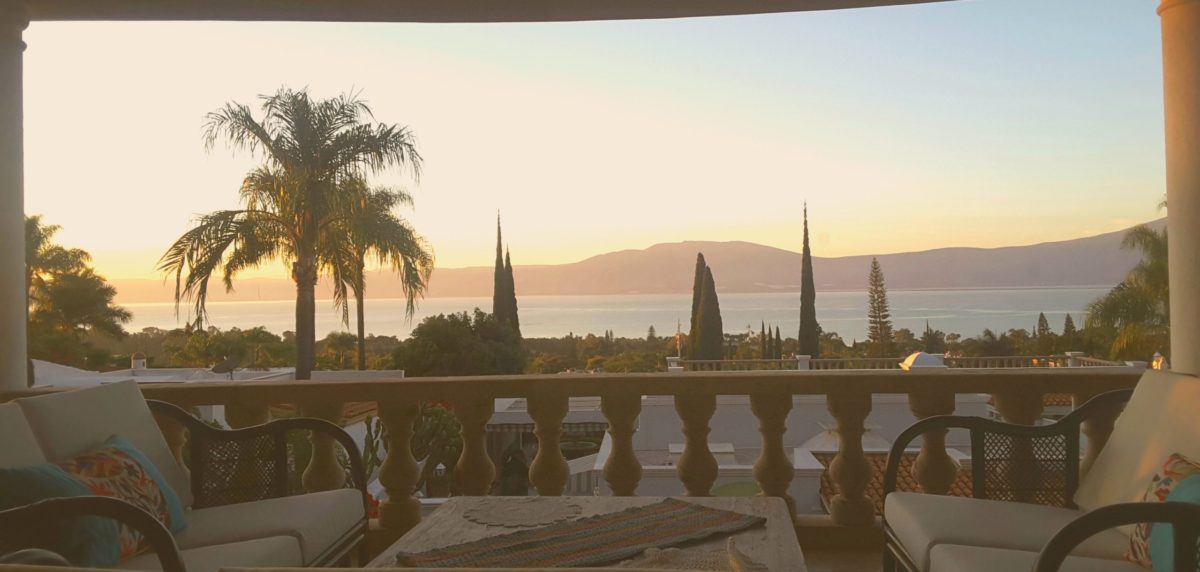
View from my couchLooking back across the square at our (blue) building
So for the next two months, we’ll be reporting on our attempt to merge our own well-settled expat lifestyle with that of Spain.
Sunday brunch: artichokes with jamon iberico and foie …Pistachio salmon, lamb shanks, and a bottle of local vino tinto
“¡Palante, como los de Alicante!” (Forward like the people of Alicante!), a common Spanish aphorism.
Various Australian ficus and pine species seem to thrive here
From an immigrant, emigrant, and expat, but not a refugee. Cue Tom Petty:
Few things get my goat more than people talking about immigration without any experience or understanding what they are talking about. I’m talking about people making broad generalizations (Trump, 2015: “When Mexico sends its people, they’re not sending their best. […] They’re sending people that have lots of problems, and they’re bringing those problems with us. They’re bringing drugs. They’re bringing crime. They’re rapists. And some, I assume, are good people.” I’m talking about people citing the words (“Give me your tired, your poor, Your huddled masses yearning to breathe free”) of a poem placed on the base of the Statue of Liberty as a fund-raising gesture to pay for its completion, and treating it as constitutional law. Get a grip.
I’m an immigrant. My status under Mexican federal law is residente permanente (permanent resident) and I am covered under El Instituto Nacional de Migración (INM), which means legally I am an immigrant because I am someone who has come to live in their country. The United States could consider me an emigrant, because I have chosen to live in a country other than the one where I am a citizen. I am still a citizen of the United States and the State of Ohio (O, H, oh, never mind). I pay all applicable federal and state taxes. I vote. I have a driver’s license (actually two). I did not move for any political reason: I simply found a place I thought my wife and I would really like to retire to, and we do. We have no intention to live anywhere else.
Long ago, people only left their homeland because they had to (refugees or deportees, which by-the-way was the original Latin meaning of expat). Modernity created a push-pull among people seeking a better life for themselves and their children. The Western Hemisphere in general and the United States in particular welcomed such people . . . but always within limits. If you know American history, there are cycles where immigration soars until the resident population reacts, then the tides reverse for a period. Long ago, all of this was legal: the law allowed people to stay and become citizens if they simply made it into the country. At times when the nation became concerned, it could become illegal to do the exact same thing. So please don’t suggest everybody came to the States in the same way.
I choose to be called an expat because it better describes my situation, not to demean anybody else. It galls me when the same people who tell me what pronouns to use try to tell me I’m a racist/class-est/whatever-ist because I choose to call myself an expat. Just honor my chosen noun, like you insist on others pro-nouns. The difference I see is I neither reject my former country nor wish to join my present one. It’s a unique happenstance of modernity that this option is available to people, but it is real. People walking up the Central American isthmus to come to the United States want to become citizens there. If you offered it, about half the world would accept the honor. That’s a big difference between an immigrant/emigrant and an expat.
As an expat, I abide by all the laws of both my country of citizenship and country of residence. There is no escaping US taxation, legally. I am enrolled in Medicare even though it does me practically no good. There are places I can’t go based on US State Department guidance and federal law. I carry a green card, the proof of my Mexican residency, with me at all times. I can be asked to display it even by the tránsito cops who do nothing but enforce traffic laws (or collect bribes). It’s no more an imposition than carrying my US passport when traveling abroad, so don’t lecture me about autocracy and “papers, please.”
My rights as a permanent resident in Mexico are enshrined in the Mexican federal constitution. Read that as you will.* All residentes must avoid becoming involved in Mexican politics. I know American expats who love to protest in public against the current American administration, but don’t seem to realize the possibility if the Mexican federal government wants to side with that administration on some issue, you might be involving yourself in Mexican politics. Ignorance is bliss. Better to avoid it all.
There are gringos who came here when Mexico had no way of keeping track of visitors, decades ago, and simply stayed. Occasionally, they are caught up in a sweep and deported back to the United States or Canada. There is no sturm-und-drang, no Nazi references, no protests. You can’t just come to a country and live there, no matter how peacefully, just because you want to. Many federal police here carry long rifles (you might know them as “assault weapons”) and wear face masks. They aren’t the Latin Gestapo, they are hiding their identities from the cartels. Funny how that works (and for the record, the Gestapo never wore masks: they didn’t need to). They all seem very intimidating until you see a convoy of Guardia Nacional, masked in trucks with crew-served automatic weapons, stuck in a traffic jam and being ignored by all the Mexicans driving around them.
Now on to compassion. Some of my brother-and-sisters-in-Christ (Christians) like to chastise (not literally) those of us who don’t seem sufficiently compassionate to people arriving undocumented, as they say. They cite that Statue of Liberty poem (irrelevant), several Old Testament verses (where do they stand on the rest of the OT?), or Christ’s command to love one another. That last one is indisputable as a command to be compassionate to (i.e., “suffer with”) others. But there is nothing compassionate about encouraging someone from a different and strange culture to uproot themselves from it, travel thousands of miles endangering themselves and their family, all for the better job of mowing your grass, doing your laundry, cleaning your home, or caring for your children. Sorry, that’s not the story Christ was telling.
Likewise, the Holy Family weren’t illegal immigrants/undocumented (they crossed no international border, needed no papers). The Good Samaritan isn’t about government policy, it’s about your personal responsibility. Recall that Jesus told the story to respond to an expert in the religious law who wanted to justify himself . . . funny how people today cite it today to . . . justify themselves. Pot meet kettle. The Good Samaritan didn’t rush to Jerusalem to lobby for universal health care; he simply took care of his neighbor. Anybody wishing to sponsor immigrants with housing and jobs and taking responsibility for them? God bless you. Or forever hold your peace.
I recently had another (yes, it’s happened before) person on social media call me a racist “who was simply afraid to live among all those brown people” (her words). I probably enjoyed too much explaining to her that I live as the palest-of-the-güeros among a nation of what she terms “brown people.”
“It is better to remain silent and be thought a fool than to speak and remove all doubt”
— a paraphrase of Proverbs 17:28
One of the staunchest American voting blocs for strict immigration enforcement is recent legal immigrants. These are the people with the most in common with those illegal or undocumented persons seeking the same advantages. Are they anti-American? Are they racist, or xenophobes? No, they’re just people who have gone about and done the right thing, and resent others who don’t. Nobody likes a line-cutter, but they only cost you a little time. Illegal immigrants have many other costs, costs born not by those same people arguing in their stead.
As an immigrant, I am very pro-immigration. Done correctly, I think it enriches the immigrant and the nation welcoming him/her. There needs to be vetting, limits, rules, and enforcement of each. It amazes me when people act like all the “legalized” immigrants (a temporary status granted by an administration) are completely vetted. How does the US government vet a person from Somalia, where there is no government? From Venezuela, where until recently, the government was antagonistic? From China; do I need to point out they might not have our best interests at heart? Really?
There is no law without enforcement. And when enforcement has been lax, its reinstatement will seem harsh. That’s where America is today. It can’t simply go back to lax enforcement, nor to endless bureaucracy (more judges!), nor opt for an amnesty which just resets the clock on an intolerable situation.
But if you don’t have skin in the immigration game, have a little humility toward those of us who do.
* By the books, the Mexican Constitution is very hard to change, almost as difficult as its famously-intransigent US cousin. In reality, it is one of the most amended existing governing documents, with over 750 article changes since it was promulgated in 1917, and six times as many words as when it was written!
As an expat, I write frequently about how much we enjoy this lifestyle: living in a different culture (a less expensive and less acquisitive one), still full of new things to learn, new people to meet, new places to see. We know it’s not for everyone, and that’s fine. If we didn’t love it, we wouldn’t still be so happy after eight-and-a-half years as expats!
This is not one of those times. We recently had a few, shall we say, challenging experiences I wish to relate. I wouldn’t go so far as to say I’m going to complain, but rather, shed light on something common to expats that may go missing in the glossy pages of International Living or the TikTok feeds sent to you about the glories of expatdom.
Late last year, for absolutely no valid reason at all, my state of Jalisco announced it was invalidating all old licence plates and replacing them with new ones. Actually, they did state the new ones had a QR code embedded in them, but some of us already had such codes on our old plates. The good news was the turn-in and replacement would happen over the course of the entire year, in an orderly fashion (right!) based on the last digit of your current plates. The better news (from the government’s perspective) was you could pay in advance online for your new plates, your required annual registration, and your emissions inspection, all bundled together at a discounted total price. It was good news for the government because virtually no one went and got emission inspections, so now the government at least got you to pay extra, whether you ever went and got your emissions inspection or not. I give them credit: that part was clever.
The bad news for the rest of us was the “orderly fashion” turned out not to be so. People due to change plates early in the year reported long delays, because the new plates weren’t ready to be issued yet. The website we were supposed to use didn’t work at first, then it only worked with FireFox browser (who knew FireFox was still around?) Or you could go to the clothing shop next door to the recaudadora (DMV) office–and no, I am NOT making this up–and the woman there could use her desktop to make your appointment for a small fee.
Others reported a quintessential problem of Mexican bureaucracy: the petty bureaucrat at the recaudadora. The government specified what you needed to bring in: proof of residence, proof of identification, proof you paid online, and your original factura (the original sales receipt for your car, which passes for a title down here). That last document is a real challenge: there are many types, based on whether you bought new or used, and you’re never supposed to have it in your car, as the paper itself proves ownership: if someone steals your car with the factura in it, they can claim it’s theirs!
Those necessary documents are pretty straightforward: here’s where the pettiness comes in. Original and one copy, or just original? Copy on both sides, or one per page? How many forms of identification? Copies in black and white or color (the latter being considered a sign in Mexico of potential forgery, so . . .)? I guarantee you, whatever set of copies you have, they’re incorrect.
I let the matter rest for most of the year, until I saw about one-quarter of the cars on the road with new plates. Then I saw some online posts that the system was more regular now, so I figured it was time to bite the bullet. I downloaded a Chrome Extension to run FireFox, accessed the website, made an appointment, and made all the appropriate copies (or so I thought).
But wait, ¡hay mas! as they say down here. We arrived for our appointment to find that citas (reservations) are just a thing, not real. You get in line like everybody else. I noticed while we waited that about two-thirds of the people trying to get new plates were turned away: not a good average. At least it wasn’t a gringo thing: the pinche burócrata was treating the poor Mexicans in line just as badly as he would soon treat us. We dutifully arrived at the front, where the official told us we needed copies of our Permanente cards, not passports, and a different form showing we had already paid. Strike One. He sent us to the helpful office around the corner where another enterprising pair of women had set up a copier and printer to help us. We made new copies and printed another receipt. “Nope, copies too dark, and this still isn’t the correct receipt” he told us. Strike Two. We didn’t have any more options for receipts, so we retreated to eat a delicious lunch of sesame-crusted tuna, then home to lick our wounds and scour our receipts for the right one.
In the official’s defense, we did have the wrong receipts. In Mexico, when you pay an official fee online, you often get three or more documents verifying your payment, but some of them are just links to a different government website where you have to print out yet another form. You have to have just the right form, although ALL the forms show you paid the correct amount, and in fact you couldn’t even get this far in the system (if one wants to call it that) without having already paid the right amount. *Sigh* In our defense, we pointed out we used the helpful ladies the official pointed us to, so how come their copier wasn’t sufficient? He shrugged, called his boss over, who also shrugged. We left the line. Maybe next time. This was all just a reminder that humility and acceptance are graces in high demand for expats.
There’s the culprit, hiding in plain sight. Are all the wires supposed to be hanging like that?
All this happened amidst a power outage in our neighborhood. Seems Monday night, something went “BOOM” and we lost power around 1:00 am. By the time we woke up the next morning, defrosting was already happening. But such outages are not uncommon here, usually lasting a few hours, so we ate a larger than normal breakfast of things not likely to last and tried to resume normalcy, awaiting the return of la luz (literally light, more generally electricity). Except our community has a well, and a pump, and that requires luz, so we had no water in addition to no power. As I said, we’ve been through this before: we have a garrofón, a giant plastic jug full of 20+ liters of fresh water lying in wait, just in case. We have smaller reusable water jugs in every bathroom, for extra water to flush in the same circumstances. We have a gas stove top, so when the power is gone, we can take out the matches and still cook, old-school. We have fancy French presses, a high-tech/lithium-ion/one-shot espresso maker, and a small mocha pot from Italy, so coffee is always available, as long as mankind doesn’t forget how to make fire (or push the button on the portable espresso device).
So the first morning wasn’t so bad. Except it was only the first morning. Seems the power company, a federal utility that goes by the initials CFE (and no, there is no truth to the rumor it stands for Can’t Find Electricity) saw a blown transformer and repaired it, but they never checked to see if that fixed all the homes that had lost power. It didn’t, and our community were the lucky hold-outs. When recontacted the second morning, they snapped to, and we had power restored (with water) in just thirty-six hours. If you’re counting, that’s well past the “throw-everything in your fridge out” limit, but just inside the “throw everything in your freezer out as well” limit. Phew.
Why am I regaling you with this? Mexicans adjust to the frequent absence of water and power. They primarily rely on garrofónes, since they don’t have wells and municipal water systems are not always potable, which means not at all. The basic level of electrical use, meaning a small refrigerator, a small television, some lights, is practically free. And if it goes out, you can always call up a relative and go visit to recharge. Or do without (gasp!). That fridge usually contains only a few items, as mamá goes out to the local tienda or mercado a few times a week to get fresh foods or perishables, and liter bottles of Coke never go bad (or is that never get worse?). And there’s no giant (capable-of-hiding-a-corpse size) freezer full of things Costco convinced you to buy, either. Storms come (in the rainy season), the power goes, life goes on.
But for expats, power and water loss are a bigger deal. Luz is what brings in North of the Border (NOB) television and the internet via Starlink and TelMex connections. Expats have things like Alexa devices, air purifiers, air conditioning, music systems, treadmills, power garage doors, a host of kitchen gadgets, and an untold number of personal apparatus from cell phones to computers to tablets to ear buds to hearing aids to CPAP machines. No power is no bueno. As much as we try to adapt to local culture, most expats are NOT trying to become Mexicans, nor do they seek to mirror how the locals live. If we did, we’d be immigrants, not expats.
In the thirty years we lived in and around Washington DC, we only had two major power outages. One was Hurricane Isabel (2003), which felled so many trees we in suburbia were without power for three days. The other was two days without power when the transformer for our apartment building in Shirlington blew up. A minor outage of more than a few hours meant untold pain for the local power company, and they fixed things up quickly. In our eight-plus years lakeside, we’ve had three or four major outages, and many, many minor ones. Enough to convince me that reliable power back-up is a necessity here for expats, not a convenience. We’re scoping out some home power stations, in effect large rechargeable batteries which can pull us through the outages we have experienced with a full fridge/freezer, internet, and maybe even TV. They are not cheap, but they are dependable, and that’s the cost of peace of mind. At the rate I am replacing fridge food, it’s a bargain.
If you’re especially observant (and my friends are), you’ll note the common theme in this post: relying on big, government-run utilities or services generally doesn’t work well. If Dante were alive today, the Mexican recaudadora would certainly merit its own ring in the Purgatorio, if not the Inferno. And CFE doesn’t respond to customers because, well, it doesn’t have to. Somewhere in the United States today, there is some slick, young huckster telling people that what we need is government-run grocery stores and child care centers.
Yup, it’s going to work this time. What could go wrong? And that still isn’t the correct receipt!
When we bought out current house lakeside, it came fully furnished, complete with a few books on the mantelpiece. One of these was a ponderous tome of 871 small-print pages, in English, with the title “Mexico, Biography of Power.” The work of Enrique Krauze, a famous Mexican historian and social commentator, it promised “a history of Mexico from 1810 to 1996.” As someone who loves history and wanted to learn more about my expat home, it beckoned. As a “busy” expat retiree with nothing to do but travel, visit family and friends, it daunted (me). This wasn’t casual summer reading. I like to take books along when we go on cruises, but this one would take up more than half of my carry-on! So I delayed diving in for a year or two, the work gathering dust in the space on my bookcase for things-not-yet-read.
Facing a two-week transatlantic cruise this year, I knew the time was ripe, so I dug into the first few chapters, then purchased an Ebook version for my Kindle, allowing me to continue reading without giving up essential cruise swimwear. As it was, I was able to read all through our travels in Europe and still have the last few chapters to finish with the hardback when we returned.
Krauze once opined that “all history is not biography, but without biography there is no history.” Mexico is a point in this thesis, in that its history is one of a series of strong men (until oh-so-recently, no woman had come near wearing the Presidential sash) personally imposing their views on the nation and its story, for good or ill. His work progresses from the War of Independence through the very end of the single-party state under the PRI, Partido Revolucionario Institucional, although when the book was completed the author was unaware that outcome was pending.
One of the themes of the book is the inescapable rise of a singular leader throughout Mexican history, which Krauze suggests is a legacy of both the tlatoani history of the Mexica (Aztecs) and the caciques of the Spanish crown. Eventually there arises a strong man to provide leadership and perhaps authoritarianism. While this parade of “great” men may seem quite common as a parallel to American readers and history, in Mexico there were significant differences. Without the famous “check & balances” of the American Republic, Mexico veers ever more so towards an all-powerful Presidente. And while violence is a common theme in both country’s stories, in Mexico the violence is consuming. So many of the contestants for leadership are assassinated, exiled, betrayed by friends, or killed while under arrest that the few who survive to a natural death are indeed exceptions to the rule.
After the multi-decade span of the Porfiriata (a dictatorship under Porfiro Diaz), these “great” men eventually settle on only one limit to their power: a single, six-year term of office called the sexenio. Their recompense is “el dedazo” (the big finger), whereby they “point” or select their successor, who is then (of course) elected. While this process developed under the PRI, it seems to be reviving under the current leadership.
Another theme is the gradual emergence of the Mexican raice, or race. In Krauze’s telling, the War of Independence is a revolt of the Criollos (Spaniards born in New Spain) against the Peninsulares (Spaniards born in Spain, living in New Spain). The nineteenth century invasions by the United States and France cement the rise of the mestizo (mixed race) segment of the population under the leadership of Benito Juarez, the first Presidente of indigenous origin. The Mexican Revolution was a final, full extension of recognition of all people, including the still extant indigenous tribes, as Mexican. This notion of a developing racial consciousness, albeit not based on skin color but ancestry, is only possible because while the Spanish conquest abused the indigenous peoples and discriminated against the mixed races, they eventually integrated all, unlike the North American model, which marginalized and virtually eliminated Native Americans.
This book also explained a historical dichotomy that had long troubled me: how was the Mexican revolution, which happened coincident with Russia’s and featured so many “socialist” ideas, not considered “Communist?” Mexico’s unique brand of institutional revolution does indeed parallel Moscow’s: single powerful leaders, a single-party state, expropriation of private property, open suppression of the Church, the creation of mega (and mega-corrupt) public utilities and sweeping public entitlements. But each of these grew out of home-grown concepts of the Mexican experience, neither Marx nor Lenin. There were Communist movements in Mexico, but they were as suppressed as any other party or foreign entity. Mexico developed its singular notion of non-intervention, which left it on the sidelines of the Cold War (and almost World War II), and while there developed a strange affection between Cuba and Mexico, much of it was based on the (misguided) hope Castro would turn out to be more nationalist than Communist.
One final very interesting point is the fact Krauze’s book was published just before Mexico developed into a true, multi-party democracy. Still, the tumultuous period of the early twentieth century eventually leads to Andres Manuel Lopez Obrador, (AMLO), the most recent “great” man who was first denied by the powers that be, then rose to destroy the PRI, only to replace it with his Morena party, which now controls the Congress, the Presidency, and the courts. Enrique Krauze, who is still alive and commenting on Mexico, has noted the consistency of recent history with his original thesis.
While this work is hardly a casual read, it rewards those with patience to persevere. Krauze brings coherence to the many revolts, wars, and violence that permeate Mexican history, and his careful attention to each succeeding leader makes the parade of unfamiliar (to me) names intelligible. His is a sympathetic take on Mexico, stressing the importance of “the revolution” as a living concept that guides leaders even today.
Musings, observations, and other half-completed thoughts that occurred to me as we took a transatlantic cruise (Miami-Barcelona), stayed in Andalusia and Alicante (Spain), then briefly toured Rome on the way home (via London and Los Angeles).
I have no idea what this warrior is supposed to be doing; Spear-throwing?
The “tourists go home” movement is mostly theater. We visited the Canary Islands, Barcelona, and Sevilla, three hotbeds of protest against foreign tourists in general and apartment-buying foreigners specifically (we are both). We saw none of it. There are occasional protest events, but they’re scheduled and conducted for the cameras and local politics (this Sunday’s protests are an example). It’s not that there isn’t a real issue: lack of affordable housing is very real, as is over-tourism. The first is primarily a problem because Spain’s socialist government hasn’t tried very hard to increase home/apartment construction since their economy imploded back in 2008. Now they have a huge backlog, and too much demand, not enough supply. And the other part is Spanish property owners changing their rental units to tourist rentals. Who wants to rent to your fellow Spaniards when they can invoke unwise renter protections and live rent-free for years while you try to evict them? Whose problem is that? The tourists? Foreign owners represent a single-digit percentage of Spanish properties. And everybody knows that Spain is riding an economic wave right now at least partly fueled by tourism. So expect a lot of press noise and political posturing, but just love from those you meet on the street.
I’ve complained every year in these posts about the growing slovenliness of travelers in general, i.e, adopting American-casual as appropriate attire. It’s official. In the Year of Our Lord 2025, you can no longer spot an American using the usual dead-giveaways (until one opens his mouth). Baseball caps are ubiquitous on men of all ages. Shorts, too. Women in workout leotards. Both sexes with oddly-named collegiate attire (“Carolina U.” in purple?) or English slang prints (sometimes quite offensive, but I guess not if you’re not primarily an English-speaker). Europeans still get dressed up for things, but if they’re just walking down for a cappuccino and a croissant, they’ll look like they might be headed to Mickey D’s!
Modern technology has pretty much ended one’s ability to get really lost. GPS is always “watching you, watching you” as Hall & Oates sang. Google has mapped the entire planet, then photographed its streets, too. I’ve come to rely on Google for locations and times of operations for local businesses, especially bars, cafes, and restaurants. And it’s been pretty accurate in major cities. But we like to get out and about, to small cities, towns, and even villages. And there,the days and hours of operation, even whether the business is still in business, are all quite lacking. The businesses themselves don’t keep the data updated, and the locals who frequent them already know. So remember, Google may get you to that little bit of heaven cafe you seek, but whether it’s open or not? Only heaven knows!
Always the Commander; he needed guidance!
There is no need to pretend you’re a Canadian, eh! Europeans don’t generally bring up politics with strangers. We met many locals, in taxis, on tours, in cafes, and we were never shy about being Americans. Of course we had two advantages: speaking Spanish and being able to say we live in Mexico, which everybody finds endlessly fascinating, so there’s no need to talk about US politics. While Americans seem to enjoy immediately picking red and blue sides, other countries don’t. So if you don’t shove it (your MAGA-hate or -hat) in a local’s face, nobody else will care, either.
Transatlantic cruises are a real alternative to red-eye flights to Europe. You can scale your costs to your budget (inside cabin/no frills, balcony with drinks package, sweet suite) compared to economy/premium economy/first class airfare. Yes, you need to get back, eventually. But you do buy 10-14 days of leisure, a few ports-of-call, and minimized jet lag. For those with the luxury of time, it is a very attractive alternative. Caveats: don’t try to discover whether you like ocean cruises on a transatlantic one. The Sargasso Sea is no place to learn you have a landlubbers stomach (although they’ll have plenty of meds on board if you do). Do research the various lines, as their offerings are very different and aimed at different crowds. Transatlantic cruises will generally feature an older, more well-off clientele, that is, people who have the time (most importantly) to spend. But in general transatlantic cruises are less pricey (per day) than other cruises, because they are one-offs (the ship needs to get from here-to-there for the upcoming season).
The EU and UK have added new travel authorizations. These are not visas, which are legal permissions to visit. Long ago, western nations agreed to visa-free travel between certain countries to facilitate business and tourism. After 9/11, the problems with this approach were apparent. The US was first off the mark with ESTA, the Electronic System for Travel Authorization. The EU has been trying to initiate a similar system called ETIAS (European Travel Information and Authorization System) for a decade, and it’s still not in effect! The UK has rolled out its Electronic Travel Authorization or ETA. All of these are administrative reviews done online. You pay some money, submit personal/travel data, and get a response which verifies your data is tied to your passport and good for travel over a specified period (usually 2+ years). The processes are simple and should be quick, as long as you haven’t been naughty, traveled to odd locations, or have a name like Bill Bin Laden. Anyway, what do you need to know? You need to complete the process before you travel! And it may apply to transit at airports, too. We were returning from Rome via London/Heathrow, and neither the government, the airport, nor the airlines could assure me we would not leave the secure area of the airport to make our connections, so we could technically “enter” the UK and need ETA. We got it (instantly) as a precaution, and it’s good for two years. Better safe than sorry. When the EU’s ETIAS comes online, you’ll need to do the same for continental Europe. Be prepared! (Late update: the Heathrow Express bus ran between the terminals on the secure side, so we didn’t need our ETA at all. But if we had checked luggage, we might have needed it.)
Always the therapist!
We remain impressed with Spain’s national train system. It was one of the worst in Europe, but a few years back, the government stopped controlling the market, let in competition, and invested in infrastructure (courtesy of the EU). The results have been tremendous. You can get comfortable, high-speed train tickets for 20-40 Euros that take you quickly cross country. Most of the lines connect in Madrid, but even with the connections they are fast. We were just on a fast line from Madrid that clocked in at 299 kph (that’s 186 mph!). There are plenty of locals lines (cercanias), trams, a few subways, and of course many busses. On the high speed network, both Renfe (the Spanish national line) and Iryo (a Italian-Spanish consortium) impressed us. Comfortable cars, multiple classes, good service, even good food at the cafeteria car. We were less impressed with Ouigo (the French-owned alternative) which seems to have adopted the budget airline model of customer service. But all were quick and inexpensive. Pro-tip: if you’re visiting Spain and moving around, skip the airports and use the train. Just book your tickets early, as there are huge discounts for early booking and the trains do fill up. Second pro-tip: if you take a high-speed train, your ticket is good for local travel before/after the main ride (ie., getting to/from the train station on other trains/trams or connecting between trains).
Maybe everybody else knows this, but here goes in case someone doesn’t: we like keeping up with the news/shows we watch regularly while we travel. So we bring a long our Firestick and remote, then plug it into the smart TVs every hotel/rental has. It updates automatically to the new television, then brings up our channels, viewing apps, etc., all as we like it. Perhaps it’s just because we use YouTube TV (not YouTube, which is different) on the Firestick. But I’m betting other streaming devices and providers have similar options. It’s a nice touch of home, and takes up very little space (about the size of an electric shaver). Don’t forget an international plug adapter!
Our two-week sojourn in Andalusia is coming to an end. We based ourselves in Sevilla (say-VEE-ah), better known in English as Seville. Our small (50m2) apartment was next to Santa Maria la Blanca church, at the edge of the old Jewish quarter (judería) in the old town. Literally in one of those tiny alleyways the city is famous for: the first thing our taxi-driver told us was how he couldn’t get us there (too small).
“Our” alley
Those teeny pedestrian alleys are a feature, not a bug. Temps hit over 38° Celsius while we visited (100° F!). Out in the sun, you quickly realize the importance of . . . not being out in the sun. But hit those alleyways, and the shade includes a blast of cool air, as the winding passages not only keep the sun/heat out, they channel winds like canyons do naturally. Pro-tip: navigate the alleys during the days, even if they take longer, because they are far more confortable.
Cathedral, alcázar, horse-drawn carriages, and tourists, all-in-one
Our apartment location was perfect: fifteen minutes (or less) walk to the Cathedral, the train stations, the Setas, the Triana market, just about everything. Sevilla is an eminently walkable place,and what extra exploration we wanted to do was available by tram, a very limited subway, or an excellent train system (local and high-speed).
This trip we wanted to settle in and enjoy the local rhythms (so to speak), while checking out neighborhoods in case we want to set up a home-base here. So we had no tight sight-seeing schedule, but rather tried to simulate living (vice visiting) here. We did decide not to try cooking too much; while the apartment had a basic set of kitchenware, cooking anything beyond the most simple dishes would have been too inconvenient (for the chef and the dish-washer). That and Sevilla is famous for its tapas bars, so why not?
Casa Morales, a tapas bar favored by locals (but known to tourists, too)
I’ve seen estimates there are more than 3,000 tapas bars in Sevilla. Having walked the town for two weeks, I think it’s an undercount. As you may know, tapas probably originated in Andalusia, most likely as free snacks placed on small plates atop drinks (to keep the flies away). In many places in Spain, tapas remain this way. But tapas in Sevilla evolved: they have become a cultural tradition. They are not free. They come in different sizes (tapas for one, raciones to share, plato for a meal). They highlight local delicacies and fusion of different cuisines.
And they are delicious! Carrillada (beef or pork cheeks) and rabo del toro (Bull’s tale) are slow-cooked, savory, and fork-tender. Every kind of fried fish, including things like cod, squid, octopus, cuttlefish, anchovies and dogfish. Pringa (pork stew) on a sandwich! Spinach and garbanzos, a warm, flavorful side dish, and of course, jamón iberico. These thin slices of the most succulent pork one can imagine, salty and sweet (some are only fed acorns), and accompanied by a surfeit of local cheeses. The servings sizes may be small, but the flavors are immense and quite filling. We regularly planned more tapas than we would order, and sometimes even more than we could eat.
Tried to take a long-resolution photo, but we ate too fast. Had tuna tartar, patatas bravas, and tuna brioche
We tried to meld our normal daily schedule with Spanish approaches. Breakfast (desayuno, literally “de” as in ending and sayunar as in fasting) is small here, usually a coffee and perhaps a small, sweet pastry. Late morning, Spaniards will have a snack (almuerzo), often some toast with olive oil and/or tomato rubbed on it (very good). Lunch is a big meal, often eaten in groups, where plates of tapas, etc., are shared. There can be another round of snacking (merienda) in the later afternoon, with dinner (not usually a big meal as in the West) not before 8:00 or even 10:00 pm! We had a single, big breakfast of coffee, fresh bakery items and pan con tomate, did some sight-seeing or neighborhood recon, then hit a tapas bar for one-of-everything, por favor. That was it for our eating day (we gave up eating dinner a few years back, which neither of us miss), although I usually had a little merienda in the afternoon.
Funny thing about tapas bars: we made a point of getting to some of the more famous ones, but every one we went to was between good and great. Businesses, especially food businesses, take great pride in their offerings here. Heck, the snack bars at the train station had better-than-average food. So you don’t really need to squeeze into a reservation slot at La Bartola, just walk around and follow these rules:
Start at any major tourist sites and walk away from it, using the smallest street you can find.
Look for places with no English-language menu offered.
Look for places which do advertise their seasonal tapas or a “menú del día.”
Select the place with the most locals eating there.
Ask the waiter “que me recomienda” (Kay may reck-oh-mee-END-ah”) to get their advice.
Never fails. And don’t be too strict in applying these rules. In a very touristy town like Sevilla, many local places have started putting English-language signs up (as they work for nearly ALL tourists). And maybe there aren’t any locals in the bar because it’s not local eating time. Be flexible! We did eat at places like La Bartola (we even walked in without reservations and only a short wait), and it was also very good. Sadly, such places have become “Insta-fodder,” overrun by younger tourists trying to be totally themselves by doing what everybody else is doing on social media. #signofthetimes.
I tried my wine experiments yet again, with great results. One is to just ask for the vino de casa (house wine) which is usually very nice. The other is to walk into any supermarket, go to the local wine section, and pick the first bottle I see. This trip it was a local red blend called Mucho Más and it was . . . excellent. For E3.50 (about $4.00 USD). Priceless.
We took a food tour, which by luck turned into a private tour with just us on it. Since we had already visited once, and already knew much about Andalusian cuisine, we spent more time talking about living in Seville and other cultural points. Our guide pointed out that while most people know to try pan con tomate for breakfast, the locals go one step further. Take your toast and give it a solid dose of extra-virgin olive oil. Let it set for a minute. Then, instead of simply rubbing on tomato puree, pour on Salmorejo, a cold, tomato-based, rich soup full of garlic. This local delicacy (Salmorejo) is beloved as a refreshing break from the meat-heavy tapas menus, but I never would have thought of it for a breakfast topping!
As for touristy things, we did visit las setas, a very recent (2011) all-wood art monument resembling giant mushrooms. The lower level has a small museum with some ancient artifacts uncovered during the construction, the ground level with shops and cafes, then a top level with a very good observation point over the city, albeit a trifle pricey (E16@). Some say the view is especially fantastic at sunset, and there is a light show on the Setas once dark sets in. Pro-tip: it doesn’t get dark before 10:30 pm in tourist season, so plan accordingly!
The people give a “little” perspective on the immensity of the structure
We also attended laudes and mass in the altar mayor (main altar) in the cathedral. It’s free for those wishing to worship, but worth the ticket (and audio guide) just to take in the largest Gothic cathedral in the world. The security folks gave us the side-eye when we said we wanted to attend services, and they did hover nearby throughout, making sure no one tried to otherwise enjoy the setting in a touristy way. Necessary if not welcoming, but understandable nonetheless. I did sneak a photo of Christopher Columbus’ tomb, camouflaging it as a photo of one of the priests at our mass (mea culpa, mea culpa, mea maxima culpa!)
Critóbal Colón, held aloft by four kings of España!
Other sites worth visiting are the Archivo de Indias, which contains all the Spanish correspondence about the New World during the age of exploration. Ever wonder why Brazil speaks Portuguese and mostly the rest of South America Spanish? Blame the Pope and the treaty of Tordesillas, which divided the entire world between Spain and Portugal. The records of the Conquistadores? All here. Free to visit, too! Nearby is the Torre de Oro, a small former watchtower which contains a very nice Spanish naval museum (they did win at Lepanto, after all, if not with the Armada) and views of the city for a small donation.
Torre de OroView form atopTreaty of Tordesillas
Our verdict on Sevilla? Very friendly, very easy to get around, very delicious. Oh, and very hot, even in mid- to late-May. Excellent hub as a home base, but still a little pricey for apartments. We liked the suburbs of Dos Hermanas, close enough for a ten-minute local train service. Jerez de la Frontera (whence the fortified wine sherry gets its name) is much closer to Cádiz, and also very enticing, but seems a little far afield. Our biggest concern is the heat. No one wants to be trapped in an air conditioned apartment from 1000-1800, or longer. The heat is so oppressive it reminded us of a winter visit to Quebec City where we simply walked from café to café downing chocolat chaud. Here the opposite extreme: I started drinking the local lager, Cruzcampo, just because it was cold! This was an extreme heat event, and it made the local news. But as we all have experienced, such “rare” events are becoming more common.
We’re headed east to the coast to try that out next!