When we travel, we try to check out local news sources to find out what the locals are up to. Sometimes it’s a dry well, other times we strike gold. This past week was the latter here in Alicante.
Beginning the procession from inside the Co-cathedral
First, Judy saw mention of a local fiesta about the “Santa Faz.” The Holy Face? So I looked it up, and sure enough, there is a monastery of the Holy Face in the greater Alicante area, dating back to the 15th Century. According to local lore, in that period, a monk from Rome smuggled part of the Veil of Veronica to Alicante to spare it from whomever was sacking Rome at that time. The Veil of Veronica? A Catholic legend that a woman named Veronica wiped Jesus’ face (as he walked the cross up to Golgotha), thereby receiving an image of his passion on the veil.
Mel Gibson’s take on the story
There’s no contiguous evidence for Veronica’s story, and some theologians believe even her name is simply a mistranslation referring to the veil (Vera icon = true image in Latin/Greek). But veils purporting to be the true image have been around since the 6th Century, and at one point the Vatican collected up the many versions to try to establish some sort of registry. Unfortunately, before the work was done, the accounting was lost, so no one knows which was which. They subsequently found paths to different places like Alicante, where they continued to be venerated. The Church has approved worship of the Holy Face (as an icon of Christ’s passion) without going any further toward validating any of the individual veils.
Locals in Alicante believe the veil has miraculous qualities, and they honor it annually with a procession from the Co-Cathedral in the city back to the monastery. The images you see in my photos/videos is NOT the veil itself. Too many people tried to touch or grab it over the centuries, and it suffered from public exposure. So the religious authorities constructed a tableau to put it in for further public exposition. The procession happens every year on the second Thursday after Easter. It starts inside the Cathedral, with prayers and a welcome from the alcalde (mayor), as the event is well-coordinated with the local authorities. The pilgrims carry cane poles with sprigs of rosemary signifying their status. It then winds through the narrow streets of the old town until reaching a major modern highway, one-side of which closed. About halfway (5 kilometers) to the monastery, local businesses set up booths offering snacks, wine, and freebies (note the many orange baseball caps, for example).
Arriving at the monastery , there is a full-scale fiesta with booths, carnival rides, etc. We inched our way closer to the main door, and found an outdoor Mass, and the chance to receive Holy Communion. We didn’t stay for the tour inside the monastery, and instead found one of the special public busses set up to take us back to the city center. As we rode home, we could still see families on the early stages of the walk! The government estimates about 330,000 people processed this year!
This adventure was the Caminar (walking) portion of the week; now for the Comer (eating).
Around the same time, the Alicante city government also sponsored “Alacroqueta,” a competition to see which local restaurant serves the best croquettes. Alicante views itself as a national leader in croqueta cuisine. Croqueta began as a solution to leftovers: take whatever didn’t get eaten, form it up into little balls (maybe add a little sauce), dip in batter, fry it up, and serve it again. Over time, they became a go-to form of tapas, the little snacks served alongside drinks in Spanish bars.
As a form of marketing mixed with self-promotion, the city sponsored a public snack-off. Fourteen finalists (after a first round competition earlier in the year) were selected to sell their best croqueta creation at this event. If you bought even one, you got a QR code to vote for best croqueta. The competition went on for four days, and we visited early on Saturday before the lunch rush.
Among the competitors we tried ones filled with kimchi, jamon iberico/mushroom/truffles, and Spanish chorizo. Each croqeuta cost two euros, and drinks were three or four (very inexpensive). We only lasted two rounds of tasting, because while the croquetas are small, they are very rich and fried, thus very filling. A tapas crawl (similar to a bar crawl) here comprises walking from bar to bar, trying their signature tapa with a caña (small beer) or small glass of wine while standing in the bar, then moving on to the next bar. For the locals, the standing and walking and waiting while chatting with friends is part of the experience, while tourists are easy to spot for ordering many different tapas while staying in the same bar.
In both cases (the caminar and the comer) it was fun to join locals enjoying their town.
You might have heard the President and the Pope were openly feuding recently. Let’s observe factually what happened, then how it was covered. The main points?
The United States and Israel engaged in offensive military operations against the Islamic Republic of Iran.
The Pope gave his “Urbi et Orbi” speech.
The President made several comments on TruthSocial disputing the Pope.
The Pope responded to press questions about the President’s remarks.
The President and Vice President made several more comments about the Pope’s comments.
Several American Cardinals defended the Pope and further criticized the American administration.
These are simple statements of fact, without editorial comment. How they played out, and how they were played by the media, are more like a remake of Mean Girls. For reasons we shall see, the facts are important, because they show how the truth was distorted for various political perspectives.
From the top, the US and Israel engaged in offensive military operations against Iran. While they achieved surprise, it was neither a surprise attack nor the beginning of the war, which as I detailed in an earlier blog post, has been going on for forty-seven years. The fact the US never responded to Iranian provocations is the reason they were so surprised this time. Whether the war is just, and whether it is wise, are questions which can be debated.
Around Christmas and Easter every year, the Pope gives his state-of-the-world speech, entitled “Urbi et Orbi” (Latin for “to the city and the world”). The speech is actually a blessing, and the tradition goes back to the 13th century. In the modern era, Popes generally highlight the need for peace, as there are almost always some form of warfare afoot. Recent Popes even took to listing each and every conflict, specifically condemning such violence.
In a different take this year (you can read the whole message here, it’s quite short), Pope Leo XIV decried war in general without naming conflicts. Pointedly, he said, “Let those who have weapons lay them down! Let those who have the power to unleash wars choose peace!” and “We are growing accustomed to violence, resigning ourselves to it, and becoming indifferent. Indifferent to the deaths of thousands of people.” There is nothing in this statement that directly attacks the administration, and it is not political. In fact, by the standard of such messages, it was quite plain.
Interestingly, just after the Pope issued his message, a news story broke that the Undersecretary of War (a Catholic) had summoned the Papal Nuncio (the Pope’s Ambassador to the United States) back in January and threatened him to “get on board” with American foreign policy. I’ll skip detailing the reasons I called this one fake immediately, and sure enough, the participants quickly and totally demolished the “controversy.” Both the administration and the Vatican have termed the report “highly distorted” and a “fabrication.” Yes, they met, and yes, they argued. They even had a frank-and-earnest exchange as they say in diplomatic terms. This story died a quick death, but we’ll return to it later.
On April 7th, President Trump issued his infamous “a whole civilization will die tonight” text; the Pope responded the next day, calling the threat “truly unacceptable.” Once again, President Trump ignored the dictates of wisdom and decorum in issuing such a statement. It was unwise because it was flippant, and a leader should be unmistakably clear when issuing threats. For example, Truman and Churchill issued the Potsdam declaration in 1945, explaining what “unconditional surrender” the allies demanded of the Imperial Japanese regime, and they ended it with this statement: “The alternative for Japan is prompt and utter destruction.” In a historical note, Truman knew the atomic bomb had been successfully tested days earlier; this was no idle threat on his part. Nor is a threat a war crime, but that’s a blog for another day.
The Pope was of course correct in criticizing the President’s language, and the matter should have stopped there, as a ceasefire was shortly thereafter announced. But the Pope had also called for a Peace Vigil on April 11th, and there he sharpened his criticism, but still without naming President Trump or the United States. He did say, “Enough of the idolatry of self and money! Enough of the display of power! Enough of war!” and “Even the holy Name of God, the God of life, is being dragged into discourses of death” adding that God “does not listen to the prayers of those who wage war, but rejects them.” Press and some Vatican sources highlighted that these last statements were directly targeted at comments from War Secretary Hegseth.
Never one to take a deescalatory ramp on social media, President Trump vented in full fury, first saying the Pope was “weak on crime” and “terrible” and suggesting Leo is only the Pope because Trump is the President. As if to move from the sublime to the ridiculous, Trump posed an AI-generated comic depicting himself in a pose eerily reminiscent of the Risen Lord, healing the sick and giving hope to all. After massive criticism from Christians of all stripes (including MAGA), he deleted it without apology, and said he thought it depicted him as a doctor (spawning even more great memes).
You have to see this to believe it!
Not to be left out, Vice President Vance took up station as Trump’s “Catholic” wing-man, suggesting the Pope needed to be careful in talking about theology and should focus on morality rather than political strategy. All those involved would be wise to be careful in their pronouncements here, friend, but sadly that’s not the case. And all political strategy is eventually about morality, dontchano? And as if to prove both points, the three most-prominent American Catholic Cardinals suddenly appeared on 60 Minutes, defending the Pope and rebuking the US President and Vice President. But they couldn’t stop there, as Cardinal McElroy went on to declare the US action against Iran is “not a just war.”
Phew. And those are just the facts, with a few observations of my own thrown in. What are we to make of it? First off, all press coverage of the Vatican is highly suspect. Most of the media view religion as some sort of weird throwback, and they don’t even have the language to describe what is happening when they cover it. If you watch the press cover a Papal conclave, they treat it like a political convention, which is just odd. Second, the timing coincidence of the Pope’s messages, the manufactured story about a Pentagon confrontation, and the 60 Minutes follow-up are at the very least suspicious (I’ll explain). Finally, one would think political leaders would have learned by now it is unwise to mess with the Pope.
The Press. Media love confrontation, and they rushed back and forth between the Pope and President figuratively asking “did you hear what she said about you?” If you believe Pope Francis said “who am I to judge” about a homosexual priest, you probably fell for one of the media’s biggest mis-characterizations. Yet they continue to repeat it. They fanned this latest controversy and made it worse than it ever was. They are the ones reporting “Vatican sources” explaining what the Pope meant, when the Pope said what he said. You need only note that when things got really touchy, the Pope said he “never attacked the President” and “doesn’t do politics,” just “proclaims the Gospel.” Period. End of sentence. The Holy Spirit doesn’t need spin.
The Coincidences. It’s probably not a true conspiracy, but I would love for an investigative journalist to pull on these threads. The FREEP (Free Press) story about the Pentagon confrontation happened in January, but suddenly broke public right after the Pope’s Urbi et Orbi message at Easter. The story was flogged nationally by Christopher Hale, a proud Democratic National Committee member and former candidate for Congress with zero Vatican expertise, who nonetheless writes a blog entitled “Letters from Leo.” Oh, and those “Vatican sources” made sure and point out that the Pope had just met with David Axelrod, Obama’s eminence gris, before this current back-n-forth. It is not a secret there are those in the Curia (the Vatican permanent bureaucracy) and even the US church hierarchy who detest President Trump. It is not at all outlandish to suggest some of these coincidences were not, well, coincidental.
Which is not to say the Pope and the President don’t have real, serious differences of opinion. The Pope has remained non-specific, sticking to the Gospel, and avoiding direct criticism of the President or the specific US military activity. How do I know that? If the Pope had indeed determined the US action in Iran was an unjust war, he would be duty-bound to declare it as such. He would not be beating around the bush or speaking elliptically: prophets (ie., people who see and tell the truth) must do so. The Almighty does not take kindly to prophets who don’t do their job, Jonah! And that would entail the twenty-five percent of the US armed forces who are Catholic–including even more of the senior military and intelligence ranks–having to choose whether to refuse orders or violate their faith. It’s the theological equivalent of the nuclear option, and not only does the Pope solely wield it, he is required to use it. And he hasn’t.
Meanwhile, the press continues to beat the confrontation drum. Legacy media headlines (NYT: ‘Woe to Those Who Manipulate Religion,’ Pope Says Amid Standoff With Trump, Washington Post: Pope Leo decries ‘tyrants’ ravaging world, days after insults from Trump) highlight a few lines from an address the Pope gave to a war-ravaged area in Cameroon which has somehow found a way to make peace among neighbors. Again, he never mentions Trump or the US war in Iran. It’s another off-ramp, even if the press would prefer it was a crash test. Trump may take this off-ramp: today he said “I’m not fighting with him” about the Pope, while claiming he (Trump) is “all about the Gospel, I’m about it as much as anyone can be.” I guess that’s a Trumpian step in the correct direction.
Finally, the Apology. Back in Ye Good Ole Days, Holy Roman Emperor Henry IV got in a feud with Pope Gregory VII about who got to appoint bishops (Pope or King). Gregory excommunicated Henry (threatening his legitimacy and thus his crown), then made him wait in the snow barefoot for three days before pardoning him. In our era, asked whether he might do something for Catholics in the Soviet Union as a sop to the Pope, Josef Stalin asked, “The Pope? How many (military) divisions does he have?” Decades later, Pope (St.) John Paul II metaphorically answered the question by helping liberate Poland with nary a soldier, beginning the process that dissolved that “Soviet Union.” When Popes speak, they often do so gently, but that doesn’t mean they are “WEAK.” The Pope may speak softly, but he carries a big . . . cross.
channeling Crockadile Dundee: “That’s not a cross, this is a cross!”
I agree with Bishop Robert Barron, who said Trump owes the Pope an apology. I doubt it will ever happen. But that’s all there is to this in the end. The President thinks he’s ending a fifty year nuclear threat. The Pope wants all to live in peace, not war. Some people who don’t like Trump will do anything to poison the well, and some on the MAGA side would just as soon worship Trump as Jesus. The press loves a good fight. Are you not entertained?
Marriage (and life in general) is a series of compromises. My dear wife would prefer to be at home, living her routine, every day, for the rest of our days. That works great for us during college football season (September-January), as I too like to be where I don’t have to search to see where games might be televised. I can access the Firestick, pull up YouTube TV, and select four games to watch simultaneously. Three times each Saturday. And some people think there is no God!
But starting in February, I get the travel itch. That’s not quite true. Starting in February I get the travel itch for next year, as by February all this year’s travel is planned, paid for, and ready to go. Judy is game for the annual exodus, but because we’re traveling, I get a chance to compromise. For example, we try to avoid those “If It’s Tuesday, This Must Be Belgium” type trips, endlessly hauling luggage up-n-down European stairwells because the Romans didn’t invent the elevator. We try to stay longer when we go somewhere. We try to avoid jet-lag. and most importantly, we try to live wherever we land within our home, expat schedule.
“What’s the point of traveling if you’re going to live like you’re at home,” you might ask. Why, that’s the point of this blog post!
Living by your typical schedule gives you a sense of normalcy in unfamiliar places. Life on the road, even a planned, extended trip, can quickly become unsettling. A rail strike in Italy, which doesn’t even get covered by the local press anymore, can mean a missed airline flight. A grabby cabbie can lunge at your fistful of dollars in Istanbul, because you don’t have enough Lira (true story). Worst of all, you might get sick. Anyone who has been sick far away from home knows the feeling: what do I do now? Visiting Oxford many years ago for an executive seminar (thanks, US taxpayers!), I got a terrible head cold. I mean snot running out my nose in a torrent. I asked the professor of my seminar where I could get some pseudoephedrine to address the symptoms. She looked at me like I was trying to score some crack. Turns out it was a controlled substance back then in the UK (now too in the US). She said Brits just go to the local apothecary, which I then did. Where, it turns out, they offered me an herbal tea and some smelly thing for a chest rub. Luckily, my wife was arriving from the States, and she smuggled in a box of extra-strength Sudafed.
But setting aside the things that go terribly or mostly wrong, just small things can add up. The coffee is not quite right, or the dining hours off, or the microwave controls appear to be from the Soyuz system. People stay up late partying next door, or don’t form a queue at the bakery, or have a trash and recycling system more complicated than voting in the States. Eventually you can figure these things out, and life sets into a slightly-different routine. But not if you don’t settle in place, first. So we try to keep our home schedule, with nice local excursions to that schedule. What’s that look like here in Alicante, Spain?
I still get up between 6-6:30 am. You can’t get up before the dawn for forty years and not establish a pattern. So that’s my quiet time, to pray, to fix some coffee, to start my daily reading. I wake Judy at 7:30, with a cup of fresh brew and a song. Always the same song. I tried to change it once and never got a verse done before she asked what I was doing. I return to my reading (and another cup) while she has her prayer and quiet time. Around 8-8:30 she makes breakfast. Here’s where small changes come in. We have a minimal kitchen here, and plentiful Spanish foods, so we generally have eggs with jamon iberico (in its many forms), toast with olive oil and salmorejo ( a cold garlicky soup the locals also pour onto the breakfast bread). Judy has the same with what I call her “nuts and twigs”: cottage cheese or yogurt with chia seeds and powdered bat-wing, eye of newt, and grass from the plaza next door. I may be wrong about the last few ingredients. Maybe. I don’t want to ask.
My breakfast, this time with black beans, too
Between 9-9:30, at home we would head to the gym we built in our basement. Here, we joined a local gym for the two months of our stay, €30 per person per month, no sign-up fee and no long-term commitment. We go six days a week, with a schedule that includes daily stretching and cardio, and weights with rest days in between. I have to say that we see the same set of twenty-something gym-bros and -bras there everyday, so I have no idea what they all do for a living. We’ll be at the gym until 11:30-noon, then back to the apartment.
Barely got a pic I was eating so fast
Lunch presents the first real choice of the day: do we eat out or will Judy cook it? Remember, we only eat breakfast and lunch, so cooking our big meal of the day is no small commitment. Judy usually plans a day or two out in advance, so sometimes there is a chicken breast or pork filet that needs eating, other times not. Fresh Broccoli, or seasonal vegetables: right now it’s asparagus and artichoke season, so they’re fresh, inexpensive, and in every tienda. I’ll have a few restaurant options to choose from if that’s what we lean toward this day. Not all of them will be tapas, croquetas, or even Spanish cuisine; we just hit a pizzeria because it advertised real Napolitano pizza, and sure enough, the chef was from Naples. There are sushi, Thai, Poke, Argentine, Chinese, and Arab restaurants within blocks.
Arroz, the local version of paellasalmon for me, lamb for Judy
After lunch, we usually go do our grocery shopping. When in Europe, shop like the Europeans: go to the store every day and get fresh bread, veggies, milk, etc. Carry them home in a little trolley. Yes, they do have giant all-in-one stores like Costco, but most people shop in the store down the street. The crazy thing is, everything in there will be fresh. When you walk into a 7-11, you expect processed and frozen food; you don’t eat the prepared stuff unless you have a death-wish. Here, even the prepared foods were made this morning, and usually by someone who really took pride in making that little ensalada rusa. And they’re good, and not expensive.
Because it’s close to the apartment and we shop for a only a few things, it’s a quick trip. We often take a short walk around town after meals. Between 1:00 and 2:00 we face a second choice: is there some place or event we want to visit? Via walking or the tram, we can get anywhere in town in under ten minutes, so we can pop over to a museum, a store, a display and be back before siesta time. Or we can always go another day, and siesta time beckons sooner. Siesta is real thing, but it doesn’t always involve sleeping in the middle of the day. Well, it does for us, but in general in Mediterranean cultures, it’s the hottest part of the afternoon, when it is best not to go out, or if you must, to run a few errands before returning to work. In Mexico the school day is a half day, so parents go home to greet their children coming home or to send the second shift off to school. Here in Spain, many more stores stay open as a convenience, but some banks and government offices close. In the Spring it seems a luxury, but in Summer, it’s a necessity.
Judy can easily put in two hours of siesta, falling asleep to her True Crime podcasts. How anybody can fall asleep to the creepy voice of the narrator saying, “he looked normal, but that machete he was sharpening had a well-worn blade” I will never understand. I take my patented Pentagon nap. Back in the day, when I was still in uniform and worked on the Joint Staff in an extremely stressful job supporting the nuclear arms talks, we all used to work insane hours. My bosses didn’t care how long we spent at the POAC: the Pentagon Officers (and civilians) Athletic Club. On really bad days, I would head down there, switch into my swim trunks, shower next to the pool, then sit down in one of the pool-side lounge chairs (yes, they really had these, although the pool was underground!) and close my eyes. Forty-five minutes later (without a smartwatch, timer, or alarm clock), I would sit up, shower and get back in uniform, and “resume the suckage” as we used to say. Thus is my siesta today.
I’ll wake Judy between 4:30 and 5:00 pm so we can indulge a guilty pleasure: watching the ABC evening news and The Five on Fox. Depending on what time zone we’re in, these shows may be live, taped, or even from the previous day (most often the case in Europe). It’s strictly to see what the legacy media is saying, and if you haven’t ever watched The Five, I recommend it to you. The panelists (mostly regulars) genuinely like each other, so the banter is spontaneous and authentic. They really do mix it up, and there are genuine representatives of different viewpoints: MAGA, trad GOP, libertarian, liberal/progressive, and comic. But there’s clearly a right-leaning take.
In the early evening, we may go for another walk. I’ll do some writing, either for this blog or for a book. We both review social media, but try to limit it by setting a time to “watch our shows” normally at 8:00 pm. At that time, we pull up some new or interesting series on Britbox, Acorn, Netflix, Amazon Prime, or other streaming services, watching however many episodes fit in before 10:00 pm and bed.
Go to sleep, rinse and repeat.
The one major difference is Sunday, where we skip the gym and instead go to church. Oh, and Monday, when we cut into siesta by getting a massage at the Thai parlor down the street.
Last week, I reported on the afternoon and late evening processions we attended, which throw this schedule off, but are of course part of the reason for travelling in the first place. This week, there’s another pilgrimage and a croquetas competition, so those will find a place on the schedule. The nice thing is we don’t have to feel rushed. It started to sprinkle today as we left church, and we hesitated: do we skip the archaeology museum for another day? We chanced it, and the threatened rain didn’t materialize. And we got that amazing pizza afterward.
We were never going to be comfortable adopting the Spanish eating schedule. As I write this, I’m watching the families out in the plaza across from our balcony apartment, and they’re sitting in the square, talking and playing games, working up an appetite for dinner, because it’s only 8:00 pm and it’s still quite light outside. They’ll be out until 10:00 pm, kids included. Works for them; would make both of us sick. But other aspects are easier to adopt. Doing small loads of laundry (we’re lucky our apartment has both a small washer and dryer), shopping daily, walking everywhere.
So any given day may seem a lot like home, with some more Spanish flavor (as in the meals) or be as different as attending a pilgrimage walk of several miles with several hundred thousand of our closest co-religionists (coming soon to a blog near you). Not overwhelming, but also different from staying at an all-inclusive or doing group tours. We probably wouldn’t be able to pull this off without our functional Spanish-language capabilities, although a tourist city like Alicante has plenty of English speakers and businesses with little Union Jack flags in the windows (English-friendly). But signing up for a gym, or shopping for clothes, or asking the museum ticket office for a special combination ticket? All that’s en español.
So that’s our approach to slow travel, and it works for us. If you have your own way to approach travel, share it in the comments!
Whether you think it was inevitable (as I did), avoidable for the moment (as most do), or completely uncalled for (really? what was your solution?), the US is at war with Iran. If you follow the legacy media closely, you might think America is at the edge of disaster. If you listen closely to the Commander in Chief, you might think we won the war several times already. Here’s a steady assessment, with some historical perspective thrown in.
The US and Israel achieved strategic surprise. It’s amazing, given that the Islamic Republic of Iran declared war on both at its inception almost fifty years ago. But the Israelis focused on closer, more immediate threats and bided their time; the United States chose to ignore the bellicose language, the hostages, the terrorist attacks, as only a superpower can choose to do. It all became so routine that Tehran’s negotiators actually thought they could show up and figuratively tell the US to “shove it” and go home smiling. It didn’t work, and they were surprised. Not sorry.
The US and Israel made a conscious choice to fight this war alone. No one was warned, no one was consulted, no UN imprimatur sought, despite the fact a war with Iran has consequences all over the world. This was a not uncommon practice for the Israelis, who increasingly see a world antagonistic to their very existence (note the spread of “from the river to the sea” rhetoric). It was very unusual for the United States. Usually we at least give our friends and allies a heads-up. In this case, we expected them to take a pass on participating, so it appears we treated them as NPCs (non-player characters, as in video games). The President should not have been surprised when the allies he treated thusly chose to criticize the war and refuse to assist. However, I will add that in the long history of ruffled US-NATO relations, there is only one time NATO countries have refused the US overflight rights, and that was only France and Spain (both quasi-NATO members at the time) during Reagan’s Libya bombing in 1986. For so many countries to do so this time represents an escalation on their part, and will have repercussions. No one can fault a NATO member for refusing to let us use US bases for bombing runs, but to deny airspace? Too far.
The US and Israel have achieved air supremacy over Iran. We are flying hundreds of sorties a day, in daylight, with minimal losses. We have deployed airframes like the venerable B52 and the inestimable A-10, which should never be used where surface-to-air missiles systems are coordinated and integrated. During the search and rescue effort for the downed F15E crew member, there is verified footage of a US aircraft refueling two helicopters at low altitude over Iran. You don’t do that where there is any kind of remaining air defense threat.
But what about that F15E? The A-10 which limped home to a crash landing? The helicopters which took fire and perhaps casualties during the rescue? Air supremacy doesn’t mean “nothing bad can happen” (except perhaps in President Trump’s mind). In my days in camouflage, we used to joke that a well-placed rock can take down a Huey (helicopter), and it wasn’t really an exaggeration. And all militaries are familiar with something called small arms air defense: the notion you take all your various “guns,” aim at a single point in the sky ahead of an aircraft, and let the pilot fly into a wall of lead, where something bad will happen. “Big sky, little bullet” is a refrain every pilot hears and fears. What does air supremacy look like? Twenty thousand sorties and two aircraft shot down, that’s what. Comical fact: right now, the Iranians have tallied two kills, the US has destroyed two of its own, and Kuwait has three kills of US aircraft (apparently it’s quite easy when shooting at your own side)!
Iran’s missile launching and production capabilities have been greatly reduced. About a third of the launchers have been confirmed as destroyed, and another third are assessed as out of action/buried. The latter can be recovered, but it’s not like we aren’t watching and waiting for Iran to attempt to do so. So they have one-third as many launchers available as they did before the war. While there aren’t details out publicly on the missile production facilities, we have been hammering them for weeks now. Note this has little effect on the total number of missiles they retain. While we know where their largest stockpiles were, missiles can be temporarily hidden in many places, which is why it’s best to focus on launchers. Missiles without launchers are static displays, not weapons.
What about the Iranian missile attacks throughout the region? The last German V1/V2 rocket attacks happened in late March 1945, about five weeks before their surrender. You can keep firing rockets and missiles right up until the end. Look at the rate of firing, which has decreased about 90%. “Oh, but Iran is holding back, waiting for the US to exhaust its interceptors” some experts say. These same experts claim Iran is in an existential war. You don’t hold back in an existential war. More likely, their command structure is fragmented, and their targeting capability is limited or non-existent. Evidence of my assertion? They don’t fire salvos designed to overwhelm any site’s defenses, they fire small numbers of missiles at widely diverse targets, from Turkey to Saudi to Diego Garcia (note to those who claim Iran doesn’t have longer-range missiles: Rome is closer to Iran than Diego Garcia). They seems to be throwing a missile here or there, hoping one hits home. They don’t fire accurately: either we are spoofing their guidance system or it isn’t good. Look at what they hit: buildings in cities, or a sprawling petro-chemical complex, especially for their longer-range missiles. Even when we mistakenly bombed two schools, the missiles hit exactly where they were aimed.
If Iran wanted to send a war-winning message, it would salvo a hundred missiles from different launch sites at a single Arab petroleum facility on the Gulf, destroying it. That would be a message. They don’t, because they can’t. Their missiles, like Germany’s buzz bombs, provide terror, not military useful capability.
What about those drones? What role have they played? Attack drones weren’t much of a thing back in my days in uniform, but clearly they are a major combat factor today (see Ukraine). Like any applied military technology, drones are in the period where they seem unstoppable: cheap to build, easy to operate, difficult to defend against. The countervailing capabilities have not yet matured, but they will. In the end, drones may prove to be Iran’s most versatile and effective weapon. But that weapon is no guarantor of success, tactically, operationally, or strategically. Like their missiles, they have shown no operational plan for employing drones, nor a strategy.
Iran’s Navy is gone. Yes, they still have small speedboats they could use to attack undefended tankers, but those are suicide missions with any naval or air protection. They can lay mines, but that again becomes a suicide mission over time, and mines are only an obstacle, they don’t close the strait permanently. Iran has some area-denial capability with shore-based anti-ship missiles, which the US is apparently moving toward targeting. But that involves launchers and missiles and fire control, all very target-able assets. These small boats, mines and missiles are not insignificant capabilities, but they present a very routine challenge to naval operations, and I trust the US Navy is capable of confronting them.
Iran has established effective control over the Strait of Hormuz. As others have pointed out and I can confirm, this outcome was considered and planned for in every Iran scenario on the books. Why was the Trump administration then surprised by it? Simple. All those scenarios started with Iran declaring the strait closed with a missile strike on a tanker or by mine-laying. Then the US declares the strait closed to all Iranian fuel exports, and the Iranian economy collapses and the war is over. That is why closing the strait never seemed much of a real threat; it’s much like the sheriff scene in Blazing Saddles.
Just remember it; Please don’t play the audio unless you want to be deeply offended
Why did it work this time? I don’t know whether whoever is remaining in charge in Iran just got lucky or was very shrewd, but the Trump administration never shut off Iran’s exports. Instead, they removed restrictions on the sale of Iranian oil, providing a temporary boon. Why? Because they feared the spike in oil prices that would result. Now before you climb high on your rhetorical horse and call this the stupidest thing you have ever heard, let me ask you this: who has the EU given more money to since Russia invaded Ukraine over four years ago: Russia, or Ukraine? In those four years, the EU has sent Russia over US$220 billion dollars for oil and natural gas, and sent Ukraine US $200 billion in all forms of aid. Oil and gas prices make nations do crazy things.
While the President has correctly insisted gas prices will return to normal once the war is over, there is little benefit in trying to hold them down while prolonging the conflict. Why he hasn’t taken (or destroyed) Kharg island or closed the strait to Iranian tankers is a strategic mystery.
Have Russia and China been the big-winners so far? No, and those suggesting so are practically cheer-leading for the mullahs. Could those countries benefit in the long run? Of course, if the US fails miserably. So far? Iran is probably not sending quite so many drones to Russia as it needs to keep them for itself. And their production facilities are under direct attack. Likewise, China provided Iran advanced military air defense equipment which has proven worthless. Neither China nor Russia can do anything to stop the American action, and much like the case with Venezuela, Xi and Putin are standing there with–ahem–their things in their hands, looking impotent, while a potential ally falters. And while the American campaign is no doubt straining our munitions supply, Ukraine indicates there has been no reduction from the US side to it thus far.
“War Crimes.” It’s perfectly normal for your enemy to claim your attacks are war crimes. It’s even normal for human rights experts to make the same claim. The first group wants you to stop, and the second views all warfare as inherently evil. It is permissible to strike infrastructure as a legitimate war target, as long as the strike has a military purpose. If we strike a hospital’s back-up generator, that would be a war crime, as its power is solely for a hospital, a protected target (unless of course the enemy builds a headquarters in the basement). If we strike the power substation that supplies power to the local IRGC unit and the hospital, that’s not a war crime. Finally, all war crimes require either intent (you meant destroy what you destroyed) or negligence (you should have known what you destroyed). A missile that misses its target or is targeted incorrectly is not a war crime.
Iran’s nuclear ambitions are real and even reinforced as long as the mullahs and IRGC remain in power, but their progress has been suspended. Here is the entire history of Iran’s nuclear ambitions in a nutshell: their Supreme Leader made a statement forbidding possession of a nuclear weapon. Meanwhile, they engaged in decades of behavior that could only result in a nuclear weapon. When called out, they negotiated limits and inspections, then cheated, lied, and denied. They have been criticized, censured, embargoed, threatened, and expelled and still refused to stop (except vocally). They fully believe none of the current attacks would have happened if they had consummated their quest, and they are correct. For the time being, Iran’s nuclear countdown clock has been defused, but no one is sure how much time was left on the timer: it may have been weeks, it may have been a year. If they are forced to give up their enriched uranium and accept real inspections, the clock may be reset.
Why does this matter? Even if Iran gets the bomb, and builds an ICBM, don’t we have sufficient forces to deter them launching one at the US? Yes, we do, and as we are the “Great Satan,” they have little doubt we will nuke the crap out of them if they try. But the problem is elsewhere: the Gulf Arab states, Europe, and especially Israel. If Iran goes nuclear, the Gulf states will insist on the same. Many believe Saudi Arabia already has a back-up plan with China or Pakistan or India to drop a line of credit and “buy” an instant nuclear capability. European countries are talking tough about defending against Russia, but they can’t even summon the will to ensure their oil and gas gets out of the Gulf; they would be open to Iranian intimidation. And that leaves Israel. I put the odds at fifty-fifty that some future Mullah Supremo in Tehran decides he will go down in the history books as the one who eliminated the Jewish race. What did the world mean when it said, “never again?”
The Middle East has been a thorn in America’s side for fifty years. A nuclear-armed Iran makes it a gaping chest wound, not a thorn. Which is why I think this war was inevitable. Inevitable doesn’t mean this was the right time to launch it, though. The necessity for surprise and the opportunity to kill the majority of Iran’s leadership in a single strike proved to be the driving force behind “why now.” Was that a good rationale?
Will the elimination of most of Iran’s leadership lead to an even worse set of leaders, or perhaps regime change? This really is the key question behind the war rationale. At its most basic, consider this: the current (dead) leadership killed more Americans, took more hostages, violated more international norms, ignored more American threats, sponsored more terrorists, suffered more international approbation, and killed more of its own people than any other country in the last fifty years. What exactly is going to come around that is “worse?” Just-as-bad is possible, maybe even probable, but worse? So a once-in-their-lifetime chance to send that top group collectively to Allah? Priceless.
What about a possible regime change? It’s not likely, at least in the short term. Everyone in the leadership pipeline is IRGC or radical mullah, so it’s naive to hope for the long-sought, never-discovered “Iranian moderates.” Tehran has proven capable of shooting unarmed female marchers in the head and hanging teenagers for protesting. They will not go down without a fight, because they know with certainty the retribution which awaits them. While a peace-loving, democratic Iran would be a wonderful thing, the US doesn’t even need that. We only need an Iran that fore-swears nuclear weapons (with requisite checks because of past bad behavior), does not sponsor terrorism, and does not threaten freedom of passage in the Gulf. They don’t have to like the Gulf Arab states or Israel, they just have to stop trying to kill them. That’s all the change we require.
What happens next? The war has plateaued just short of the “hell” President Trump twice (or was it thrice?) threatened. It will not resolve without some further escalation. To the regret of my air-power enthusiast friends, this war will disprove (one again) the idea you can win a war by aerial bombing. The slowest, safest next step is to establish a naval blockade of Iranian exports, seizing them à la Venezuela. The problem here is that it’s very slow and time consuming.
If the US chooses a slightly faster approach, we could use the Marines to conduct raids or clearing operations on the smaller islands in the strait, limiting-but-not-eliminating Iran’s control. It would also serve as a point of pride to occupy Iranian territory and take prisoners. These islands are sparsely inhabited and defended, so the Marines could make short work of them. The same can be said for raids on anti-ship missile locations on the Iranian mainland. Again, not completely decisive, but tightening the noose, so to speak.
The faster and most decisive move is to concentrate the Marines and airborne soldiers on taking Kharg island. The IRGC cannot hold it against those forces for long. Control of that island results in control of around seventy-five percent of Iran’s oil exporting capability. Iran could destroy their own infrastructure, but again, that’s suicidal. Likewise, bombing our forces there has the same result, as Iran’s missiles and artillery aren’t accurate enough to do otherwise. This option goes back to the “game-over” strategy that ended all those Iran wargames in the Pentagon. Our forces there could prove to be a magnet for Iranian drones, missiles, and artillery, but that of course means they have to come out and play in a fairly limited area of the Iranian mainland across from the island. Taking Kharg is messy (as in casualties and destroyed infrastructure) but it’s effective.
And of course a negotiated settlement is always available. But for the US to claim this “excursion” was worth it, we require an iron-clad “no nukes” pledge backed up by independent inspections, free navigation for the strait of Hormuz, and probably a commitment to stop supporting terrorist proxies. I say probably on the last one because the Israelis have gone a long way to ending this problem. If Iran wants a limited end to hostilities, these should be the terms. if they want more, like out of sanctions and back into the community of nations, ending their threats to the Gulf Arab states and Israel are also a must, as well as limiting their ballistic missile efforts and terrorist proxies.
The United States isn’t asking for much: stop acting like an unhinged death-cult. We really have few gripes with Iran, while they have many with others.
Not a typo, but a Latin term used by the Catholic Church for the three days coming after the Lenten penitential season. Some old Catholics and other Christians may recall references to the “forty days of Lent” but that is a historical reference, not an actual count. Pope Leo I originally set the Lenten period at forty days, but later Popes set Ash Wednesday (you know, the day you see people walking around with smudges on their foreheads?) as the beginning of Lent , which reset Lent to more than forty days. Some folks contend the Sundays in Lent don’t count (Sundays are always “feast days”) but that would leave Lent at less than forty days. Either way, Lent ends with Holy Thursday, the start of a three-day period called Triduum. And yes, it’s still confusing, because the three days comprise Thursday-to-Friday, Friday-to-Saturday, and Saturday-to-Sunday. Which is Easter.
While many people think of Christmas and Easter as equally important peak days of Christianity, that’s not entirely correct. The Triduum, the mysterious period where Jesus Christ holds the Last Supper, is betrayed, accused, chastised*, tried, condemned, crucified, and then rises from the dead, is the summit of Christian experience. Of course, you can’t get there without the Incarnation (Mary’s fiat in Nazareth, Jesus’ birth at Bethlehem), but we can’t get there (Heaven) without the Triduum.
The Alicante processions continued all week, and while we didn’t attend each and every one, the ones we did attend were all unique. On Wednesday we tried to get close to the Hermanidad Penitencial procession in the Santa Cruz neighborhood. I say tried, because despite going early, we only got this close:
The Santa Cruz area is the original old city, on a hillside, with very narrow lanes. Maneuvering the paso through involves all kinds of complicated maneuvers. Going under a doorway might have the costaleros crawling on their hands and knees; going downhill means holding the front over their heads, hands extended (to equalize the weight; think about carrying a couch down a stairwell). A French couple with whom we were watching another procession told us the costaleros return the paso to the top of the hill by running with it! Luckily, someone else got a better video of the event:
This video captures the scenes in Santa Cruz quite well
On Holy Thursday we stayed up till 11:30 pm to watch the beginning of the “silent procession.” Two surprises awaited us. First, the procession turned right coming out of the door of the Co-cathedral, while the official tourist guide assured me they would turn left. So we were out of position. Second, the band started up; maybe the silent part comes later?
Lest we find ourselves distant onlookers yet again, the Spirit took pity on us when we returned to our apartment. One more procession, not just in the neighborhood, but right under our balcony!
and then . . .
We eventually recovered from our late night, and now happily and solemnly await Easter morning. I know I’m looking forward to chocolate (from the Leonidas store two blocks away) and ice cream (gelato!); Judy will resume listening to true-crime podcasts. We hope your Lent was spiritually fruitful!
Blessed Easter to All!
The paso which passed beneath our balcony
*Chastisement was a spectrum of Roman punishment, from mild public scolding to heavy flogging designed solely for those about to be executed by crucifixion. Odd how in English, it has become solely the former.
Children processing with palm branches kick-off the proceedings
Choosing to spend some quality expat spring time in Spain meant the opportunity to witness how the Spanish do Holy Week: Holy Cow! When we moved to rural Mexico, we were impressed by the Passion plays, posadas, and festivities surrounding Catholic feasts (especially Christmas, Easter, and each pueblo’s patron saint). But like so many other things (vaqueros/cow-boys, talavera pottery, skeletons/catrinas, use of doubled surnames), Mexican culture has significant antecedents from Spanish culture. Now you might think that Spain, being an advanced European nation with a sophisticated, post-Enlightenment mentality, might have outgrown much religious “superstition.” And you would be wrong.
Woke up from our siesta to music outside the balcony . . . another procession starting from the church down the street
In addition to all the religious services normally associated with the end of Lent and the celebration of Easter, one of Spain’s most treasured traditions is the procession. These processions are elaborate affairs, supported by local organizations (often called cofradias or hermanidades) and some trace all the way back to the sixteenth century. These groups resemble the “krewes” who perform a similar function for Mardi Gras in New Orleans, but there are no beads and no flashing in these processions. Instead, the groups arrange elaborate floats (pasos) which are hand-carried through the streets, accompanied by a drumbeat, sacred tune, and members of the groups in official costumes. The pasos can weigh between 4,000-12,000 pounds, including elaborate sculptures, statues, and floral arrangements. Thus the costaleros carrying the floats can number in the hundreds, and it is an honor to be chosen to carry. The massive floats maneuver down narrow city streets, usually passing by several major plazas and the town hall and either ending or beginning at a basilica or cathedral.
This video includes a pit-stop crew change . . . wait for it!
We considered visiting Sevilla for this special week, as the processions there are often featured in videos and draw large crowds, so I assumed they were unique and special. But I decided to double-check what was on the agenda for Alicante: twenty-six distinct processions, starting on Palm Sunday and ending Easter morning. No need to take a train to see one, they were coming (figuratively, I thought) down my street!
We noticed no one was out in front of our restaurant after lunch, so we went outside to find out why . . .
All this was only Palm Sunday. Now it was also the first week of Daylight Saving Time, so the already night-owlish Spaniards were quite happy to be out and about with the 60 degree temps and an extra hour of evening sun (it got dark around 9:30 pm).
As we prepared for bed, that earlier procession came back past our block!
Before anybody asks: no, the klan is not well-represented here. The pointed white hats and hoods are a holdover from the infamous Spanish Inquisition. One of the punishments meted out to the sinful-but-repentant was to parade through town wearing this “dunce cap” carrying a sign or symbol of one’s serious sins. Thus the penitent was forced to face public ridicule, but was anonymous, sparing them the greatest disgrace. Or they marched without the face covering, but with nothing identifying exactly what sin they committed. Today, we embrace our shame and post about it on Insta; haven’t we come so far! The caps are called capirotes, and the various groups who sponsor the processions adopted them as uniforms showing their own contrition.
For those without the time/patience/bandwidth to watch the videos: this image captures the sights, if not the sounds and smells
Longtime readers will recall Judy & I started absconding to Europe in the springtime a few years back. First, because it’s less crowded than summertime and the weather is still nice. Second, Ajijic is at the end of its dry season, when it warms up and gets a little dusty. Third, according to Judy, I can’t just sit still and enjoy our wonderful home when there are still battlefields, historic ruins, and cathedrals we haven’t seen. Anyway, shoulder season is getting more crowded all the time, we now have air conditioning and total off-grid solar power at home, but there are still battlefields, historic ruins, and cathedrals we haven’t seen! She’s probably correct.
We just arrived after a seventeen-day transatlantic cruise, and we’ve settled into a rental apartment in Alicante, Spain for the next two months. I’ve previously extolled the virtues of cruising to Europe (here), so I’ll summarize it thusly: if you have the time, if you know what type of cruise line you prefer (they are VERY different), if you hate jet-lag, if you don’t get seasick or aren’t afraid of the open ocean, cruising to Europe is a comfortable bargain. End of commercial.
Why Alicante? We visited here for a week last year, after doing a lot of due diligence about perhaps buying a vacation home in Spain. Our two finalist locations were Sevilla and Alicante. Either would be a great place for an extended visit, but Sevilla well-earns its nickname as the “oven of Europe” for summer temperatures. Alicante, on the Costa Blanca (south of Valencia, north of Cartagena) has more moderate weather, which made it our winner.
But our vacation home-buying plans are in abeyance right now, due to the politics of the Spanish government. Spain has an affordable housing crisis, as there are too many people chasing two few houses in the cities where everyone wants to live. Vast rural areas and small towns in Spain are depopulating at an alarming rate, but zoning and other regulations impede new construction in more desirable locations. Demonstrating that other countries can be as mismanaged as our own, the Spanish Prime Minister has unilaterally given amnesty to 500,000 illegal immigrants, and pledged to be more welcoming to immigration in the future . . . while not increasing the housing supply. The government’s straw-man arguments are to blame the lack of housing on (wait for it) foreigners buying vacation homes in Spain (us in the future conditional tense), and overtourism (us in the present tense) creating demand which results in converting long-term rentals (for locals) to short-term rentals (for tourists).
Actually, both of these arguments hold some water, but they omit important details. Home buying by foreigners is a very tiny part of the market, and represents a net gain economically by introducing well-off clientele to the local economy. And who owns all those apartments being converted for tourists? Spaniards, making money off the rentals. “My, you’re the dark one,” said the pot to the kettle!
Santa Barbara, atop the hill
While the government has done nothing but complain about the situation, they have threatened measures like a 100% purchase-price tax on foreign home-buyers, which is the kind of thing to cool one’s ardor to buy a home in Spain right now. At least it cooled ours. Just to buy, not to visit. In fact, we viewed the cooling off period as an opportunity to try out the lifestyle we were considering, just short of going all in with a purchase. So here we are in Alicante.
Looking north across the beaches to the resorts at Benidorm; Sunday, noon, around 60 F
Alicante is big enough (pop: 370,000) to have everything one wants in a city, but retains the smaller town feel. The casca antiguo (old city) clings to the hillside beneath the obligatory mountain-top fortress of Castell de Santa Bàrbara. The areas closest to the beach have been gentrified into shopping/eating/touristing, but the quaint lanes of old casas still line the Santa Cruz neighborhood. There is a fine marina, with a stunning, large esplanade of mosaic tiles and tapas bars. While some tourists stay in Alicante, most descend upon the nearby purpose-built beach suburb of Benidorm, where high-rises stretch from the beach to the hills. The downtown is flat and very walkable, while the city and local beach communities are connected by an inexpensive tram.
A small portion of the famous esplanade
We have a small (600 sq. ft.) apartment in the centro. While it does have two bedrooms, a kitchen and a combo living/dining room, it is designed primarily as a short-term rental. Because we were looking for a longer-term and seeking outside the high season, we were able to cut a deal with the property manager. When I say deal, don’t think “steal”: it was still expensive, but worth it to try out the lifestyle short of the cost of buying a place!
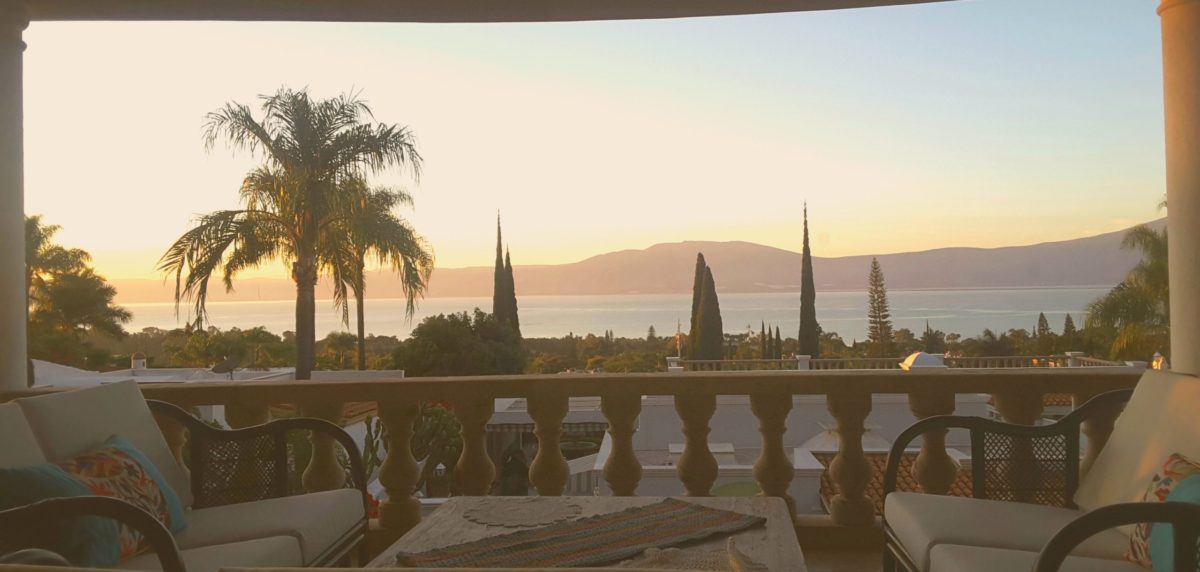
View from my couchLooking back across the square at our (blue) building
So for the next two months, we’ll be reporting on our attempt to merge our own well-settled expat lifestyle with that of Spain.
Sunday brunch: artichokes with jamon iberico and foie …Pistachio salmon, lamb shanks, and a bottle of local vino tinto
“¡Palante, como los de Alicante!” (Forward like the people of Alicante!), a common Spanish aphorism.
Various Australian ficus and pine species seem to thrive here
A few years back, I finally completed writing my first book: RedStReam. I detailed the story of how I got the idea, and what eventually forced me to write it out (and publish it) in a blog post. That was about a year-and-a-half ago, and after a brief pause to do nothing at all, I got started on the sequel. As I alluded to in that blog post, I had the story line all set up. Being part of an intended trilogy, I had left some elements of the first novel hanging, and I wanted to give the characters their due.
One thing slowing me down was the 2024 Presidential election. I was writing about a fictional world which closely mirrors the real one, while not “naming names” and letting the reader decide if they think certain characters seem a lot like famous, real people. The first book ended very near that election, and I needed to know who was going to win to complete the plot of the second one. As it turned out, the results gave my sequel another interesting story-line. The President I had returning to the Oval Office was the only one the CIA Red Team had NOT briefed in with the full truth about their ability to “see the future.” And the new novel had an impending crisis which required that President to trust his intelligence advisors implicitly . . . which is something that character is not known for.
Likewise, as I was writing, the real world intervened with additional material. Nothing like the unforeseen arrival of an “American” Pope to spice up the moral-ethical implications of an American intelligence capability to know the future. If I had invented that part, no one would have ever believed it!
The story of a Russian source–or a “mole”–inside the CIA was one of the hanging elements from RedStReam. The second novel completes the cat-n-mouse game between Charles, the leader of the Red Team, and Susan, the highly-placed woman in Personnel who acts out against the President she detests.
Finally, one of the most underdeveloped characters from the first book, Margaret Chang, gets her moments in the spotlight. The impending crisis I mentioned, involving a Chinese attempt to take Taiwan in a lightning strike, puts her family (back in China) in peril, and reveals the fate of her long-lost brother.
Of course there are all sorts of personal complications for the characters: a pregnancy, some new characters, a retirement, a death, and a defection. Almost none of the character’s story lines are complete with this second novel, but a few are edging very close to it, and there are hints aplenty at what comes next, in the final book of the trilogy. And yes, there’s a (spoiler) cliff hanger ending in this one, too.
I may take another year off before completing the series. I’ll still be blogging, and I have an unrelated bit of historical fiction I will write up and publish in the meantime. The pace of the action among the characters in this series has been pretty intense, and all their story lines will come to a close in the next one. To get there, the characters themselves demand a little time and distance. So they’ll have it!
You can buy the book, titled “Interesting Times” from Amazon (link here). It is available as an ebook right now, and if you have Kindle Unlimited, it’s free to you! I also allowed it to be downloaded (a new Amazon option) so if you’re not into Kindle, you can still download an ebook version. It is available for the low, low price of USD $5.99 for the ebook, USD $9.99 for the paperback!
If nothing else, you’ll learn that we do indeed live in interesting times. You might also find out there is no Chinese curse to the effect, “may you live in interesting times.” The real Chinese saying is even better! I trust you will enjoy the book; note I don’t use the word hope . . . there’s a reason for that, which becomes obvious in the book!
I have been “jonesing” to write about our current war with Iran. We’re still at sea, I have oodles of time on my hands, and the wonders of modern digital communications mean I can still be inundated with current information and commentary. But I waited, and waited. Why? Because first-takes are often the worst takes, war reporting is often just wrong (Clausewitz–that dead Prussian, called it the “fog of war”), and most of the commentary I have read thus far proceeds from an underlying political premise to a hasty conclusion. Of two stripes, both reminiscent of Trump Devotion/Derangement Syndrome (TD2S):
Trump is a mastermind playing 4D chess (!?!) and all this will come out great for America, or
Trump is an idiot and therefore the US is headed for a devastating failure, a quagmire, or both. And he only did it because (1) Putin told him to, (2) to distract from the Epstein files, or (3) because he suffers from third stage syphilis. No kidding. I have seen all three, sometimes in combination.
Now before I go any further, let me be clear: I haven’t made up my mind whether this particular Iran campaign is a good idea. It is simply too early to tell. Bad ideas can have good outcomes, and vice versa. But I can assure you this: if you have made up your mind already, it’s because you fell into one of the two mindsets described above. Because there is not enough evidence to do otherwise.
Which is not to say there are not criticisms (valid or otherwise) based on what we know thus far. And here they are:
“Trump has engaged in a war of choice.”
I regret to inform you that war always requires at least two parties, and both sides must opt “in.” If one doesn’t, the other wins by default. When the rebels shelled Fort Sumter, Lincoln had the choice to ignore them and let the South “go its own way” (cue Fleetwood Mac). Many of his advisors actually counselled him to do so, as most realized what a bloody mess it would be. He chose to resist. If you think there is something unique about the choice Trump just made, you’re wrong. It happens all the time. Yes, most Presidents provide much more explanation to the country before going into war, and what explanation Trump has provided has been inconsistent (I’m being diplomatic to a fault here, but more on that later). So complain about the explanation, but drop the “choice” argument. It only sounds impressive if you know nothing about war, politics, etc.
“This is an illegal war.”
Usually followed by reference to the War Powers Act (WPA). Very simply, no President has followed the WPA as it was passed by Congress since it was passed by Congress (overriding a Nixon veto). Why not? It is a law without any consequences. Commit treason, and you can look up the penalty. Violate the War Powers Act, and you’ll get a “harrumph” from the House of Representatives. They knew this when they passed it, and they knew it even better as each of the Presidents (yes, Ford, Carter, Reagan, Bush uno, Clinton, Bush dos, Obama, Trump, and even Biden) did what they wanted and “interpreted” it as compliant with the WPA. The only mechanisms for compliance are impeachment or cutting off funding for the military. Why doesn’t Congress do the latter if they feel so strongly about it? Because they fear some military unit somewhere will get attacked and be unable to defend itself because Congress cut off funds. So they “piddle, twiddle, and resolve.” Don’t be like Congress (which is a great life rule, really).
“The US engaged in bad faith negotiations” or “launched a surprise attack.”
This criticism often compares the US attack on Iran with the Japanese attack on Pearl Harbor (no, really). Japan never gave the US an ultimatum, even their last communication (which was delivered late) was an ambiguous observation about ending negotiations, not war. Meanwhile, the US made clear that Iran had to renounce its nuclear ambitions. I understand they were confused when we attacked, as we had allowed them to obfuscate for literal decades, but that’s on them, not the US.
But the larger, even gaping hole in this criticism is this: Iran has been at war with the US for forty-seven years, since Ayatollah Khomeini’s revolutionary forces chased the Shah of Iran from power. His regime instituted barbaric penalties against women and minorities, sought ballistic missiles and nuclear weapons, sponsored or protected numerous bloody terrorist movements, threatened to exterminate the Jewish people, attacked its neighbors, and acted in constant opposition to American interests. What country (excluding insurgent movements) is responsible for more American deaths over that period? Iran. They literally chanted “Death to America” every morning. I know one man who tied himself into knots claiming such chants were just words, and “never hurt anybody.” Okay. They also took hostages, blew up diplomatic buildings, tried to assassinate US officials, attacked warships, and lobbed missiles indiscriminantly. Their main protection was a sense that any attempt to reduce their capabilities or change the regime would be costly and difficult. That deterrence worked, until a few days ago.
So we indeed surprised them when we started fighting back, not when we started a war.
“This could go very wrong.”
Yes, indeed, this opertion could still “go south” as we used to say in the business, and may do so. But to ignore the fact it hasn’t yet? That’s just willful disregard for reality. The great Prussian strategist Carl von Clasewitz often gets cited for his maxims about the fog and friction of war (come to think of it, I did so earlier). If uncertainty is all one takes from Clausewitz, it is a thin strategic gruel. Uncertainty resides in all life’s actions: your next parent-teacher conference, your next plane trip, your next skin cancer screening. While war has its own risks, it never is certain. To whit:
Our landings in the Cherbourg-Havre area have failed to gain a satisfactory foothold and I have withdrawn the troops. My decision to attack at this time and place was based upon the best information available. The troops, the air and the Navy did all that bravery and devotion to duty could do. If any blame or fault attaches to the attempt it is mine alone.
— Text prepared by General Eisenhower in case the D-Day landings failed
We all know how D-Day came out. If it had failed, the Iron Curtain would have descended on the Rhine, or the English Channel, instead of central Germany. But Ike didn’t know for sure, and had to prepare that note. If today’s media had covered Normandy, the slaughter at Omaha Beach might have convinced the American public it wasn’t worth it. Missed assault landing zones, paratroopers drowned in marshes, guns without ammo, you name it, it happened. But this was an amazing success story, not a failure. The most complicated over-the-beach invasion in military history put ashore a fighting army in days, all the trauma aside.
Set down your dog-eared (hopefully) edition of “On War” and watch, not pontificate.
“There is no plan.”
This is one I can definitively refute. From all the way back to the creation of US Central Command, they have had a OPLAN (Operational Plan) for war with Iran. It once was OPLAN 1001, and later 1025. There are also various CONPLANs (Contingency Plans) for specific scenarios of hostilities. These are the ones each President has to approve, and there are extensive war-games, reviews, and constant updates. Trump doesn’t show up at “the tank” (the Joint Chiefs of Staff conference room) and say, “go kill the ba@st@rds!” Well, maybe Hegseth did. But what the War Department does is execute a plan. Because there is one.
Related to this is the claim the administration “was surprised” by something the Iranians did. Again, I can confirm that nothing the Iranians have done so far was not already in the planning documents. When commanders or civilian officials say they “didn’t anticipate Iran closing the strait of Hormuz” they are saying they knew it was possible, but considered unlikely because it’s a losing proposition. Closing the strait means nobody’s oil gets out, not just the Arab states. That ticks off countries who might otherwise look favorably on Iran, like China. And Iran can’t make the closure permanent: they only have so many mines, so many boats, so many anti-ship missiles. And each time they come out, they’re vulnerable to US air power. They can wreak havoc for sure, for a time. But if they do, the US still retains the option to destroy (or better yet) occupy Kharg island, the main point of loading for Iranian oil. No oil, no money for the IRGC or the mullahs. This is why the closure of the strait was seen as an option for Iran, but a bad one: we can escalate to cause more pain for them then they can cause for us.
“This war is a disaster.”
This is especially offensive. Couching the war as “leading to a disaster” is at least a hedge. But look at the results thus far. Iran’s blue water navy is unintentionally sub-marine. Their air force is a series of chalk outlines on the tarmac. Missile launches are down 90%, as are drone attacks. Perhaps they are holding back, but that leads one to ask: for what? The US and Israel are flying over Iran unopposed and blowing up targets at a record clip. That does not equal victory, but it can’t be characterized by a rational mind as a disaster (I’m talking to you, Senator Murphy).
As positive as the US results have been, Iran’s responses have been pathetic. While they have had some limited success against military radars, for the most part they have lobbed missiles and drones at hotels, refineries, our embassy in Baghdad, and anywhere in Israel, resulting in limited damage. Military planners considered this too as an option for Iran, and again, decided it was a bad one. Yes, they can cause some damage. No, they don’t have the targeting or missiles/drones to make an operational difference. The only effective measure by the Iranian regime thus far is the threat by the Basij militia to shoot any protestors in the head. Tough guys.
If this were a prize fight, the ref would have stopped it. But it’s not a prize fight; it’s a war. Meaning round one is just that, and no one knows how it will turn out yet. But if you think the US is behind on points in the early rounds, you might have been a Soviet Olympic judge.
“No one has explained why this war, why now.”
I’m a little sympathetic with those who are exasperated by the ever-changing comments by Trump about the goals, activities, and length of this war. But only a little. After ten years of Trump, who says whatever is on his mind without any filter, why does anybody still parse his words and complain about their unreality, their mutual incoherence, or their flat-out distortion? Why? If you look to what the Chairman of the Joint Chiefs says, or the CENTCOM Commander, or even Secretary Rubio, you’ll find the clarity you crave. Note I didn’t include War Secretary Hegseth, who seems to act more and more like a Marvel comics character every day. Trump and Hegseth have all the message discipline of two adolescents babbling-while-high on their sugary Halloween take.
But the American people deserve a better explanation. The funny thing is, they have had it for forty-seven years. All those Presidents have held that Iran could not be allowed to achieve nuclear weapons, had to stop killing or taking Americans hostage, had to stop fomenting terrorism. At times, some Presidents acted on those demands; other times, they negotiated, while realizing that the Iranian regime has a perfect record of not complying with any of their negotiated limitations. Sadly, the Trump administration is unwilling to make the case that this attack is a response completely in accord with decades of US policy. But it is.
Whatever you feel about it, the US is at war with Iran. If you want to make a case against the war, do so, but remember to address the problem, not the President. How does your criticism or policy alternative eliminate Iran’s nuclear program, missiles, or terrorist proxies? That’s the problem. This war may not solve it either, but you don’t have to be a Clausewitz scholar to understand how it might.
Would I like to see the Islamic Republic flushed down the toilet bowl of history? Yes, yes I would. Would I settle for them being neutered back into the Stone Age they seem to revere? Probably. Strategy in war is all about adjusting your means to accomplish your ends. I’m reminded of another statement by Lincoln:
“My paramount object in this struggle is to save the Union, and is not either to save or to destroy slavery. If I could save the Union without freeing any slave I would do it, and if I could save it by freeing all the slaves I would do it; and if I could save it by freeing some and leaving others alone I would also do that.”
An Iran whose missiles no longer threaten the entire Middle East, who no longer threatens to choke off the Strait of Hormuz, who no longer funds terrorism or seeks nuclear weapons, is a goal worth fighting for, whether the President can string the subjects and verbs together or not. Finally, as we are at war, never fail to realize all our efforts must be toward victory. If you–even for a moment–think a negative result on the battlefield serves some partisan political purposes, shame on you. Few regimes have been as unceasingly evil as the one in Tehran. That doesn’t justify anything or everything the US does (just war and justice in war, as they say), but we should all be clear what we’re fighting against. And it’s not each other.
There is absolutely nothing penitential about being on a cruise ship. In fact, few things are more in the spirit of Carneval (literally “carne val” or away with meat, denoting the feasting one does before the meat goes away) than ocean cruising. “Would you like three appetizers, sir?” “A second lobster thermidor? Of course!” One must find one’s penance in forgoing all the offerings, at best. But one positive aspect of such a Lenten journey is the opportunity to pray at sea.
Amen!
Now I’m a land-lubber, and the most land-locked of those. I was born far away from any useful water source. Lake Michigan’s beaches were full of dead alewifes when I grew up, and worse yet, my mother had an inexplicably morbid fear of water, so much so none of her children were encouraged to go near it. I didn’t learn to swim until I got to West Point, where they pointed me to the pool, handed me a old rifle with the barrel full of cement, and told me to get to the other side without drowning. Actually, that was the final test, but the twenty or so African American cadets and I in what they called “rock-squad” swimming class felt like it was the beginning.
Anyway, I now feel very secure that I am drown-proofed, but I retain an abiding respect for the sea. Amidst a transatlantic crossing, one spends days away from the sight of land, so early morning is a perfect time to go out on a balcony, take in the majesty of the Good Lord’s creation, and render him homage. Nothing makes you feel smaller, and the world bigger and full of wonder, than staring out above the abyss.
If it makes me feel insignificant, that’s a good thing. In the larger scheme, we all are. That may be the point. There is a larger scheme, and we all have very small and insignificant parts. Bishop Robert Barron is fond of describing it as the contest between the theo-drama, the story the Lord is actively writing, and the ego-drama, the one each of us seeks to star-in all by ourselves. I like to call it the meo-drama, just to make the point sharper. The way of the Lord leads to peace of mind; the way of the ego leads to constant aggravation. The world doesn’t go our way. We’re never as rich, as thin, or as popular as we want. The government doesn’t accept our policies, the courts don’t abide by our rulings, our neighbors don’t live by our rules.
Reinhold Niebuhr, the American theologian, is credited with the Serenity prayer: “Lord, give me the serenity to accept those things I cannot change, the passion to change those I can, and the wisdom to discern the difference.” There is great wisdom in this simple statement. Notice that serenity (and humility) is the foremost request, because life will be an unending series of things we cannot change. Only then comes the request for passion, because without the Lord’s guidance, our passions are mostly (if not entirely) ill-used. Finally, the prayer ends with the call for wisdom, which will temper both the heat of our passion and coolness of our restraint.
I write all this because I often get asked–either in wonder or incredulity–“Pat, how can you remain so calm amidst everything going on? Are you unconcerned about (fill-in your favorite controversy, there are so many)? Don’t you see the severity of our situation? How can you be unmoved?”
First off, I’m often moved, moved to prayer. For those who see prayer as meaningless, I’m sorry, but in my world, it changes everything, starting with me. Second, as a student of history (I’m not sure one is ever a master of history), I know how much worse things have been before, even in my limited span of years. Name a challenge, and I’ll name its historical topper.
I call to mind Jesus admonition in the Olivet Discourse (Matthew 24:6-13)
“You will hear of wars and reports of wars; see that you are not alarmed, for these things must happen, but it will not yet be the end.
Nation will rise against nation, and kingdom against kingdom; there will be famines and earthquakes from place to place. All these are the beginning of the labor pains.
Then they will hand you over to persecution, and they will kill you. You will be hated by all nations because of my name.
And then many will be led into sin; they will betray and hate one another.
Many false prophets will arise and deceive many; and because of the increase of evildoing, the love of many will grow cold.
But the one who perseveres to the end will be saved.
And this gospel of the kingdom will be preached throughout the world as a witness to all nations, and then the end will come.”
No, I’m not suggesting we’re in the end times, except for the fact we’re always in the end times, in general, and you and I are very much in our very own end times. One of the key traits of the Devil (and yes, I do believe Satan is real) is his tendency to scatter, just as Christ seeks to bring all things together. Nothing is more emblematic of this today than the constant harangue from our algorithms telling us how stupid, how biased, and how evil others are. And of course it has its effect, dehumanizing us just as it dehumanizes those with whom we disagree.
People decry horrid language by our politicians by using equally objectionable language. Some take to the streets, protesting or interfering with federal agents who have guns; others decry any restraint concerning how American citizens are treated at home. How one feels about the killing of one of the worst, mass-murdering terrorist leaders of the last fifty years is determined by your politics. A senior politician predicts the defeat of US military forces as they are out there, fighting. Of course there are policies and politics to be validly debated here, but this is all scattering, not discourse.
This Lent, I’m participating with the Hallow app in reading the Brothers Karamazov and reflecting on it. It has been a moving experience thus far, and we’re only two weeks in! One of the lessons Dostoevsky presents is “everyone is really responsible to all men, for all men, and everything.” What seems logically impossible is actually a call to recognize we are all constantly contributing to the holiness or sin of all those around us. Constantly, and with everyone. Our good and evil acts, no matter how minor, ripple out across the community and the world. Refuse a beggar, cut-off a driver, post a false meme, share another’s secrets, and you may have no idea what evil you may have wrought. And that ignorance is not an excuse.
This is not a call for passivity, because the alms you give, the person to whom you yield, the truth you insist upon, and the confidence you keep also ripple out. Rather than judging, we are called to acknowledge our own sinfulness, then to proceed from humility, realizing we are no better than anyone else: we’re just as responsible in all cases. Like another biblical saying about removing the beam from one’s own eye before trying to remove the splinter in your brother’s, once we are seeing aright in our own life, we can clearly see how to respond to others (even in politics!).
The really amazing part? Once one truly embraces this approach, one is freed from the need to judge others, and instead can act solely for their good. Which brings joy and peace of mind.
So this Lent, if the way you’re living seems to be a collection of scattering, if you’re always angry, consider the alternative.
“Behold, now is a very acceptable time; behold, now is the day of salvation.
* After I wrote this, I realized that while many of my friends know all about Lent, others may not. Lent is a penitential season (for many Christians, especially Catholics) leading up to Easter. During this period, we are asked to deny ourselves some things we like, fast and abstain from certain foods, give alms to the poor and generally recommit ourselves to the Way.