Where we are in the Iran War

Whether you think it was inevitable (as I did), avoidable for the moment (as most do), or completely uncalled for (really? what was your solution?), the US is at war with Iran. If you follow the legacy media closely, you might think America is at the edge of disaster. If you listen closely to the Commander in Chief, you might think we won the war several times already. Here’s a steady assessment, with some historical perspective thrown in.

The US and Israel achieved strategic surprise. It’s amazing, given that the Islamic Republic of Iran declared war on both at its inception almost fifty years ago. But the Israelis focused on closer, more immediate threats and bided their time; the United States chose to ignore the bellicose language, the hostages, the terrorist attacks, as only a superpower can choose to do. It all became so routine that Tehran’s negotiators actually thought they could show up and figuratively tell the US to “shove it” and go home smiling. It didn’t work, and they were surprised. Not sorry.

The US and Israel made a conscious choice to fight this war alone. No one was warned, no one was consulted, no UN imprimatur sought, despite the fact a war with Iran has consequences all over the world. This was a not uncommon practice for the Israelis, who increasingly see a world antagonistic to their very existence (note the spread of “from the river to the sea” rhetoric). It was very unusual for the United States. Usually we at least give our friends and allies a heads-up. In this case, we expected them to take a pass on participating, so it appears we treated them as NPCs (non-player characters, as in video games). The President should not have been surprised when the allies he treated thusly chose to criticize the war and refuse to assist. However, I will add that in the long history of ruffled US-NATO relations, there is only one time NATO countries have refused the US overflight rights, and that was only France and Spain (both quasi-NATO members at the time) during Reagan’s Libya bombing in 1986. For so many countries to do so this time represents an escalation on their part, and will have repercussions. No one can fault a NATO member for refusing to let us use US bases for bombing runs, but to deny airspace? Too far.

The US and Israel have achieved air supremacy over Iran. We are flying hundreds of sorties a day, in daylight, with minimal losses. We have deployed airframes like the venerable B52 and the inestimable A-10, which should never be used where surface-to-air missiles systems are coordinated and integrated. During the search and rescue effort for the downed F15E crew member, there is verified footage of a US aircraft refueling two helicopters at low altitude over Iran. You don’t do that where there is any kind of remaining air defense threat.

But what about that F15E? The A-10 which limped home to a crash landing? The helicopters which took fire and perhaps casualties during the rescue? Air supremacy doesn’t mean “nothing bad can happen” (except perhaps in President Trump’s mind). In my days in camouflage, we used to joke that a well-placed rock can take down a Huey (helicopter), and it wasn’t really an exaggeration. And all militaries are familiar with something called small arms air defense: the notion you take all your various “guns,” aim at a single point in the sky ahead of an aircraft, and let the pilot fly into a wall of lead, where something bad will happen. “Big sky, little bullet” is a refrain every pilot hears and fears. What does air supremacy look like? Twenty thousand sorties and two aircraft shot down, that’s what. Comical fact: right now, the Iranians have tallied two kills, the US has destroyed two of its own, and Kuwait has three kills of US aircraft (apparently it’s quite easy when shooting at your own side)!

Iran’s missile launching and production capabilities have been greatly reduced. About a third of the launchers have been confirmed as destroyed, and another third are assessed as out of action/buried. The latter can be recovered, but it’s not like we aren’t watching and waiting for Iran to attempt to do so. So they have one-third as many launchers available as they did before the war. While there aren’t details out publicly on the missile production facilities, we have been hammering them for weeks now. Note this has little effect on the total number of missiles they retain. While we know where their largest stockpiles were, missiles can be temporarily hidden in many places, which is why it’s best to focus on launchers. Missiles without launchers are static displays, not weapons.

What about the Iranian missile attacks throughout the region? The last German V1/V2 rocket attacks happened in late March 1945, about five weeks before their surrender. You can keep firing rockets and missiles right up until the end. Look at the rate of firing, which has decreased about 90%. “Oh, but Iran is holding back, waiting for the US to exhaust its interceptors” some experts say. These same experts claim Iran is in an existential war. You don’t hold back in an existential war. More likely, their command structure is fragmented, and their targeting capability is limited or non-existent. Evidence of my assertion? They don’t fire salvos designed to overwhelm any site’s defenses, they fire small numbers of missiles at widely diverse targets, from Turkey to Saudi to Diego Garcia (note to those who claim Iran doesn’t have longer-range missiles: Rome is closer to Iran than Diego Garcia). They seems to be throwing a missile here or there, hoping one hits home. They don’t fire accurately: either we are spoofing their guidance system or it isn’t good. Look at what they hit: buildings in cities, or a sprawling petro-chemical complex, especially for their longer-range missiles. Even when we mistakenly bombed two schools, the missiles hit exactly where they were aimed.

If Iran wanted to send a war-winning message, it would salvo a hundred missiles from different launch sites at a single Arab petroleum facility on the Gulf, destroying it. That would be a message. They don’t, because they can’t. Their missiles, like Germany’s buzz bombs, provide terror, not military useful capability.

What about those drones? What role have they played? Attack drones weren’t much of a thing back in my days in uniform, but clearly they are a major combat factor today (see Ukraine). Like any applied military technology, drones are in the period where they seem unstoppable: cheap to build, easy to operate, difficult to defend against. The countervailing capabilities have not yet matured, but they will. In the end, drones may prove to be Iran’s most versatile and effective weapon. But that weapon is no guarantor of success, tactically, operationally, or strategically. Like their missiles, they have shown no operational plan for employing drones, nor a strategy.

Iran’s Navy is gone. Yes, they still have small speedboats they could use to attack undefended tankers, but those are suicide missions with any naval or air protection. They can lay mines, but that again becomes a suicide mission over time, and mines are only an obstacle, they don’t close the strait permanently. Iran has some area-denial capability with shore-based anti-ship missiles, which the US is apparently moving toward targeting. But that involves launchers and missiles and fire control, all very target-able assets. These small boats, mines and missiles are not insignificant capabilities, but they present a very routine challenge to naval operations, and I trust the US Navy is capable of confronting them.

Iran has established effective control over the Strait of Hormuz. As others have pointed out and I can confirm, this outcome was considered and planned for in every Iran scenario on the books. Why was the Trump administration then surprised by it? Simple. All those scenarios started with Iran declaring the strait closed with a missile strike on a tanker or by mine-laying. Then the US declares the strait closed to all Iranian fuel exports, and the Iranian economy collapses and the war is over. That is why closing the strait never seemed much of a real threat; it’s much like the sheriff scene in Blazing Saddles.

Just remember it; Please don’t play the audio unless you want to be deeply offended

Why did it work this time? I don’t know whether whoever is remaining in charge in Iran just got lucky or was very shrewd, but the Trump administration never shut off Iran’s exports. Instead, they removed restrictions on the sale of Iranian oil, providing a temporary boon. Why? Because they feared the spike in oil prices that would result. Now before you climb high on your rhetorical horse and call this the stupidest thing you have ever heard, let me ask you this: who has the EU given more money to since Russia invaded Ukraine over four years ago: Russia, or Ukraine? In those four years, the EU has sent Russia over US$220 billion dollars for oil and natural gas, and sent Ukraine US $200 billion in all forms of aid. Oil and gas prices make nations do crazy things.

While the President has correctly insisted gas prices will return to normal once the war is over, there is little benefit in trying to hold them down while prolonging the conflict. Why he hasn’t taken (or destroyed) Kharg island or closed the strait to Iranian tankers is a strategic mystery.

Have Russia and China been the big-winners so far? No, and those suggesting so are practically cheer-leading for the mullahs. Could those countries benefit in the long run? Of course, if the US fails miserably. So far? Iran is probably not sending quite so many drones to Russia as it needs to keep them for itself. And their production facilities are under direct attack. Likewise, China provided Iran advanced military air defense equipment which has proven worthless. Neither China nor Russia can do anything to stop the American action, and much like the case with Venezuela, Xi and Putin are standing there with–ahem–their things in their hands, looking impotent, while a potential ally falters. And while the American campaign is no doubt straining our munitions supply, Ukraine indicates there has been no reduction from the US side to it thus far.

“War Crimes.” It’s perfectly normal for your enemy to claim your attacks are war crimes. It’s even normal for human rights experts to make the same claim. The first group wants you to stop, and the second views all warfare as inherently evil. It is permissible to strike infrastructure as a legitimate war target, as long as the strike has a military purpose. If we strike a hospital’s back-up generator, that would be a war crime, as its power is solely for a hospital, a protected target (unless of course the enemy builds a headquarters in the basement). If we strike the power substation that supplies power to the local IRGC unit and the hospital, that’s not a war crime. Finally, all war crimes require either intent (you meant destroy what you destroyed) or negligence (you should have known what you destroyed). A missile that misses its target or is targeted incorrectly is not a war crime.

Iran’s nuclear ambitions are real and even reinforced as long as the mullahs and IRGC remain in power, but their progress has been suspended. Here is the entire history of Iran’s nuclear ambitions in a nutshell: their Supreme Leader made a statement forbidding possession of a nuclear weapon. Meanwhile, they engaged in decades of behavior that could only result in a nuclear weapon. When called out, they negotiated limits and inspections, then cheated, lied, and denied. They have been criticized, censured, embargoed, threatened, and expelled and still refused to stop (except vocally). They fully believe none of the current attacks would have happened if they had consummated their quest, and they are correct. For the time being, Iran’s nuclear countdown clock has been defused, but no one is sure how much time was left on the timer: it may have been weeks, it may have been a year. If they are forced to give up their enriched uranium and accept real inspections, the clock may be reset.

Why does this matter? Even if Iran gets the bomb, and builds an ICBM, don’t we have sufficient forces to deter them launching one at the US? Yes, we do, and as we are the “Great Satan,” they have little doubt we will nuke the crap out of them if they try. But the problem is elsewhere: the Gulf Arab states, Europe, and especially Israel. If Iran goes nuclear, the Gulf states will insist on the same. Many believe Saudi Arabia already has a back-up plan with China or Pakistan or India to drop a line of credit and “buy” an instant nuclear capability. European countries are talking tough about defending against Russia, but they can’t even summon the will to ensure their oil and gas gets out of the Gulf; they would be open to Iranian intimidation. And that leaves Israel. I put the odds at fifty-fifty that some future Mullah Supremo in Tehran decides he will go down in the history books as the one who eliminated the Jewish race. What did the world mean when it said, “never again?”

The Middle East has been a thorn in America’s side for fifty years. A nuclear-armed Iran makes it a gaping chest wound, not a thorn. Which is why I think this war was inevitable. Inevitable doesn’t mean this was the right time to launch it, though. The necessity for surprise and the opportunity to kill the majority of Iran’s leadership in a single strike proved to be the driving force behind “why now.” Was that a good rationale?

Will the elimination of most of Iran’s leadership lead to an even worse set of leaders, or perhaps regime change? This really is the key question behind the war rationale. At its most basic, consider this: the current (dead) leadership killed more Americans, took more hostages, violated more international norms, ignored more American threats, sponsored more terrorists, suffered more international approbation, and killed more of its own people than any other country in the last fifty years. What exactly is going to come around that is “worse?” Just-as-bad is possible, maybe even probable, but worse? So a once-in-their-lifetime chance to send that top group collectively to Allah? Priceless.

What about a possible regime change? It’s not likely, at least in the short term. Everyone in the leadership pipeline is IRGC or radical mullah, so it’s naive to hope for the long-sought, never-discovered “Iranian moderates.” Tehran has proven capable of shooting unarmed female marchers in the head and hanging teenagers for protesting. They will not go down without a fight, because they know with certainty the retribution which awaits them. While a peace-loving, democratic Iran would be a wonderful thing, the US doesn’t even need that. We only need an Iran that fore-swears nuclear weapons (with requisite checks because of past bad behavior), does not sponsor terrorism, and does not threaten freedom of passage in the Gulf. They don’t have to like the Gulf Arab states or Israel, they just have to stop trying to kill them. That’s all the change we require.

What happens next? The war has plateaued just short of the “hell” President Trump twice (or was it thrice?) threatened. It will not resolve without some further escalation. To the regret of my air-power enthusiast friends, this war will disprove (one again) the idea you can win a war by aerial bombing. The slowest, safest next step is to establish a naval blockade of Iranian exports, seizing them à la Venezuela. The problem here is that it’s very slow and time consuming.

If the US chooses a slightly faster approach, we could use the Marines to conduct raids or clearing operations on the smaller islands in the strait, limiting-but-not-eliminating Iran’s control. It would also serve as a point of pride to occupy Iranian territory and take prisoners. These islands are sparsely inhabited and defended, so the Marines could make short work of them. The same can be said for raids on anti-ship missile locations on the Iranian mainland. Again, not completely decisive, but tightening the noose, so to speak.

The faster and most decisive move is to concentrate the Marines and airborne soldiers on taking Kharg island. The IRGC cannot hold it against those forces for long. Control of that island results in control of around seventy-five percent of Iran’s oil exporting capability. Iran could destroy their own infrastructure, but again, that’s suicidal. Likewise, bombing our forces there has the same result, as Iran’s missiles and artillery aren’t accurate enough to do otherwise. This option goes back to the “game-over” strategy that ended all those Iran wargames in the Pentagon. Our forces there could prove to be a magnet for Iranian drones, missiles, and artillery, but that of course means they have to come out and play in a fairly limited area of the Iranian mainland across from the island. Taking Kharg is messy (as in casualties and destroyed infrastructure) but it’s effective.

And of course a negotiated settlement is always available. But for the US to claim this “excursion” was worth it, we require an iron-clad “no nukes” pledge backed up by independent inspections, free navigation for the strait of Hormuz, and probably a commitment to stop supporting terrorist proxies. I say probably on the last one because the Israelis have gone a long way to ending this problem. If Iran wants a limited end to hostilities, these should be the terms. if they want more, like out of sanctions and back into the community of nations, ending their threats to the Gulf Arab states and Israel are also a must, as well as limiting their ballistic missile efforts and terrorist proxies.

The United States isn’t asking for much: stop acting like an unhinged death-cult. We really have few gripes with Iran, while they have many with others.

Triduum

Not a typo, but a Latin term used by the Catholic Church for the three days coming after the Lenten penitential season. Some old Catholics and other Christians may recall references to the “forty days of Lent” but that is a historical reference, not an actual count. Pope Leo I originally set the Lenten period at forty days, but later Popes set Ash Wednesday (you know, the day you see people walking around with smudges on their foreheads?) as the beginning of Lent , which reset Lent to more than forty days. Some folks contend the Sundays in Lent don’t count (Sundays are always “feast days”) but that would leave Lent at less than forty days. Either way, Lent ends with Holy Thursday, the start of a three-day period called Triduum. And yes, it’s still confusing, because the three days comprise Thursday-to-Friday, Friday-to-Saturday, and Saturday-to-Sunday. Which is Easter.

While many people think of Christmas and Easter as equally important peak days of Christianity, that’s not entirely correct. The Triduum, the mysterious period where Jesus Christ holds the Last Supper, is betrayed, accused, chastised*, tried, condemned, crucified, and then rises from the dead, is the summit of Christian experience. Of course, you can’t get there without the Incarnation (Mary’s fiat in Nazareth, Jesus’ birth at Bethlehem), but we can’t get there (Heaven) without the Triduum.

The Alicante processions continued all week, and while we didn’t attend each and every one, the ones we did attend were all unique. On Wednesday we tried to get close to the Hermanidad Penitencial procession in the Santa Cruz neighborhood. I say tried, because despite going early, we only got this close:

The Santa Cruz area is the original old city, on a hillside, with very narrow lanes. Maneuvering the paso through involves all kinds of complicated maneuvers. Going under a doorway might have the costaleros crawling on their hands and knees; going downhill means holding the front over their heads, hands extended (to equalize the weight; think about carrying a couch down a stairwell). A French couple with whom we were watching another procession told us the costaleros return the paso to the top of the hill by running with it! Luckily, someone else got a better video of the event:

This video captures the scenes in Santa Cruz quite well

On Holy Thursday we stayed up till 11:30 pm to watch the beginning of the “silent procession.” Two surprises awaited us. First, the procession turned right coming out of the door of the Co-cathedral, while the official tourist guide assured me they would turn left. So we were out of position. Second, the band started up; maybe the silent part comes later?

Lest we find ourselves distant onlookers yet again, the Spirit took pity on us when we returned to our apartment. One more procession, not just in the neighborhood, but right under our balcony!

and then . . .

We eventually recovered from our late night, and now happily and solemnly await Easter morning. I know I’m looking forward to chocolate (from the Leonidas store two blocks away) and ice cream (gelato!); Judy will resume listening to true-crime podcasts. We hope your Lent was spiritually fruitful!

Blessed Easter to All!

The paso which passed beneath our balcony

*Chastisement was a spectrum of Roman punishment, from mild public scolding to heavy flogging designed solely for those about to be executed by crucifixion. Odd how in English, it has become solely the former.

Holy Week in Spain (Palm Sunday)

Children processing with palm branches kick-off the proceedings

Choosing to spend some quality expat spring time in Spain meant the opportunity to witness how the Spanish do Holy Week: Holy Cow! When we moved to rural Mexico, we were impressed by the Passion plays, posadas, and festivities surrounding Catholic feasts (especially Christmas, Easter, and each pueblo’s patron saint). But like so many other things (vaqueros/cow-boys, talavera pottery, skeletons/catrinas, use of doubled surnames), Mexican culture has significant antecedents from Spanish culture. Now you might think that Spain, being an advanced European nation with a sophisticated, post-Enlightenment mentality, might have outgrown much religious “superstition.” And you would be wrong.

Woke up from our siesta to music outside the balcony . . . another procession starting from the church down the street

In addition to all the religious services normally associated with the end of Lent and the celebration of Easter, one of Spain’s most treasured traditions is the procession. These processions are elaborate affairs, supported by local organizations (often called cofradias or hermanidades) and some trace all the way back to the sixteenth century. These groups resemble the “krewes” who perform a similar function for Mardi Gras in New Orleans, but there are no beads and no flashing in these processions. Instead, the groups arrange elaborate floats (pasos) which are hand-carried through the streets, accompanied by a drumbeat, sacred tune, and members of the groups in official costumes. The pasos can weigh between 4,000-12,000 pounds, including elaborate sculptures, statues, and floral arrangements. Thus the costaleros carrying the floats can number in the hundreds, and it is an honor to be chosen to carry. The massive floats maneuver down narrow city streets, usually passing by several major plazas and the town hall and either ending or beginning at a basilica or cathedral.

This video includes a pit-stop crew change . . . wait for it!

We considered visiting Sevilla for this special week, as the processions there are often featured in videos and draw large crowds, so I assumed they were unique and special. But I decided to double-check what was on the agenda for Alicante: twenty-six distinct processions, starting on Palm Sunday and ending Easter morning. No need to take a train to see one, they were coming (figuratively, I thought) down my street!

We noticed no one was out in front of our restaurant after lunch, so we went outside to find out why . . .

All this was only Palm Sunday. Now it was also the first week of Daylight Saving Time, so the already night-owlish Spaniards were quite happy to be out and about with the 60 degree temps and an extra hour of evening sun (it got dark around 9:30 pm).

As we prepared for bed, that earlier procession came back past our block!

Before anybody asks: no, the klan is not well-represented here. The pointed white hats and hoods are a holdover from the infamous Spanish Inquisition. One of the punishments meted out to the sinful-but-repentant was to parade through town wearing this “dunce cap” carrying a sign or symbol of one’s serious sins. Thus the penitent was forced to face public ridicule, but was anonymous, sparing them the greatest disgrace. Or they marched without the face covering, but with nothing identifying exactly what sin they committed. Today, we embrace our shame and post about it on Insta; haven’t we come so far! The caps are called capirotes, and the various groups who sponsor the processions adopted them as uniforms showing their own contrition.

For those without the time/patience/bandwidth to watch the videos: this image captures the sights, if not the sounds and smells

And all this was only the beginning.

Pat the (Spanish) Expat?

Longtime readers will recall Judy & I started absconding to Europe in the springtime a few years back. First, because it’s less crowded than summertime and the weather is still nice. Second, Ajijic is at the end of its dry season, when it warms up and gets a little dusty. Third, according to Judy, I can’t just sit still and enjoy our wonderful home when there are still battlefields, historic ruins, and cathedrals we haven’t seen. Anyway, shoulder season is getting more crowded all the time, we now have air conditioning and total off-grid solar power at home, but there are still battlefields, historic ruins, and cathedrals we haven’t seen! She’s probably correct.

We just arrived after a seventeen-day transatlantic cruise, and we’ve settled into a rental apartment in Alicante, Spain for the next two months. I’ve previously extolled the virtues of cruising to Europe (here), so I’ll summarize it thusly: if you have the time, if you know what type of cruise line you prefer (they are VERY different), if you hate jet-lag, if you don’t get seasick or aren’t afraid of the open ocean, cruising to Europe is a comfortable bargain. End of commercial.

Why Alicante? We visited here for a week last year, after doing a lot of due diligence about perhaps buying a vacation home in Spain. Our two finalist locations were Sevilla and Alicante. Either would be a great place for an extended visit, but Sevilla well-earns its nickname as the “oven of Europe” for summer temperatures. Alicante, on the Costa Blanca (south of Valencia, north of Cartagena) has more moderate weather, which made it our winner.

But our vacation home-buying plans are in abeyance right now, due to the politics of the Spanish government. Spain has an affordable housing crisis, as there are too many people chasing two few houses in the cities where everyone wants to live. Vast rural areas and small towns in Spain are depopulating at an alarming rate, but zoning and other regulations impede new construction in more desirable locations. Demonstrating that other countries can be as mismanaged as our own, the Spanish Prime Minister has unilaterally given amnesty to 500,000 illegal immigrants, and pledged to be more welcoming to immigration in the future . . . while not increasing the housing supply. The government’s straw-man arguments are to blame the lack of housing on (wait for it) foreigners buying vacation homes in Spain (us in the future conditional tense), and overtourism (us in the present tense) creating demand which results in converting long-term rentals (for locals) to short-term rentals (for tourists).

Actually, both of these arguments hold some water, but they omit important details. Home buying by foreigners is a very tiny part of the market, and represents a net gain economically by introducing well-off clientele to the local economy. And who owns all those apartments being converted for tourists? Spaniards, making money off the rentals. “My, you’re the dark one,” said the pot to the kettle!

Santa Barbara, atop the hill

While the government has done nothing but complain about the situation, they have threatened measures like a 100% purchase-price tax on foreign home-buyers, which is the kind of thing to cool one’s ardor to buy a home in Spain right now. At least it cooled ours. Just to buy, not to visit. In fact, we viewed the cooling off period as an opportunity to try out the lifestyle we were considering, just short of going all in with a purchase. So here we are in Alicante.

Looking north across the beaches to the resorts at Benidorm; Sunday, noon, around 60 F

Alicante is big enough (pop: 370,000) to have everything one wants in a city, but retains the smaller town feel. The casca antiguo (old city) clings to the hillside beneath the obligatory mountain-top fortress of Castell de Santa Bàrbara. The areas closest to the beach have been gentrified into shopping/eating/touristing, but the quaint lanes of old casas still line the Santa Cruz neighborhood. There is a fine marina, with a stunning, large esplanade of mosaic tiles and tapas bars. While some tourists stay in Alicante, most descend upon the nearby purpose-built beach suburb of Benidorm, where high-rises stretch from the beach to the hills. The downtown is flat and very walkable, while the city and local beach communities are connected by an inexpensive tram.

A small portion of the famous esplanade

We have a small (600 sq. ft.) apartment in the centro. While it does have two bedrooms, a kitchen and a combo living/dining room, it is designed primarily as a short-term rental. Because we were looking for a longer-term and seeking outside the high season, we were able to cut a deal with the property manager. When I say deal, don’t think “steal”: it was still expensive, but worth it to try out the lifestyle short of the cost of buying a place!

So for the next two months, we’ll be reporting on our attempt to merge our own well-settled expat lifestyle with that of Spain.

¡Palante, como los de Alicante!” (Forward like the people of Alicante!), a common Spanish aphorism.

Various Australian ficus and pine species seem to thrive here

It’s A(nother) Book!

A few years back, I finally completed writing my first book: RedStReam. I detailed the story of how I got the idea, and what eventually forced me to write it out (and publish it) in a blog post. That was about a year-and-a-half ago, and after a brief pause to do nothing at all, I got started on the sequel. As I alluded to in that blog post, I had the story line all set up. Being part of an intended trilogy, I had left some elements of the first novel hanging, and I wanted to give the characters their due.

One thing slowing me down was the 2024 Presidential election. I was writing about a fictional world which closely mirrors the real one, while not “naming names” and letting the reader decide if they think certain characters seem a lot like famous, real people. The first book ended very near that election, and I needed to know who was going to win to complete the plot of the second one. As it turned out, the results gave my sequel another interesting story-line. The President I had returning to the Oval Office was the only one the CIA Red Team had NOT briefed in with the full truth about their ability to “see the future.” And the new novel had an impending crisis which required that President to trust his intelligence advisors implicitly . . . which is something that character is not known for.

Likewise, as I was writing, the real world intervened with additional material. Nothing like the unforeseen arrival of an “American” Pope to spice up the moral-ethical implications of an American intelligence capability to know the future. If I had invented that part, no one would have ever believed it!

The story of a Russian source–or a “mole”–inside the CIA was one of the hanging elements from RedStReam. The second novel completes the cat-n-mouse game between Charles, the leader of the Red Team, and Susan, the highly-placed woman in Personnel who acts out against the President she detests.

Finally, one of the most underdeveloped characters from the first book, Margaret Chang, gets her moments in the spotlight. The impending crisis I mentioned, involving a Chinese attempt to take Taiwan in a lightning strike, puts her family (back in China) in peril, and reveals the fate of her long-lost brother.

Of course there are all sorts of personal complications for the characters: a pregnancy, some new characters, a retirement, a death, and a defection. Almost none of the character’s story lines are complete with this second novel, but a few are edging very close to it, and there are hints aplenty at what comes next, in the final book of the trilogy. And yes, there’s a (spoiler) cliff hanger ending in this one, too.

I may take another year off before completing the series. I’ll still be blogging, and I have an unrelated bit of historical fiction I will write up and publish in the meantime. The pace of the action among the characters in this series has been pretty intense, and all their story lines will come to a close in the next one. To get there, the characters themselves demand a little time and distance. So they’ll have it!

You can buy the book, titled “Interesting Times” from Amazon (link here). It is available as an ebook right now, and if you have Kindle Unlimited, it’s free to you! I also allowed it to be downloaded (a new Amazon option) so if you’re not into Kindle, you can still download an ebook version. It is available for the low, low price of USD $5.99 for the ebook, USD $9.99 for the paperback!

If nothing else, you’ll learn that we do indeed live in interesting times. You might also find out there is no Chinese curse to the effect, “may you live in interesting times.” The real Chinese saying is even better! I trust you will enjoy the book; note I don’t use the word hope . . . there’s a reason for that, which becomes obvious in the book!

Lincoln, Ike, a dead Prussian & Iran

I have been “jonesing” to write about our current war with Iran. We’re still at sea, I have oodles of time on my hands, and the wonders of modern digital communications mean I can still be inundated with current information and commentary. But I waited, and waited. Why? Because first-takes are often the worst takes, war reporting is often just wrong (Clausewitz–that dead Prussian, called it the “fog of war”), and most of the commentary I have read thus far proceeds from an underlying political premise to a hasty conclusion. Of two stripes, both reminiscent of Trump Devotion/Derangement Syndrome (TD2S):

  • Trump is a mastermind playing 4D chess (!?!) and all this will come out great for America, or
  • Trump is an idiot and therefore the US is headed for a devastating failure, a quagmire, or both. And he only did it because (1) Putin told him to, (2) to distract from the Epstein files, or (3) because he suffers from third stage syphilis. No kidding. I have seen all three, sometimes in combination.

Now before I go any further, let me be clear: I haven’t made up my mind whether this particular Iran campaign is a good idea. It is simply too early to tell. Bad ideas can have good outcomes, and vice versa. But I can assure you this: if you have made up your mind already, it’s because you fell into one of the two mindsets described above. Because there is not enough evidence to do otherwise.

Which is not to say there are not criticisms (valid or otherwise) based on what we know thus far. And here they are:

“Trump has engaged in a war of choice.”

I regret to inform you that war always requires at least two parties, and both sides must opt “in.” If one doesn’t, the other wins by default. When the rebels shelled Fort Sumter, Lincoln had the choice to ignore them and let the South “go its own way” (cue Fleetwood Mac). Many of his advisors actually counselled him to do so, as most realized what a bloody mess it would be. He chose to resist. If you think there is something unique about the choice Trump just made, you’re wrong. It happens all the time. Yes, most Presidents provide much more explanation to the country before going into war, and what explanation Trump has provided has been inconsistent (I’m being diplomatic to a fault here, but more on that later). So complain about the explanation, but drop the “choice” argument. It only sounds impressive if you know nothing about war, politics, etc.

“This is an illegal war.”

Usually followed by reference to the War Powers Act (WPA). Very simply, no President has followed the WPA as it was passed by Congress since it was passed by Congress (overriding a Nixon veto). Why not? It is a law without any consequences. Commit treason, and you can look up the penalty. Violate the War Powers Act, and you’ll get a “harrumph” from the House of Representatives. They knew this when they passed it, and they knew it even better as each of the Presidents (yes, Ford, Carter, Reagan, Bush uno, Clinton, Bush dos, Obama, Trump, and even Biden) did what they wanted and “interpreted” it as compliant with the WPA. The only mechanisms for compliance are impeachment or cutting off funding for the military. Why doesn’t Congress do the latter if they feel so strongly about it? Because they fear some military unit somewhere will get attacked and be unable to defend itself because Congress cut off funds. So they “piddle, twiddle, and resolve.” Don’t be like Congress (which is a great life rule, really).

“The US engaged in bad faith negotiations” or “launched a surprise attack.”

This criticism often compares the US attack on Iran with the Japanese attack on Pearl Harbor (no, really). Japan never gave the US an ultimatum, even their last communication (which was delivered late) was an ambiguous observation about ending negotiations, not war. Meanwhile, the US made clear that Iran had to renounce its nuclear ambitions. I understand they were confused when we attacked, as we had allowed them to obfuscate for literal decades, but that’s on them, not the US.

But the larger, even gaping hole in this criticism is this: Iran has been at war with the US for forty-seven years, since Ayatollah Khomeini’s revolutionary forces chased the Shah of Iran from power. His regime instituted barbaric penalties against women and minorities, sought ballistic missiles and nuclear weapons, sponsored or protected numerous bloody terrorist movements, threatened to exterminate the Jewish people, attacked its neighbors, and acted in constant opposition to American interests. What country (excluding insurgent movements) is responsible for more American deaths over that period? Iran. They literally chanted “Death to America” every morning. I know one man who tied himself into knots claiming such chants were just words, and “never hurt anybody.” Okay. They also took hostages, blew up diplomatic buildings, tried to assassinate US officials, attacked warships, and lobbed missiles indiscriminantly. Their main protection was a sense that any attempt to reduce their capabilities or change the regime would be costly and difficult. That deterrence worked, until a few days ago.

So we indeed surprised them when we started fighting back, not when we started a war.

“This could go very wrong.”

Yes, indeed, this opertion could still “go south” as we used to say in the business, and may do so. But to ignore the fact it hasn’t yet? That’s just willful disregard for reality. The great Prussian strategist Carl von Clasewitz often gets cited for his maxims about the fog and friction of war (come to think of it, I did so earlier). If uncertainty is all one takes from Clausewitz, it is a thin strategic gruel. Uncertainty resides in all life’s actions: your next parent-teacher conference, your next plane trip, your next skin cancer screening. While war has its own risks, it never is certain. To whit:

Our landings in the Cherbourg-Havre area have failed to gain a satisfactory foothold and I have withdrawn the troops. My decision to attack at this time and place was based upon the best information available. The troops, the air and the Navy did all that bravery and devotion to duty could do. If any blame or fault attaches to the attempt it is mine alone.

— Text prepared by General Eisenhower in case the D-Day landings failed

We all know how D-Day came out. If it had failed, the Iron Curtain would have descended on the Rhine, or the English Channel, instead of central Germany. But Ike didn’t know for sure, and had to prepare that note. If today’s media had covered Normandy, the slaughter at Omaha Beach might have convinced the American public it wasn’t worth it. Missed assault landing zones, paratroopers drowned in marshes, guns without ammo, you name it, it happened. But this was an amazing success story, not a failure. The most complicated over-the-beach invasion in military history put ashore a fighting army in days, all the trauma aside.

Set down your dog-eared (hopefully) edition of “On War” and watch, not pontificate.

“There is no plan.”

This is one I can definitively refute. From all the way back to the creation of US Central Command, they have had a OPLAN (Operational Plan) for war with Iran. It once was OPLAN 1001, and later 1025. There are also various CONPLANs (Contingency Plans) for specific scenarios of hostilities. These are the ones each President has to approve, and there are extensive war-games, reviews, and constant updates. Trump doesn’t show up at “the tank” (the Joint Chiefs of Staff conference room) and say, “go kill the ba@st@rds!” Well, maybe Hegseth did. But what the War Department does is execute a plan. Because there is one.

Related to this is the claim the administration “was surprised” by something the Iranians did. Again, I can confirm that nothing the Iranians have done so far was not already in the planning documents. When commanders or civilian officials say they “didn’t anticipate Iran closing the strait of Hormuz” they are saying they knew it was possible, but considered unlikely because it’s a losing proposition. Closing the strait means nobody’s oil gets out, not just the Arab states. That ticks off countries who might otherwise look favorably on Iran, like China. And Iran can’t make the closure permanent: they only have so many mines, so many boats, so many anti-ship missiles. And each time they come out, they’re vulnerable to US air power. They can wreak havoc for sure, for a time. But if they do, the US still retains the option to destroy (or better yet) occupy Kharg island, the main point of loading for Iranian oil. No oil, no money for the IRGC or the mullahs. This is why the closure of the strait was seen as an option for Iran, but a bad one: we can escalate to cause more pain for them then they can cause for us.

“This war is a disaster.”

This is especially offensive. Couching the war as “leading to a disaster” is at least a hedge. But look at the results thus far. Iran’s blue water navy is unintentionally sub-marine. Their air force is a series of chalk outlines on the tarmac. Missile launches are down 90%, as are drone attacks. Perhaps they are holding back, but that leads one to ask: for what? The US and Israel are flying over Iran unopposed and blowing up targets at a record clip. That does not equal victory, but it can’t be characterized by a rational mind as a disaster (I’m talking to you, Senator Murphy).

As positive as the US results have been, Iran’s responses have been pathetic. While they have had some limited success against military radars, for the most part they have lobbed missiles and drones at hotels, refineries, our embassy in Baghdad, and anywhere in Israel, resulting in limited damage. Military planners considered this too as an option for Iran, and again, decided it was a bad one. Yes, they can cause some damage. No, they don’t have the targeting or missiles/drones to make an operational difference. The only effective measure by the Iranian regime thus far is the threat by the Basij militia to shoot any protestors in the head. Tough guys.

If this were a prize fight, the ref would have stopped it. But it’s not a prize fight; it’s a war. Meaning round one is just that, and no one knows how it will turn out yet. But if you think the US is behind on points in the early rounds, you might have been a Soviet Olympic judge.

“No one has explained why this war, why now.”

I’m a little sympathetic with those who are exasperated by the ever-changing comments by Trump about the goals, activities, and length of this war. But only a little. After ten years of Trump, who says whatever is on his mind without any filter, why does anybody still parse his words and complain about their unreality, their mutual incoherence, or their flat-out distortion? Why? If you look to what the Chairman of the Joint Chiefs says, or the CENTCOM Commander, or even Secretary Rubio, you’ll find the clarity you crave. Note I didn’t include War Secretary Hegseth, who seems to act more and more like a Marvel comics character every day. Trump and Hegseth have all the message discipline of two adolescents babbling-while-high on their sugary Halloween take.

But the American people deserve a better explanation. The funny thing is, they have had it for forty-seven years. All those Presidents have held that Iran could not be allowed to achieve nuclear weapons, had to stop killing or taking Americans hostage, had to stop fomenting terrorism. At times, some Presidents acted on those demands; other times, they negotiated, while realizing that the Iranian regime has a perfect record of not complying with any of their negotiated limitations. Sadly, the Trump administration is unwilling to make the case that this attack is a response completely in accord with decades of US policy. But it is.

Whatever you feel about it, the US is at war with Iran. If you want to make a case against the war, do so, but remember to address the problem, not the President. How does your criticism or policy alternative eliminate Iran’s nuclear program, missiles, or terrorist proxies? That’s the problem. This war may not solve it either, but you don’t have to be a Clausewitz scholar to understand how it might.

Would I like to see the Islamic Republic flushed down the toilet bowl of history? Yes, yes I would. Would I settle for them being neutered back into the Stone Age they seem to revere? Probably. Strategy in war is all about adjusting your means to accomplish your ends. I’m reminded of another statement by Lincoln:

“My paramount object in this struggle is to save the Union, and is not either to save or to destroy slavery. If I could save the Union without freeing any slave I would do it, and if I could save it by freeing all the slaves I would do it; and if I could save it by freeing some and leaving others alone I would also do that.”

An Iran whose missiles no longer threaten the entire Middle East, who no longer threatens to choke off the Strait of Hormuz, who no longer funds terrorism or seeks nuclear weapons, is a goal worth fighting for, whether the President can string the subjects and verbs together or not. Finally, as we are at war, never fail to realize all our efforts must be toward victory. If you–even for a moment–think a negative result on the battlefield serves some partisan political purposes, shame on you. Few regimes have been as unceasingly evil as the one in Tehran. That doesn’t justify anything or everything the US does (just war and justice in war, as they say), but we should all be clear what we’re fighting against. And it’s not each other.

Lent* at Sea

There is absolutely nothing penitential about being on a cruise ship. In fact, few things are more in the spirit of Carneval (literally “carne val” or away with meat, denoting the feasting one does before the meat goes away) than ocean cruising. “Would you like three appetizers, sir?” “A second lobster thermidor? Of course!” One must find one’s penance in forgoing all the offerings, at best. But one positive aspect of such a Lenten journey is the opportunity to pray at sea.

Amen!

Now I’m a land-lubber, and the most land-locked of those. I was born far away from any useful water source. Lake Michigan’s beaches were full of dead alewifes when I grew up, and worse yet, my mother had an inexplicably morbid fear of water, so much so none of her children were encouraged to go near it. I didn’t learn to swim until I got to West Point, where they pointed me to the pool, handed me a old rifle with the barrel full of cement, and told me to get to the other side without drowning. Actually, that was the final test, but the twenty or so African American cadets and I in what they called “rock-squad” swimming class felt like it was the beginning.

Anyway, I now feel very secure that I am drown-proofed, but I retain an abiding respect for the sea. Amidst a transatlantic crossing, one spends days away from the sight of land, so early morning is a perfect time to go out on a balcony, take in the majesty of the Good Lord’s creation, and render him homage. Nothing makes you feel smaller, and the world bigger and full of wonder, than staring out above the abyss.

If it makes me feel insignificant, that’s a good thing. In the larger scheme, we all are. That may be the point. There is a larger scheme, and we all have very small and insignificant parts. Bishop Robert Barron is fond of describing it as the contest between the theo-drama, the story the Lord is actively writing, and the ego-drama, the one each of us seeks to star-in all by ourselves. I like to call it the meo-drama, just to make the point sharper. The way of the Lord leads to peace of mind; the way of the ego leads to constant aggravation. The world doesn’t go our way. We’re never as rich, as thin, or as popular as we want. The government doesn’t accept our policies, the courts don’t abide by our rulings, our neighbors don’t live by our rules.

Reinhold Niebuhr, the American theologian, is credited with the Serenity prayer: “Lord, give me the serenity to accept those things I cannot change, the passion to change those I can, and the wisdom to discern the difference.” There is great wisdom in this simple statement. Notice that serenity (and humility) is the foremost request, because life will be an unending series of things we cannot change. Only then comes the request for passion, because without the Lord’s guidance, our passions are mostly (if not entirely) ill-used. Finally, the prayer ends with the call for wisdom, which will temper both the heat of our passion and coolness of our restraint.

I write all this because I often get asked–either in wonder or incredulity–“Pat, how can you remain so calm amidst everything going on? Are you unconcerned about (fill-in your favorite controversy, there are so many)? Don’t you see the severity of our situation? How can you be unmoved?”

First off, I’m often moved, moved to prayer. For those who see prayer as meaningless, I’m sorry, but in my world, it changes everything, starting with me. Second, as a student of history (I’m not sure one is ever a master of history), I know how much worse things have been before, even in my limited span of years. Name a challenge, and I’ll name its historical topper.

I call to mind Jesus admonition in the Olivet Discourse (Matthew 24:6-13)

“You will hear of wars and reports of wars; see that you are not alarmed, for these things must happen, but it will not yet be the end.

Nation will rise against nation, and kingdom against kingdom; there will be famines and earthquakes from place to place.
All these are the beginning of the labor pains.

Then they will hand you over to persecution, and they will kill you. You will be hated by all nations because of my name.

And then many will be led into sin; they will betray and hate one another.

Many false prophets will arise and deceive many; and because of the increase of evildoing, the love of many will grow cold.

But the one who perseveres to the end will be saved.

And this gospel of the kingdom will be preached throughout the world as a witness to all nations, and then the end will come.”

No, I’m not suggesting we’re in the end times, except for the fact we’re always in the end times, in general, and you and I are very much in our very own end times. One of the key traits of the Devil (and yes, I do believe Satan is real) is his tendency to scatter, just as Christ seeks to bring all things together. Nothing is more emblematic of this today than the constant harangue from our algorithms telling us how stupid, how biased, and how evil others are. And of course it has its effect, dehumanizing us just as it dehumanizes those with whom we disagree.

People decry horrid language by our politicians by using equally objectionable language. Some take to the streets, protesting or interfering with federal agents who have guns; others decry any restraint concerning how American citizens are treated at home. How one feels about the killing of one of the worst, mass-murdering terrorist leaders of the last fifty years is determined by your politics. A senior politician predicts the defeat of US military forces as they are out there, fighting. Of course there are policies and politics to be validly debated here, but this is all scattering, not discourse.

This Lent, I’m participating with the Hallow app in reading the Brothers Karamazov and reflecting on it. It has been a moving experience thus far, and we’re only two weeks in! One of the lessons Dostoevsky presents is “everyone is really responsible to all men, for all men, and everything.” What seems logically impossible is actually a call to recognize we are all constantly contributing to the holiness or sin of all those around us. Constantly, and with everyone. Our good and evil acts, no matter how minor, ripple out across the community and the world. Refuse a beggar, cut-off a driver, post a false meme, share another’s secrets, and you may have no idea what evil you may have wrought. And that ignorance is not an excuse.

This is not a call for passivity, because the alms you give, the person to whom you yield, the truth you insist upon, and the confidence you keep also ripple out. Rather than judging, we are called to acknowledge our own sinfulness, then to proceed from humility, realizing we are no better than anyone else: we’re just as responsible in all cases. Like another biblical saying about removing the beam from one’s own eye before trying to remove the splinter in your brother’s, once we are seeing aright in our own life, we can clearly see how to respond to others (even in politics!).

The really amazing part? Once one truly embraces this approach, one is freed from the need to judge others, and instead can act solely for their good. Which brings joy and peace of mind.

So this Lent, if the way you’re living seems to be a collection of scattering, if you’re always angry, consider the alternative.

“Behold, now is a very acceptable time; behold, now is the day of salvation.

* After I wrote this, I realized that while many of my friends know all about Lent, others may not. Lent is a penitential season (for many Christians, especially Catholics) leading up to Easter. During this period, we are asked to deny ourselves some things we like, fast and abstain from certain foods, give alms to the poor and generally recommit ourselves to the Way.

Giving In

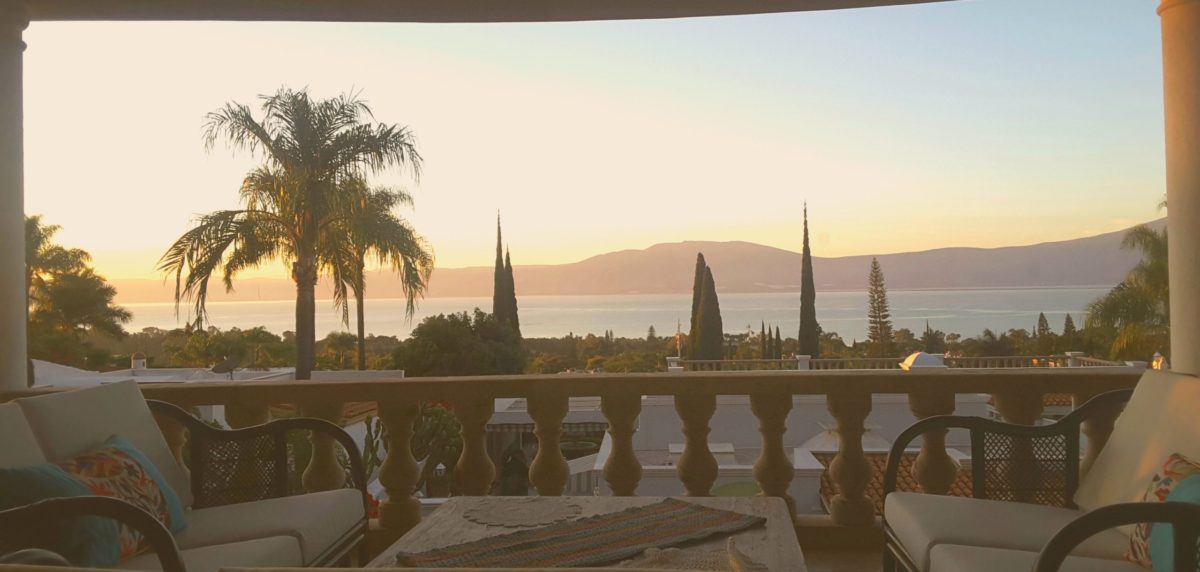
I have often cited the amazing weather here lakeside. As I ponder the live news and weather from WTOP in DC, I sit on my veranda and enjoy bountiful sunshine over the lake. It’s early morning in winter, so I have to wear sweatpants and a long-sleeve t-shirt. It drops below 50 degrees (F) at night here, but quickly recovers to the 70s. My morning coffee outfit will return to shorts and short-sleeve t-shirt . . . shortly.

I say this not to gloat (ok, a little gloat, a gloat-ee perhaps) but to introduce a surrender on my part. For years I have been telling people we don’t have heating or air-conditioning in our house, because we don’t need it. My dear wife bought an electric heating pad for the bed, which she installs for the winter, but which we rarely ever use. Local friends have warned me that eventually I would feel otherwise and want heating and air-conditioning. I resisted. Some cited climate change, and while the summers have become a little hotter and the winters a little colder, the data say nothing more than that: a little. Others were more persuasive: “you’re getting older, and the temperature will feel more extreme.” This was an inevitability staring me in the face.

I already noticed that “my blood had thinned” when we returned to the States annually for Thanksgiving. Back in the day, I dodged dinosaurs while running in shorts and t-shirts in howling DC snowstorms. I took perverse delight in running on “black-flag” heat-warning days, when breathing outside was allegedly equivalent to chain-smoking a pack of unfiltered cigarettes (nobody who has ever smoked an unfiltered cigarette agrees with this comparison, BTW). But now I shivered in the 40s, snugly wrapped in multiple layers of fleece and down and anything else I could find. Yes, I had hard evidence that age was turning me into a weather wimp.

One technique we used to avoid the warmest, driest part of the year here (April-June) was to travel. Late Spring is an ideal time to head to Europe, before the crowds and heat settle there. Alas, as Don Henley crooned, “But there’re just so many summers. And just so many springs.” What to do when our world travel plans diminish and end?

I could wait and see. Perhaps the adjustment will be gradual enough I will accommodate it with some extra cool margaritas in summer, sweatshirts in winter. Perhaps. Or I could prepare for it. Those who know me already know which I chose. So, we’re putting air conditioning units into the bedrooms. They are capable of heat or cooling, and sufficient to ensure a good, comfortable night’s rest regardless of the ambient conditions. Of course, it can’t be that simple, can it?

We already max-out electricity use, and adding air conditioning will push us to the very top of the spectrum. To explain, electric power in Mexico is a state-run monopoly. The most basic usage is practically free, and accommodates the average poor Mexican household with a small fridge, a television, and a few electric lights (oh, and cell phones, always cell phones). A secondary level doubles that usage, covering the majority of Mexican families who might also have an electric appliance or two. The third level triples the usage and costs, and this is where most gringos pay, owing to the plethora of electric devices we have. Finally, there is a penalty rate for extreme usage, called DAC, which doubles or triples the total cost. You enter into DAC by average use exceeding a standard for a set period of time, and stay in it (thus fined) until the average dips below the limit. Now that sounds horrible, except that even in high gringo usage, our monthly electric bill runs USD $75. It’s insanely high by local standards, but I’ll bet most readers would gladly trade bills with me!

Adding electric heating/cooling would undoubtedly push us permanently into DAC. And we live in a place with year-round, abundant, strong sunlight. So we’ll be responsible and install eight solar panels and a whole-house power wall back-up system at the same time, which also eliminates the need for future blog posts about the occasional power outages which force us to play beat-the-clock with our fridge and freezer.

I consider it being prepared, but it is fair to say I am giving in. Time stands still for no one, but the local power utility stands still all the time during outages. Better to go solar, add a battery, and a little heat and cooling now. Maybe it’s not a surrender. Maybe it’s just a tactical retreat. Or even I’m attacking the problem from a different direction! Whatever. As Mr. Buffet said, “but there’s booze in the blender, and soon it will render . . .”

Thoughts on immigration

From an immigrant, emigrant, and expat, but not a refugee. Cue Tom Petty:

Few things get my goat more than people talking about immigration without any experience or understanding what they are talking about. I’m talking about people making broad generalizations (Trump, 2015: “When Mexico sends its people, they’re not sending their best. […] They’re sending people that have lots of problems, and they’re bringing those problems with us. They’re bringing drugs. They’re bringing crime. They’re rapists. And some, I assume, are good people.” I’m talking about people citing the words (“Give me your tired, your poor, Your huddled masses yearning to breathe free”) of a poem placed on the base of the Statue of Liberty as a fund-raising gesture to pay for its completion, and treating it as constitutional law. Get a grip.

I’m an immigrant. My status under Mexican federal law is residente permanente (permanent resident) and I am covered under El Instituto Nacional de Migración (INM), which means legally I am an immigrant because I am someone who has come to live in their country. The United States could consider me an emigrant, because I have chosen to live in a country other than the one where I am a citizen. I am still a citizen of the United States and the State of Ohio (O, H, oh, never mind). I pay all applicable federal and state taxes. I vote. I have a driver’s license (actually two). I did not move for any political reason: I simply found a place I thought my wife and I would really like to retire to, and we do. We have no intention to live anywhere else.

Long ago, people only left their homeland because they had to (refugees or deportees, which by-the-way was the original Latin meaning of expat). Modernity created a push-pull among people seeking a better life for themselves and their children. The Western Hemisphere in general and the United States in particular welcomed such people . . . but always within limits. If you know American history, there are cycles where immigration soars until the resident population reacts, then the tides reverse for a period. Long ago, all of this was legal: the law allowed people to stay and become citizens if they simply made it into the country. At times when the nation became concerned, it could become illegal to do the exact same thing. So please don’t suggest everybody came to the States in the same way.

I choose to be called an expat because it better describes my situation, not to demean anybody else. It galls me when the same people who tell me what pronouns to use try to tell me I’m a racist/class-est/whatever-ist because I choose to call myself an expat. Just honor my chosen noun, like you insist on others pro-nouns. The difference I see is I neither reject my former country nor wish to join my present one. It’s a unique happenstance of modernity that this option is available to people, but it is real. People walking up the Central American isthmus to come to the United States want to become citizens there. If you offered it, about half the world would accept the honor. That’s a big difference between an immigrant/emigrant and an expat.

As an expat, I abide by all the laws of both my country of citizenship and country of residence. There is no escaping US taxation, legally. I am enrolled in Medicare even though it does me practically no good. There are places I can’t go based on US State Department guidance and federal law. I carry a green card, the proof of my Mexican residency, with me at all times. I can be asked to display it even by the tránsito cops who do nothing but enforce traffic laws (or collect bribes). It’s no more an imposition than carrying my US passport when traveling abroad, so don’t lecture me about autocracy and “papers, please.”

My rights as a permanent resident in Mexico are enshrined in the Mexican federal constitution. Read that as you will.* All residentes must avoid becoming involved in Mexican politics. I know American expats who love to protest in public against the current American administration, but don’t seem to realize the possibility if the Mexican federal government wants to side with that administration on some issue, you might be involving yourself in Mexican politics. Ignorance is bliss. Better to avoid it all.

There are gringos who came here when Mexico had no way of keeping track of visitors, decades ago, and simply stayed. Occasionally, they are caught up in a sweep and deported back to the United States or Canada. There is no sturm-und-drang, no Nazi references, no protests. You can’t just come to a country and live there, no matter how peacefully, just because you want to. Many federal police here carry long rifles (you might know them as “assault weapons”) and wear face masks. They aren’t the Latin Gestapo, they are hiding their identities from the cartels. Funny how that works (and for the record, the Gestapo never wore masks: they didn’t need to). They all seem very intimidating until you see a convoy of Guardia Nacional, masked in trucks with crew-served automatic weapons, stuck in a traffic jam and being ignored by all the Mexicans driving around them.

Now on to compassion. Some of my brother-and-sisters-in-Christ (Christians) like to chastise (not literally) those of us who don’t seem sufficiently compassionate to people arriving undocumented, as they say. They cite that Statue of Liberty poem (irrelevant), several Old Testament verses (where do they stand on the rest of the OT?), or Christ’s command to love one another. That last one is indisputable as a command to be compassionate to (i.e., “suffer with”) others. But there is nothing compassionate about encouraging someone from a different and strange culture to uproot themselves from it, travel thousands of miles endangering themselves and their family, all for the better job of mowing your grass, doing your laundry, cleaning your home, or caring for your children. Sorry, that’s not the story Christ was telling.

Likewise, the Holy Family weren’t illegal immigrants/undocumented (they crossed no international border, needed no papers). The Good Samaritan isn’t about government policy, it’s about your personal responsibility. Recall that Jesus told the story to respond to an expert in the religious law who wanted to justify himself . . . funny how people today cite it today to . . . justify themselves. Pot meet kettle. The Good Samaritan didn’t rush to Jerusalem to lobby for universal health care; he simply took care of his neighbor. Anybody wishing to sponsor immigrants with housing and jobs and taking responsibility for them? God bless you. Or forever hold your peace.

I recently had another (yes, it’s happened before) person on social media call me a racist “who was simply afraid to live among all those brown people” (her words). I probably enjoyed too much explaining to her that I live as the palest-of-the-güeros among a nation of what she terms “brown people.”

 “It is better to remain silent and be thought a fool than to speak and remove all doubt”

— a paraphrase of Proverbs 17:28

One of the staunchest American voting blocs for strict immigration enforcement is recent legal immigrants. These are the people with the most in common with those illegal or undocumented persons seeking the same advantages. Are they anti-American? Are they racist, or xenophobes? No, they’re just people who have gone about and done the right thing, and resent others who don’t. Nobody likes a line-cutter, but they only cost you a little time. Illegal immigrants have many other costs, costs born not by those same people arguing in their stead.

As an immigrant, I am very pro-immigration. Done correctly, I think it enriches the immigrant and the nation welcoming him/her. There needs to be vetting, limits, rules, and enforcement of each. It amazes me when people act like all the “legalized” immigrants (a temporary status granted by an administration) are completely vetted. How does the US government vet a person from Somalia, where there is no government? From Venezuela, where until recently, the government was antagonistic? From China; do I need to point out they might not have our best interests at heart? Really?

There is no law without enforcement. And when enforcement has been lax, its reinstatement will seem harsh. That’s where America is today. It can’t simply go back to lax enforcement, nor to endless bureaucracy (more judges!), nor opt for an amnesty which just resets the clock on an intolerable situation.

But if you don’t have skin in the immigration game, have a little humility toward those of us who do.

* By the books, the Mexican Constitution is very hard to change, almost as difficult as its famously-intransigent US cousin. In reality, it is one of the most amended existing governing documents, with over 750 article changes since it was promulgated in 1917, and six times as many words as when it was written!

Another Death in the Morning

I won’t spend as much time analyzing the shooting death of Alex Pretti as I did previously with Renee Good. One colleague criticized my approach as “frame-by-frame” as if more detail and thoughtful analysis was unnecessary. It’s a sad commentary on where we are when otherwise rational people take such a position. Instead, I recommend you read/view this New York Times analysis which does a fair job of analyzing the scene. But I will add some thoughts in general.

  1. Continuing the theme that our national derangement has left folks unable to think clearly, gun-restriction enthusiasts are now championing the dead man’s right-to-bear-arms in a confrontation with law enforcement. And Second Amendment absolutists are questioning it. Foolish (key word) consistency is the hobgoblin of small minds. These role reversals denote no minds at all.
  2. I see nothing in the Times’ analysis which suggests a deadly threat. Pretti could barely be described as impeding, as he backs away from one agent and only briefly touches him when that agent pushes a woman over a snowbank. This is a normal reaction for anybody in such a situation. He does then resist, as it takes six agents to take him to the ground, and even then he remains on his knees, not prone (which would be the position law enforcement would be placing him in for detention). But resistance is not a threat. The discovery of his weapon amidst the scrum is handled by one agent removing it, yet another then opens fire. While the Times makes much of the number of shots subsequently fired, I will point out again that once an officer makes the decision to use deadly force, that officer (and others) are authorized to continue firing until the target is completely neutralized (ie, dead or incapacitated). If you want to make the case for warning shots or shooting people in the legs or whatever, you’re in the realm of TV, not the real world. Those are the rules established (repeatedly) by the Supreme Court. The issue here is the lack of a reasonable cause for deadly force in the first place, because there probably is none. I only say “probably” because we don’t have all the video and audio.
  3. Mr. Pretti’s right to carry a weapon is undeniable. His duty to be responsible when doing so can be questioned. The fact he went to the trouble of getting a concealed carry permit suggests he was a serious, law-abiding person. We don’t know whether he had his permit and identification on him, as required by Minnesota state law, but even if he didn’t, it’s a misdemeanor punishable by a minor fine and can be remediated simply by showing one has a valid permit. As a serious, law-abiding citizen, he no doubt knew that Minnesota is a duty-to-acknowledge state with respect to carrying weapons. Some states require those carrying weapons to announce so to law enforcement (called duty-to-disclose). Minnesota only requires one to acknowledge carrying a weapon “if asked” by law enforcement. However, nearly all gun-rights organizations have training (real and online) telling in detail exactly how to disclose your carry status when dealing with law enforcement, explaining it is always best to do so, because the sudden discovery of a concealed weapon can become deadly. Needless to say, engaging in a scrum is not a responsible way to conduct your right to concealed carry.
  4. The immediate overreaction by those vilifying the agents involved is expected, if unfortunate. Even if the crticis are ultimately justified, they were wrong to jump to conclusions. I am more offended by the similar over-reaction by ICE and DHS officials. Immediately declaring the victims were “domestic terrorists” is beyond the pale, especially given the lack of a formal investigation in the Good shooting, and the lack of a completed one in the Pretti shooting. Standing up for your agents can be accomplished with tact and not at the expense of the reputation of American citizens. President Trump should fire DHS Secretary Noem, as she lacks all public credibility at this point. Border Patrol Commander Bovino merits the same treatment.
  5. Both shootings merit full, independent investigations. Of the orders given, the actions taken, and the motives involved. On all sides. ICE needs to assess its use-of-force criteria, especially when dealing with citizens rather than illegal/undocumented persons. Telling people that ICE agents have no authority to arrest US citizens is not only wrong, it’s deadly. Suggesting impeding them is some type of game should likewise be treated as a criminal activity.
  6. The propaganda from both sides has to stop, as it fuels the tension. If states or cities don’t want to cooperate with ICE, that is their prerogative. So don’t ask your criminals about their immigration status, or don’t notify ICE when such people are released. Fine. But providing local police to create a perimeter where ICE is conducting an ERO is NOT cooperating with ICE: it’s doing your job, protecting your citizens. Watch the Good video. Watch the Pretti video. What’s the one thing you don’t see in those videos? Local police doing what they did under the Obama and Biden and even the first Trump administration: creating a buffer between people and ICE agents doing their federal job. Your Governor or Mayor does NOT get to determine whether (or even how) the federal government enforces immigration law. You don’t have to cooperate, you do have to render assistance, because that’s in the best interest of your citizens. Just Do it!
  7. The Trump administration blundered badly when it veered from nationwide immigration enforcement and started a targeted operation in Minnesota because of the extensive federal funding fraud there. You don’t fight fraud with ICE or Border Patrol. While ethnic Somalis were involved in the fraud, there isn’t a nexus to the same persons being here illegally. The full weight of the DOJ (FBI) and Treasury (IRS) needs to be brought to bear on the situation. Mixing in DHS/ICE and Border Patrol only confused the situation.
  8. Let’s stop arguing about the “worst of the worst,” shall we? First off, there are over one-million people in the country who have received final deportation orders. This means they have attended all the hearings, applied for every type of relief, and been denied. They have exhausted all due-process. And when they were called to report for deportation, they simply didn’t show. Some have been here for decades. They are not guilty of any other crime, but they have no legal recourse to stay in the country. If you’re arguing they get to stay, you’re saying the law does not matter. Second, while the administration argues the vast majority of those it is deporting are criminals, they play fast and loose with the statistics. They include people who have been convicted along with people who have only been charged, not convicted of a crime. Oh, and they even include people who have had previous convictions or charges dropped or erased from their records through remediation, including sealed records. Some people recoil at this. I only point out that all these things (convictions, charges, and even remediated cases) ARE specifically permitted to be used in determining whether to deport someone. Once again, the rights of a citizen are not the same as those of someone trying to become a citizen or resident. Finally, the illegal alien detained by ICE at the scene where Mr. Pretti was killed was a man previously charged by state and local officials for domestic assault and disorderly conduct. Yes, state and local police. You and I may argue whether those charges are enough to deport someone, but you can’t make up the idea the detentions are random. Last year, there was a major increase in non-criminal removals as a result of “collateral arrests,” where ICE agents executing a warrant for one individual also arrest everyone else present at the scene who lacks legal status. That is not random, either.
From the Cato institute, which opposes the Trump approach

If you want to go all-in on abolishing ICE or promoting MAGA, you probably don’t like my analysis, and frankly, yours is a tired take. If you want to argue a point or an opinion, have at it. There are other ways to parse the data, or make the case for or against immigration enforcement /reform. I’m interested in solutions, especially those that fix an immigration mess decades in the making and recently resulting in American citizens dying at the hands of federal agents.