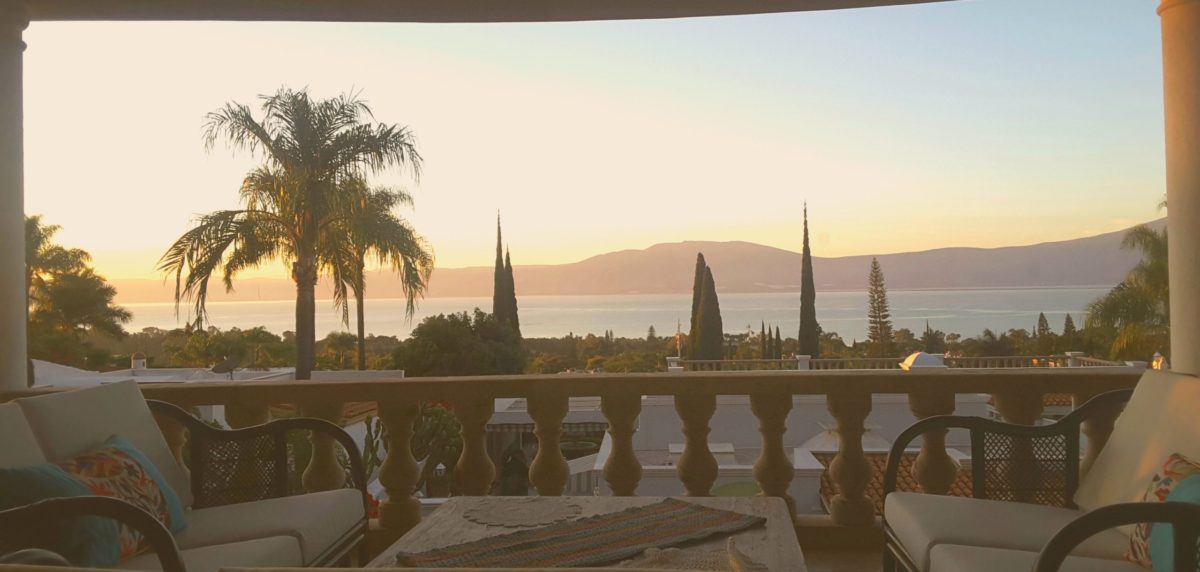
Longtime readers will recall Judy & I started absconding to Europe in the springtime a few years back. First, because it’s less crowded than summertime and the weather is still nice. Second, Ajijic is at the end of its dry season, when it warms up and gets a little dusty. Third, according to Judy, I can’t just sit still and enjoy our wonderful home when there are still battlefields, historic ruins, and cathedrals we haven’t seen. Anyway, shoulder season is getting more crowded all the time, we now have air conditioning and total off-grid solar power at home, but there are still battlefields, historic ruins, and cathedrals we haven’t seen! She’s probably correct.
We just arrived after a seventeen-day transatlantic cruise, and we’ve settled into a rental apartment in Alicante, Spain for the next two months. I’ve previously extolled the virtues of cruising to Europe (here), so I’ll summarize it thusly: if you have the time, if you know what type of cruise line you prefer (they are VERY different), if you hate jet-lag, if you don’t get seasick or aren’t afraid of the open ocean, cruising to Europe is a comfortable bargain. End of commercial.
Why Alicante? We visited here for a week last year, after doing a lot of due diligence about perhaps buying a vacation home in Spain. Our two finalist locations were Sevilla and Alicante. Either would be a great place for an extended visit, but Sevilla well-earns its nickname as the “oven of Europe” for summer temperatures. Alicante, on the Costa Blanca (south of Valencia, north of Cartagena) has more moderate weather, which made it our winner.
But our vacation home-buying plans are in abeyance right now, due to the politics of the Spanish government. Spain has an affordable housing crisis, as there are too many people chasing two few houses in the cities where everyone wants to live. Vast rural areas and small towns in Spain are depopulating at an alarming rate, but zoning and other regulations impede new construction in more desirable locations. Demonstrating that other countries can be as mismanaged as our own, the Spanish Prime Minister has unilaterally given amnesty to 500,000 illegal immigrants, and pledged to be more welcoming to immigration in the future . . . while not increasing the housing supply. The government’s straw-man arguments are to blame the lack of housing on (wait for it) foreigners buying vacation homes in Spain (us in the future conditional tense), and overtourism (us in the present tense) creating demand which results in converting long-term rentals (for locals) to short-term rentals (for tourists).
Actually, both of these arguments hold some water, but they omit important details. Home buying by foreigners is a very tiny part of the market, and represents a net gain economically by introducing well-off clientele to the local economy. And who owns all those apartments being converted for tourists? Spaniards, making money off the rentals. “My, you’re the dark one,” said the pot to the kettle!

While the government has done nothing but complain about the situation, they have threatened measures like a 100% purchase-price tax on foreign home-buyers, which is the kind of thing to cool one’s ardor to buy a home in Spain right now. At least it cooled ours. Just to buy, not to visit. In fact, we viewed the cooling off period as an opportunity to try out the lifestyle we were considering, just short of going all in with a purchase. So here we are in Alicante.

Alicante is big enough (pop: 370,000) to have everything one wants in a city, but retains the smaller town feel. The casca antiguo (old city) clings to the hillside beneath the obligatory mountain-top fortress of Castell de Santa Bàrbara. The areas closest to the beach have been gentrified into shopping/eating/touristing, but the quaint lanes of old casas still line the Santa Cruz neighborhood. There is a fine marina, with a stunning, large esplanade of mosaic tiles and tapas bars. While some tourists stay in Alicante, most descend upon the nearby purpose-built beach suburb of Benidorm, where high-rises stretch from the beach to the hills. The downtown is flat and very walkable, while the city and local beach communities are connected by an inexpensive tram.

We have a small (600 sq. ft.) apartment in the centro. While it does have two bedrooms, a kitchen and a combo living/dining room, it is designed primarily as a short-term rental. Because we were looking for a longer-term and seeking outside the high season, we were able to cut a deal with the property manager. When I say deal, don’t think “steal”: it was still expensive, but worth it to try out the lifestyle short of the cost of buying a place!


So for the next two months, we’ll be reporting on our attempt to merge our own well-settled expat lifestyle with that of Spain.


“¡Palante, como los de Alicante!” (Forward like the people of Alicante!), a common Spanish aphorism.
