So named because the flora in the canyon gives it a copper (oxidized) green hue.
They made the letters in copper color . . . get it?
We stayed at the Hotel Mirador, aptly named as all the rooms lie along the canyon top with balconies overlooking the canyon. Here’s a map to orient you on where we were:
Ahhhh, Chihuahua!
During this trip, we started off off-map in El Fuerte and traveled up the red line (ChePe train) to Bahuichivo. We took a van to Cerocahui, then on to the Gallego overlook of Urique. Next we traveled by van to Posada Barranacas, where we stayed four nights overlooking the canyon. We also took day trips to Creel and to the other named “valleys.” Let me shut up for a moment and let the pictures do the talking:
Our hotel in Posada Barranancas, from the bottom of the canyon
There seems to be a very human need to anthropomorphize physical structures, thus:
Valley of the Frogs
Valley of the Mushrooms
Van of the cute dogs
Little known fact: Yogi bear retired to Mexico, too!The Spaniards called it Valley of the Monks. The Raramuri called it Valley of the Phalluses: You decide!Rorshach test: whole lotta’ monks or phalluses here!The start of the world’s second longest zip line. Note that there is also a tram line.
I encouraged my fellow travelers who had not done so to take the zip line. It’s safe, and everyone should do something like that sometime in your life. Previously, I jumped out of planes and rappelled down cliffs, among other things. I took the tram. Mis amigos were not amused. 😎
Waterfall near Creel
All in all, an amazing eight-day trip. As I told my Spanish teacher, “Cada nueva vista es mas espectacular que la ultima.“(“Each new view is more spectacular than the last.”) A big thanks to our friends who formed our travel pod; a trip is always better when shared with great company! And special thanks to Rosie at Charter Club Tours for arranging, chaperoning, and leading the trip.
You say “to-may-to”, I say “to-mah-to.” The Raramuri are an indigenous tribe living–mostly as they always have–in the Sierra Madre range in the Mexican state of Chihuahua. When the Spanish arrived, they dubbed the peoples as Tarahumara. Much like the Mexica people eventually accepted being called Aztecs, the Raramuri (who speak Raramuri and call themselves Raramuri), accepted others calling them Tarahumara. I’ll go with what they call themselves.
The Raramuri peoples were closely associated with the Apache tribe, so much so they consider themselves to be from the same lineage. The Raramuri say that the Apaches were very bellicose, always looking for a fight, while the Raramuri were more peaceful, so the tribes split up. Eventually the Spanish came a knocking and even the Raramuri put up a fight. Spain tried three times without success to “pacify” the Raramuri. Finally, some Raramuri took up the Spanish language and the cross, while the rest retreated into the canyons to continue life as they liked. Over the years, Spanish influence and Catholicism spread, but with a distinct Raramuri flavor.
Valley farms for the Raramuri
The Raramuri live a spartan existence with individual homes, often built upon existing caves in the canyon walls. Even those who live in the valleys still insist on subsistence farming and hunting for themselves, gathering together mostly for fiestas and seasonal events. Oh, and running.
I don’t mean “let’s go out and get some exercise” running. Not even marathon running–that’s too short in their opinion. No, I’m talking about the kind of extreme long distance running that makes Forrest Gump look like a weekend jogger. It seems that one of the Raramuri beliefs that survived to the present day is that running helps keep the Earth spinning on its axis (in a spiritual, not physical, sense). So they run. and run. and run. Men, and women, and children, even the elderly (to some extent). Barefoot, or in huarache sandals made with twine and the tread of old car tires. How far do they run? While we were there, Raramuri runners competed in a virtual international race where their top runner ran 429 kilometers, or 268 miles. He only averaged a 15 minute mile . . . for sixty-four straight hours (he didn’t win)!
Three years back, a Raramuri woman entered and won her first race, an ultramarathon of thirty-one miles, wearing a skirt and sandals.
“One of these things, is not like the others”
Running is also the Raramuri way to settle disputes. Have an argument over some land, or a cow? Think someone dissed you, but they don’t think so? Really like that shirt the other guy is wearing? The Raramuri challenge each other in a race which can last more than a day. The two contestants push a wooden ball along with a stick, over mountain and canyon trails, and to the winner belongs the spoils!
If the Raramuri/Tarahumara start to sound familiar to you–and if you ever were a runner, they do–you might have read Christopher McDougall’s book Born to Run, which highlighted the “light-footed” (Raramuri means “light-footed”) people who run on their toes in sandals, which in turn helped spark the barefoot/Vibram running craze.
We didn’t see a lot of running, as the Raramuri aren’t there to perform for you. We did have the opportunity to visit two cave-homes. The first was along a road and supported an extended family of about fifteen people, including giving them the chance to market various goods and natural medicines.
Cave home/marketInside, they keep the fire burningChicken coop next door
The second was on the top of a cliff, and was owned by an older couple who are so wealthy (!?!?), they have a second cave house down in the valley, where the climate is tropical. So they move back and forth, depending on the season. Cliff side snowbirds, so to speak.
Judy snaps a photo of the canyon while the man of the house arrivesCatalina tidies up since she had visitors, and she seemed so fond of me Judy had to reclaim me!
Almost all the Raramuri we saw had adopted or adapted to aspects of modern lives. The small farms had satellite dishes, the men wore pants in place of the traditional diaper-like shorts, they hunt with rifles and catch the train to move between towns. But the women still weave pine needles into baskets and wear multiple layers of skirts. And they all still gather to run, just to keep the Earth spinning. So when the Sun comes up tomorrow, think of the Raramuri who ran last night to make it so!
From El Fuerte and the nineteenth century we traveled a short distance to a godforsaken little train station to ride the last passenger train in Mexico: the Chihuahua al Pacifico, or “Che-Pe.” Passenger trains were once legion in Mexico, but they gradually gave way (as in the States) to freight carriers. AMLO, Mexico’s Presidente, has inaugurated the construction of a controversial tourist train in the Yucatan, but who knows if that will ever come to fruition. In the meantime, ChePe is the only game in town. This particular train still moves a few passengers from the coast to the mountains, and locals joke that Che-Pe stands for “always late.” Mostly, this train takes tourists up into the towns of the Sierra Madre, where they can view the Barrancas del Cobre or Copper Canyon.
The train tracks run across some scrub and high sierra desert landscapes before entering into a series of climbs along canyons cut into the mountains by the various tributaries of the Rio Fuerte. Each landscape, tunnel, trestle, and cut is more spectacular than the last. Makes one glad we no longer worry about film but simply shoot the pixels and worry about the good ones later!
On the way up; at the top left, you can see where we later entered a long tunnel after a massive switchback
heading up the canyon
looking down out of the train
This being a Mexican train, you can open the windows and hang out. Of course, if you do, you’ll see the various mudslides, overnight arroyos, track and railroad ties lying beside the railway, and of course tunnel walls which whizz by about a meter from your window. Throughout the day, we rose from sea level to eight thousand feet, crossing forty bridges and passing through over eighty tunnels, before arriving in the eighteenth century, more specifically the mission town of Cerocahui.
I leaned out once for a pic
ok, ok, twice
Cerocahui is even smaller and more rustic than El Fuerte. This town was originally just the site of a cemetery for the Raramuri peoples, when the Jesuits came around and built a mission to evangelize them in the seventeenth century. When Spain expelled the Jesuits in 1767, and the town had to wait on a Franciscan priest to arrive in the 1940s! We’ll revisit the Raramuri in another post.
Cerocahui from a mountain overlook; notice the clouds in the valley in the background to the left
Our hotel, very cozy
vineyards
the mission church
This day we traveled up a scary mining road to a scenic outlook over the Urique valley, one of the canyons forming the Copper Canyon.
Our group & van on the mining road, visiting a Rarumari cave turned into a small storeThe Urique valleyClose up of the town of Urique
The traveling life is back on, masks and all! We’re on a group tour to the Sierra Madre Occidental, specifically to the Mexican states of Sinaloa and Chihuahua. Our first stop is the tiny pueblo called El Fuerte, so called because the Spanish build a fort here in 1610.
El Fuerte is a pueblo magico, a special designation for towns of historic consequence or natural beauty. It certainly has both, as these pictures attest. The historic side is one familiar to those who watched American TV in the 60’s: El Fuerte is the home of the real life El Zorro. Out hotel claims to be the house of the original el Zorro, complete with statue and a tributary room. El Fuerte–built alongside the eponymous river which will feature more in this trip–is a picturesque step back in time to early nineteenth century Mexico. We got a chance to taste one of the two local specialties: black sea bass; unfortunately, the local langostinos are off limits for mating season, so we had to fall back upon regular shrimp. Enjoy the pics!
Zorro, . . .
and his room
The Spanish fort
The fort commands the town
and the river
Our hotel exemplified
the local beauty
and had a fine bar & pool
This mural in the government building gives a short history of the region. Reader’s Digest version: Spanish arrive, everything changes, nobody “wins.”
We’re using El Fuerte to stage higher into the Sierra Madre, before plunging (so to speak) into the Barrancas del Cobre.
Whatever happened to my promise for more visuals in this blog? Oh, yeah, here they are:
The jardineros love to stack rocks
Sunset on the lake &
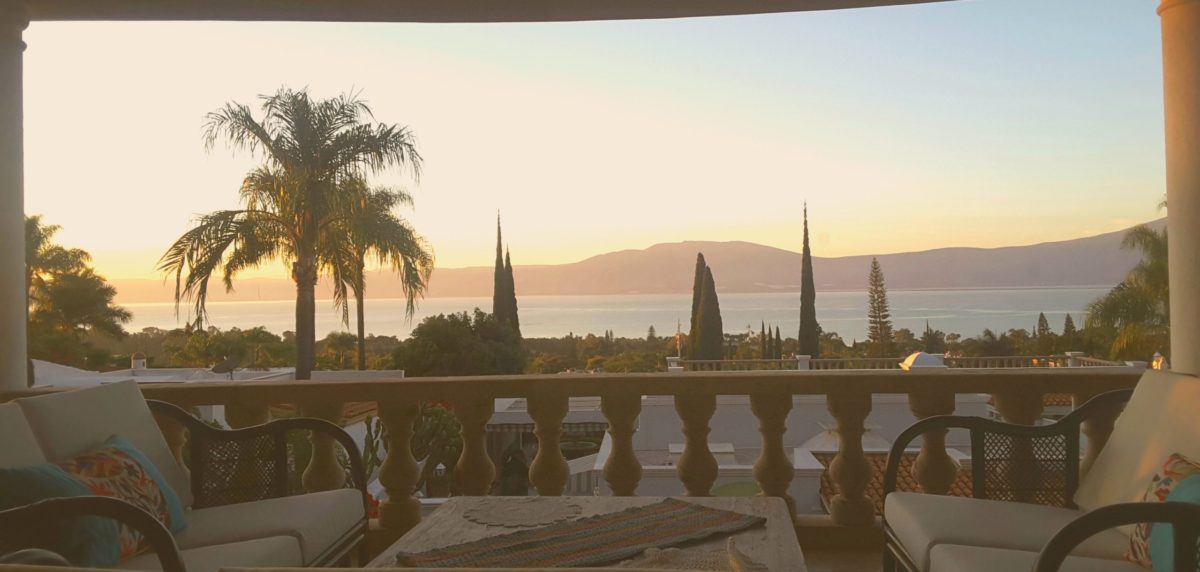
from the Mirador
These ornamental grasses still amaze mePlenty of forage for everyoneThis is a (drivable) north-south path leading up the mountain, but the last rain made it an arroyoLirio out on the lakeand of course, my beautiful dinner date!
They are funny things, those words. Anyone who travels to faraway places and has to live by gesturing instantly recognizes how critical they are. Sign language aside, words are critical to communication. It’s one thing to travel to Lithuania and see a sign you can’t quite understand; it’s something else to see a sign whose characters are not of your ken! Words are important. Edward Bulwer-Lytton wrote “the pen is mightier than the sword” and we nod, because a man armed with the latter can kill only one at a time, but a man armed with the former can kill en masse.
At the same time, words are so commonplace we take them for granted. Writing well takes time and effort, while writing a lot is easy. The French polymath Blaise Paschal once ended a letter thus: “I have only made this letter longer because I have not had the time to make it shorter.” We downplay the effect of words: “Sticks & stones may break my bones, but words will never hurt me” is a great children’s rhyme and terrible psychology. “Deeds not words” clearly places the active life as more important. Any police detective (or teacher, or priest, or . . .) can tell you that when we want to dissemble, we become voluble. That is, our lies involve more words than our truths. “Let your ‘yes’ mean ‘yes’ and your ‘no’ mean ‘no’; anything more is from the Evil One.”–Matthew 5:34.
Modern technology even fills in words for us–mostly wrong ones, to much hilarity. The Internet is a source of unending streams of words, including this blog. Twitter will test whether the natural process of evolution continues. It has reduced communication to cue-less, clueless tweets, where words are replaced by emojis, and emotions are more highly-prized than thoughts. It remains to be seen whether this particular advance in communication will be naturally selected to survive.
The power of words depends upon their meaning. After all, words are just collections of letters representing sounds. If we agree what a word means, we can use that understanding to accomplish much: to barter, to pray, to argue, to convince, to plead, to congratulate, to joke, to love. But only if we understand the words themselves, and they–the words–are not static. I think I first realized I was a conservative of sorts when I felt the keen desire to stand athwart the highway of progress and say “No further!” to ever-worse grammar and usage. The other day, I saw a reference to the enormity of a baseball stadium (“Why, was it Yankee stadium?” I mused). But awful used to mean “worthy of awe” and to fathom was to measure (the distance of one’s arms outstretched).
Some suggest that the hidden power of the English language is its ability to adapt: to change meaning as necessary, to borrow words and phrases from other languages, to make new words easily. I agree. Yet in the end all the flexibility and nuance and versatility must yield to one thing: meaning. And the meaning of words is a two-party action; are you inferring what I’m implying? I have never forgotten the Washington DC story about a guy who lost his District government job for using the word “niggardly” which a co-worker thought was a racial slur. The there’s this New York Times piece (a very interesting one about the Defund the Police effort in Minneapolis) that ends quoting an activist who uses they/their pronouns: as a result, it is impossible to understand what they meant or to whom they were referring!
It goes way beyond simple homonyms or even words with new, changed meanings. We give words meaning based on how we feel about who says them. Check out these quotes:
“The only thing we have to fear is fear itself.”
FDR, First Inaugural address
“We are at war, . . . I ask you to be responsible all together and not to give in to any panic”
Emmanuel Macron
“Don’t panic, but don’t think for a moment that he or she doesn’t really matter. No one is expendable. Everyone counts, it takes all our efforts.”
Angela Merkel
“Don’t let it dominate you. Don’t be afraid of it.”
Donald Trump
“Don’t Fear the Reaper”
Blue Oyster Cult
Okay the last one was just an excuse for a video, but hey, oddly appropriate, no?
In the cold spacing of text on the page, the quotes are quite similar. But how we interpret those quotes comes through a lens of exactly who said just what and when. The words matter, but just so. When the meaning of words becomes a point of contention, democratic discussion becomes difficult. If we can’t communicate, we can’t argue, we can’t even discuss, and we can’t ever agree.
I noticed this recently in a social media discussion spurred on by the Amy Coney Barrett nomination for the Supreme Court. And it bears on the meaning of the word “handmaid.” Some of my friends knew the word primarily from Margaret Atwood’s The Handmaid’s Tale, and they inferred a negative connotation of feminine submission. Which is accurate IF your point of view stems from Atwood’s dystopian novel. But the word has a historical association which is positive, connoting agency demonstrated by willingness to align one’s will with God’s Will (To be concise, Adams’s sin was to place his will over God’s, while Mary’s fiat reordered mankind’s relationship with God back to what He originally intended). I’m not asking you to believe any of that, but you must acknowledge this other interpretation was the primary understanding of the term handmaid from antiquity until, oh, say 1985. If you hear the word handmaid and recoil, while I hear it and mutter “thanks be to God,” we’ll have trouble discussing it further.
Words matter. They can inspire people to do amazing things, or strike fear into the innocent heart. But only if we know what they mean. “I do” is a memorable phrase only if it means something more than “I do, mostly.” I wonder: is our societal stress caused by misunderstanding (willful or unintentional), or is the lack of agreement over meaning the symptom of that stress?