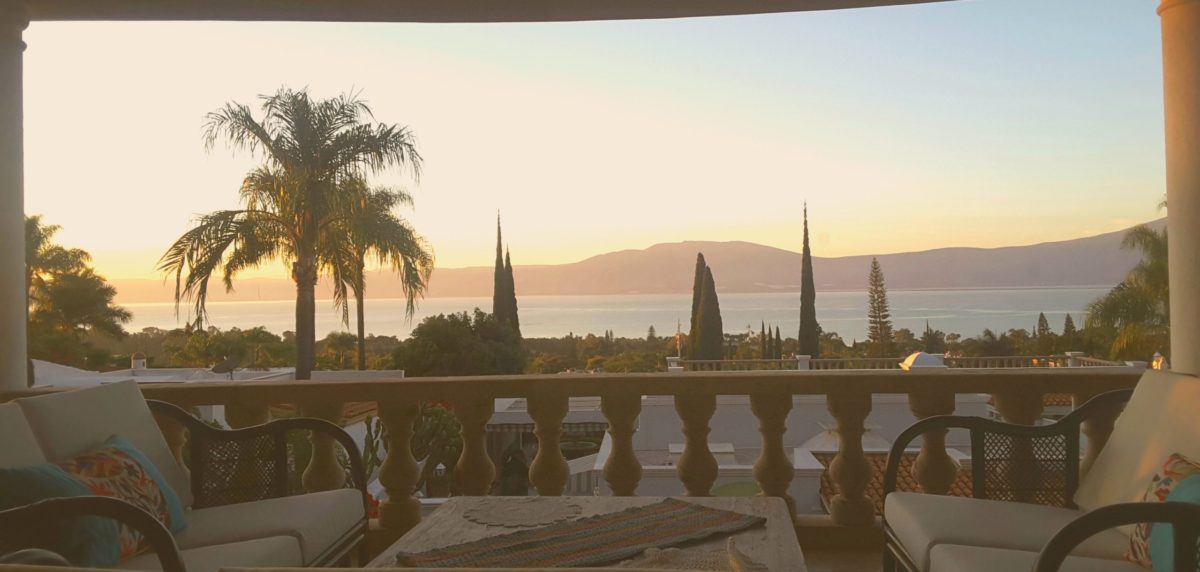
Tuscany

Most travelers either have gone, or someday plan to go, to Italy for the Big Three: Roma, Firenze (Florence), and Venezia (Venice). We’ve done it, and highly recommend it, staying at least three days in Rome, two in Florence, and one night in Venice. Such a visit is fairly easy to accomplish, with easy access to either end from international airports, and excellent train connections between them. And of course all three welcome tourists, although Venice has become a little more circumspect of late. It is well worth it, and each city presents unique and complementary aspects.

But I’m blogging today on a different kind of Italy visit: getting off the well-trod path of the Big Three and seeing the Italian countryside in a more personal, less touristy way. You can pick almost any region of Italy to do this kind of visit, but we’re staying in Tuscany, so that’s the example I will use.

Under the Tuscan clouds is none too shabby, either

What makes this kind of slow, local travel more interesting? First off, it’s the absence of the checklist effect. You know, the Rome? Colosseum: check. Vatican museum: check. Forum: check. And so on until you can’t remember what-you-saw-where or what-you-ate-when. The funny thing about staying in a small village or region is that there will still be nice museums, great restaurants, amazing views, friendly locals, cozy enotecas (wine bars) and pizzerias. You might not be at the one everybody else is doing TikTok videos from, but the one you’re at will be (1) less crowded, (2) less expensive, and (3) just as good.

Your typical, little ol’ village

The interesting thing about staying local in Italy is nearly every region, every village, has something interesting to do and very good places to eat. Italians take pride in how they live, and that extends to all aspects: a bad restaurant is an affront to the village, not just the owner. And as any Stanley Tucci fan knows, every region has unique local cuisine that must be tried and enjoyed. So don’t fret about staying in an out of the way place: it will be great!

What’s with the lion? I dunno, he just seemed to demand my attention

But where to stay, if you’re not in a tourist-friendly hotel chain near the center of a big city? I’d recommend choosing either a castle-stay or an agriturismo. Many entrepreneurs have renovated castles, keeps, or watchtowers into boutique hotels in Italy, and they are comfortable and available. They might be a little on the expensive side: you’re paying extra for the experience. And you might have to carry your bags across the moat. But then again, you’ll be able to complain about having to carry your bags across a moat. Who gets to do that?

Castello di Tornano in Chianti

As to agriturismos, these are government-regulated farm stays. To qualify for the government funding, the property must be an active farm which provides some measure of room and board. There are such farms which welcome you to join in the chores, and many more with a bed-n-breakfast(+) design. You’ll get farm-fresh meals, cozy accommodations, and a chance to meet real locals. While there are a wide range of prices, they can be very affordable.

Once you’ve selected a region and settled on a home base, now comes the fun part. Ask for local recommendations for things to do and places to eat, and limit how far you’re willing to drive. Did I mention driving? Many caution against driving in Italy, and I fully understand why. But that prohibition stands mostly for the big cities. Italian drivers are aggressive (not dangerous, just not defensive), city streets are narrow, parking is limited, gas is expensive, and there are ZTLs (Zona a Traffico Limitato): places where only registered locals can drive, where you as a tourist can get a big fine. But to get around the countryside, driving is fine. Here in Tuscany, the local roads are wind-y, narrow, and full of cyclists. Car trips take time, and the driver doesn’t get to enjoy the beautiful scenery as he/she dodges italianos bent on breaking a personal best on their Colnagos. Remember, the town, castle, or restaurant two hours away is probably no better (just different from) the one five minutes away. Stay at home and visit, and limit the driving.

Now go back to the same places at different times. In a week, you can become a veritable local at the village osteria! Or work your way down the village square hitting every local establishment. Ask for different gelato flavors every day at the nearby gelateria. You can drive yourself (literally) crazy chasing after the next-better wine tasting in Italy, since wines like Chianti Classico and Montepulciano d’Abruzzo aren’t that far apart. And that’s just the DOCs: don’t even try to compare vintners within each DOC: your liver will never make it! (I know, I tried).

We’ve stayed local in Tuscany twice now, and it’s been very rewarding. There are those little hang-ups which make the trip more memorable. Ever have a multi-hundred Euro heating bill at the Hilton? Of course not, but if you heat your castle room with propane, you might! But you forgot to bring your servants and firewood to the castle, now didn’t you?

My dear wife has made it her life’s work to eat Ribollita, the hearty (almost a stew) Tuscan vegetable-and-bread soup at nearly every restaurant; she can even discern the differences in which vegetables and bread are used! For my part, in smaller villages, I’ve found it possible to dress up a little bit and not have everybody automatically think I’m an American. . . of course, the minute I open my mouth . . .

You can still day-trip into those more famous places, experiencing those crowds and selfie-stick hordes, secure in the knowledge that when you’re fed up with it, you can hop back in your Fiat, motor off into the countryside and breathe!

Ever wish they would let the horses loose randomly, in the middle of the day?

The Cruellest Month

My very literate friends will immediately recognize the line from “The Waste Land.” T.S. Elliot began his epic poem with the line “April is the cruellest month, breeding. . .” With all due respect to the great poet, he must never have visited lakeside, for here all know that May, not April, is the cruellest month.

Brown up, Green down

Now in most of the rest of the world, if you ask for a “bad-weather month” you might likely receive December or January in temperate climes, maybe August in tropical ones. Most of the Northern Hemisphere is quite nice and Spring-like in May, the Southern likewise Fall-ish. Lakeside is famous–even if erroneously so, since National Geographic magazine NEVER called it the second best climate in the world–for having great weather. And that much is true. But among all those sunny, dry, comfortable months, May stands out as the worst.

You see, May is the last full month of the dry season. We have not seen measurable precipitation since October, which is the norm. June will herald the arrival of the rainy season, not to be confused with a monsoon. Rather, here it is simply an acknowledgement that it will rain. After seven months without it, it is always welcome. People wander outside during the first real rainstorm just to feel it, much as the MesoAmericans must have with great thanksgiving. No more human sacrifices, though. There might have been a day in those seven months with a shower; for example, the day before yesterday we had a few drops for a few seconds. But that is not rainfall. It was more like what you’d expect if you turn on your yard sprinkler and realize it’s aimed directly at you. Splash, and then gone.

A little green, here

The mountains are uniformly brown, with a splotch of green here and there, from some uniquely-evolved native plant or tree which resists nature’s regulatory palette. The yards and the gardens remain green with an explosion of well-watered and cared-for flora. There is an omnipresent thin coat of dust which settles on all horizontal surfaces, and which magically recreates itself after each sweeping/cleaning. Wearing white or black pants is a newbie’s mistake.

May is the hottest month lakeside. Our average daily high temperature is 85° Fahrenheit, with a low of 60°. May stretches that high into the mid-90s. Now it’s true that temperature is for full sun exposure in the middle of the afternoon, which is why the culture has a siesta: only mad dogs and Gringos go out in the noonday Sun, as it were. And it’s also true the temperature moderates quickly down to a comfortably sleepy level by early evening.

You’re reading this and thinking, “Pat, you’re whining” and you’re right. We are spoiled by a great climate, or as I prefer to say, we just don’t have weather here. Which makes the few negatives stand out all the more. I have transitioned into a local for climatic purposes. I still use Fahrenheit over Celsius, but I swear that the metric measurement for temperature is superior. Why? Because there is no reason for temperatures below zero. We should just stop at 0° Celsius and say, “enough, it’s too cold, stop measuring it.” I haven’t taken to wearing gloves and ski jackets below 6o° as the Mexicans do, but I can see it in my future.

Therefore May is the perfect month to venture out of the slightly uncomfortable paradise at lakeside to the far ends of the globe. Most of the United States is lovely now, although there is the occasional hail of bullets. Europe is in shoulder season and at bargain prices. Heck, even Canada has ice-free roads (for a day or two).

May also heralds the departure of the snowbirds, those semi-annual visitors from up north, who begin returning home in April and finish up in May, leaving us year-round expats with time to savor unclogged roads and restaurant visits without reservations. Like the rain, after seven months we’ll even miss them and want them back!

I admit there is something magical about the four seasons as one experiences them in northern climes. Spring is especially welcome, what with the signs of new life. But June and the rainy season play a similar role here: it is a different world once the rains come. They are eagerly anticipated. Local legend has it that once the rainbirds (aka cicadas) start singing, the rains will come too. Some overly-eager (or is it literal) types compete to announce the rainbirds’ song. Perhaps they confuse correlation with causation. We did have dark clouds, wind, and a few drops the other day, and the rainbirds are giving tinnitus a run for its money.

Or as Eliot later wrote,

Only a cock stood on the rooftree
Co co rico co co rico
In a flash of lightning. Then a damp gust
Bringing rain.

There is a green cactus in there, but that don’t count!

Progressivism: . . . and the Ugly

Today’s Progressives seem to have all the good intentions of their earlier believers, but they seem to have learned little from their history. What makes the outcome ugly is their stubborn insistence that ‘this time it will be different’ married to the quasi-fervor that their ends justifies the means.

Today’s progressives remain true believers in science, but that “faith” has edged over into scientism, the belief that science can settle all questions, and can in fact itself be “settled.” Science can’t unlock the secret of love nor can it explain the evil mind. Science is settled only until it’s not, and if the recent pandemic taught the average person anything, it was to be very careful about expert opinion. Science is great at explaining how (and sometimes why) things work. It’s not so good at determining policies affecting people’s lives.

Another place where Progressivism today is worse than its predecessor is in its adoption of another -ism: presentism. Presentism is the belief that people today are superior (morally, ethically, intellectually) to those who came before, and we should judge the past by our superior standards. While today’s technology is undeniably better, I see no data which suggest people today are superior. Where’s today’s Jefferson, Michelangelo, da Vinci? Ranchers one-hundred years ago knew ecology better than most ecologists today. Farmers two centuries past produced surplus crops without modern irrigation or drones. Common people during the Middle Ages spoke a vernacular language as well as Latin, and they mastered trade skills as a way of life. Humanity today has better tools, but human nature remains unchanged. Societies can be more or less humane, but progress there is not certain.

As an example of presentism, I often mention that family structures in the US were more stable in the 1950s. I barely can finish posting that on social media when Progressives will retort that I “long for the patriarchy” or “forgot Jim Crow” or want to send people “back into the closet.” That’s presentism rearing its ugly head. Yes, all those things happened in the 1950s, including stable family structures. Now there is no evidence to suggest that limiting anyone’s freedom contributed to more stable families. I would argue stable families happened despite those challenges. Especially for black families, who faced so much oppression, yet were remarkably stable. Not any more. What happened? If you’re a progressive today, the notion there was anything good in the past has to be rejected, as only today, and the better future, matter.

You can hear presentism whenever a Progressive talks about being on “the right side of history.” Christians believe history has a direction, which is what led the Rev. Dr. Martin Luther King Jr. to famously say “the arc of the moral universe is long, but it bends toward justice.” But that’s a religious proposition, not a progressive one. Ultimate belief in one’s righteousness about ‘the side of history’ has been at the core of many of the worst examples of inhumanity in the past century.

Finally, Progressives also retain their fondness for change. As they have seen their ideas rejected by the courts and the voters, they now opt to argue for changing the system in toto. Progressives are proposing eliminating the Senate (because it equalizes all States and thus currently favors Republicans), enlarging the House of Representatives (because, yes, everybody agrees we need MORE politicians in Washington), term-limiting the Supreme Court (not mentioned when the octogenarian RBG wore the robes) or simply ignoring its rulings when they are not consistent with Progressive values (did they not learn about the South’s Massive Resistance in the 1960s?).

“We’d all love to change your head”

Rather than learning humility from their failed history, today’s progressives double-down on their beliefs. I still don’t question their motives. The original progressives were just as self-righteous, but they had an excuse in that history had not yet shown them their follies. Perhaps Progressivism will learn, change itself, and survive as a movement. But there’s a difference between being blind, and refusing to see. That’s from a really old book, but most progressives wouldn’t want to read it.

Progressivism: The Bad . . .

If you thought my last post was my attempt to come-out as a Progressive, never fear, you’ll feel differently after this one. Or maybe the next.

My review of Progressive theory’s positives centered on its good intentions, its openness, and its vitality. To which I would now note:

  1. the path to hell is paved with the first
  2. no tent is ever big enough, and
  3. action in the wrong direction is not progress.

Why all the negativity? Well, as I alluded to in my first post, today’s Progressives act like they have never heard of their movement’s past. America tried Progressivism once before, and to paraphrase Dr. Malcolm, Progressives “had their shot, and nature chose them for extinction.”

He got all the best lines!

American Progressivism developed in the period 1890-1920. It grew rapidly, and by the time of the 1912 Presidential election, all three major party candidates (Democratic, Republican, and Progressive) identified as some form of Progressive. This was a period of profound social and technological change, which was fertile soil for Progressive beliefs. A person born in 1860 went from a society on horseback to railroads, automobiles, and even planes by the age of sixty. Communications went from letter and post to telegraph, telephone, radio, and silent movies. Medicine identified disease theory and greatly reduced infant mortality. And society went from farms and small shops to factories and mass production.

It’s easy to see why Progressivism would be attractive under such conditions. Technology seemed to be promising unending improvements. New groups of people were disadvantaged by all the changes: factory workers, miners, immigrants. The system (whether it was society, religion, or the government) appeared to be unequal to the task of adapting. Progressives held some form of power in Washington from 1901 (when Teddy Roosevelt replaced the assassinated McKinley) through the Republican Taft administration until 1920 (the end of Democrat Woodrow Wilson’s second term). At that point, a massive voter rejection of Progressive policies ended the movement’s influence for a century.

Progressivism scored some major victories: Woman’s suffrage, laws against forced labor and poor working conditions, and others for unionization and protecting the environment (including the National Park system). But it also led to over-reach, as in the case of Prohibition.

What happened to Progressivism? Many of those positive qualities I mentioned in the previous post had a negative side, too. For example, the belief that technology (especially science and medicine) always make things better proved to be disastrously false in the Great War. Mass production brought mass warfare. Flight brought aerial bombardment of cities. Chemistry brought gas warfare. TriNitroToulene (TNT) made better explosives. Even electricity and mass production led to child labor at sweatshops.

The drive to improve mankind also had consequences. Some doctors wrongly applied evolutionary concepts to biology and society, developing bogus concepts like eugenics and championing discredited phrenology. They furthered efforts to limit the growth of “unwanted populations” or uncivilized ethnic groups. Contraception led to mass sterilization, care for the mentally-ill led to mass involuntary hospitalization, and the apparent “superiority” of European cultures promoted paternalism at home and colonialism abroad.

Politically, Progressive’s Big Tent failed to screen out elements with whom they should not have allied. Communism seemed to be like-minded, even as it quickly showed its de-humanizing techniques. Racists and Nazis championed Progressive ideas, taking them to their logical extremes. International bodies like the League of Nations treated all countries equally, a recipe for inaction, while idealists put forward treaties outlawing “war” as if that had any significance.

This history, long established and not controversial, always made me wonder why certain liberals chose to brand themselves “Progressives” in the early 2000s. It would be like some new German party saying they were for National Socialism, not realizing the words had history with another meaning. Of course, Republicans spent decades besmirching “liberalism” which was the very essence of republican (note the small ‘r”) values, so perhaps self-proclaimed liberals had to come up with a better name. They didn’t.

Progressivism not only failed to deliver on its promise, it played a major role in setting the stage for some of the horrors of the 20th century, from the Holocaust to medical experimentation to racism to global war. By the early 1920s, Americans were already tired of it, yet they would suffer its consequences for almost thirty more years. And then it became a dirty word, buried in history for another fifty years.

When, like a political zombie, it came back. Next, part three, the Ugly.