Slovenia

Shhhhhhh. I’m going to let you in on a secret, but you have to promise not to tell ANYONE, OK? Covid is gone, or should I say, we’ve stopped caring about it, and travel is back with a vengeance. And that means the crowds are back: the tourist buses, the cruise crowds, the extended families in matching outfits traipsing through the museum. Add in social influencers taking selfies as if the whole world is their stage (“isn’t it?”) and digital nomads turning any neighborhood into an Air BnB wasteland, and well, you get the picture. The only thing missing at this point is the mega-tours of Chinese travelers, but wait another six months and they’ll be back, too.

The secret? Oh, that. You don’t have to deal with all of these travel annoyances. And you don’t have to be rich to avoid them. You just have to know where to go, and where NOT to go. The throngs tend to, well, “throng” at the same places at the same time. They don’t do their research, don’t consider their options. They travel as much to say they’ve been there as to experience anything in particular. If they visit a place no one else recognizes, it defeats the whole purpose for them. But this presents an opportunity for the savvy traveler.

A prime example is Slovenia. No, not Slovakia. You know, that little country directly east of Italy up by the Alps? Yes, that one!

It was a small but prosperous part of Yugoslavia until that country broke apart in 1991. It was ethnically distinct (Slavic and Catholic) and geographically compact, so after a brief ten-day “war” Yugoslavia let it go independent. Which was a real blessing, as Slovenia escaped all the bloodshed and turmoil witnessed by Croatia, Bosnia, Serbia, et al. Slovenes instead busied themselves joining the EU and NATO, trading freely and building up their infrastructure.

What does Slovenia offer?

First off, convenience. It is centrally located in Europe and easy to get to. It’s small with an excellent road system: you can drive across the country in three hours. It uses the Euro, and because the education system incorporated mandatory English language classes, nearly everybody speaks English. Yes, the place names and Slovenian language are a challenge, but the Slovenes we met were happy with a “hvala” and “prosim” (thank you and please).

Second, it’s beautiful on multiple counts. Like rolling farms with vineyards and meadows? Check. Alpine hiking and views? Check. Pristine streams and lakes? Check. Hiking trails, ski resorts, caves? Triple-check. Quaint villages and local diners? Check. If you like your travel to include amazing landscapes, Slovenia has one specifically to take your breath away.

Third, it’s interesting. The cuisine is a mix of influences: Balkan, Austrian, Hungarian, Italian. The ingredients are very natural and organic: locals are interested in making and having the best of their produce, not labeling it, marketing it, and selling it elsewhere. Its history is Europe’s history. There are Roman, Venetian, even Byzantine ruins, little known World War I battlefields, baroque architecture recalling Vienna, and pieces of Yugoslav Communist kitsch.

Fourth, Slovenia is small-town friendly. There are only about two million Slovenes. Theirs is a developed nation with a rich history, but they don’t care to crow too much about it. Furthermore, they haven’t been inundated with tourists yet, so we’re still welcome here.

Fifth and finally, Slovenia is on sale. Being off the beaten path, undiscovered on TikTok, means prices are still reasonable. How so? Farm-stay bed-and-breakfast with huge breakfast buffet: 80 Euros a night. Dinner for two with apps and drinks: 60 Euros.

We stayed in the karst region, with all the caves, for three nights at the already-mentioned farm. It made for a leisurely pace to visit the massive caves at Postonja and the impressive castle at Predjama, which are only about ten kilometers apart. Postonja Jama (cave) is touristy in a good way: easy to get to, easy to park at, with a dual track mini-train doing the hard work of getting you deep into the system, and back out again, and solid audioguides to explain what you’re seeing. But as with any natural wonder, perhaps it’s better just to sit back and take in the beauty. No “turn out the lights” tricks or claims about ghosts, pirates or aliens; just a pretty, large, natural wonder.

Wheeeeeee. I enjoyed the train ride best.

Predjama castle bills itself as the “world’s largest cave castle”: who knew that was even a thing? It is an impressive structure with (of course) a medieval legend about a Robin Hood-esque knight. The tour highlights how the castle, built over and into the mouth of a cave system, provided safety above all else. But it also emphasized how ingenious the builders had been to make the place as livable as possible.

We did a day trip to Lake Bled, which may be the photo op extraordinaire of Slovenia. No doubt you’ve seen the pictures, even if you’ve never visited! The day was overcast with some light rain. We took the traditional pletna boat (rowed out to the island). There is no color/warmth editing in these photos:

You could easily walk around the lake in a few hours. . . you could, we didn’t, as the occasional rain told us to find a restaurant with this on serve:

Foreground: my pork filet over polenta. Background: Judy’s Slovenian style pizza, always with Union unfiltered dark beer!
free mini-bus

It only took us thirty minutes to drive from Lake Bled to Ljubljana, the capital of Slovenia. The old city is small and nestles around the river under a cliff-top castle. While the city has modern neighborhoods that sprawl out from there, the center is very walkable with good transportation options, including a free mini-bus even in the pedestrian zone. The influence of centuries under the Hapsburgs shows in numerous cafes and pocket parks. There are also interesting elements of baroque architecture (especially the Cathedral of St. Nicolas), art nouveau, and even brutalist buildings from Tito’s reign.

Sadly, the steady rain followed us from Lake Bled, so we spent the next few days dashing about under umbrellas and rain jackets. Happily, there are many (many) cafes and bars to duck into for a forced cappuccino or Aperol Spritz!

The old town area is achingly cute. You can barely turn a corner without seeing something quaint: a museum, a restaurant, a curio shop.

Slovene cuisine tends toward meat (especially sausage and game) and potatoes, although I did find a restaurant with pizza rolls in the menu, a sure sign of highly refined culinary culture!

There are a number of good museums covering music, art, natural history, national history and the like.

Ljubljana was a real winner in our book. Good food, great scenery, and a walkable environment. We met service staff that were very friendly, and others who were bored with their jobs. Tipping is minimal here, so perhaps that plays a role. Three days is a good visit, and that leaves you time to visit the natural beauty of the coast, the vineyards, the lakes, and of course the mountains.

But go soon, as Slovenia keeps popping up on travel sites as one of the next big things!

Tuscany

Most travelers either have gone, or someday plan to go, to Italy for the Big Three: Roma, Firenze (Florence), and Venezia (Venice). We’ve done it, and highly recommend it, staying at least three days in Rome, two in Florence, and one night in Venice. Such a visit is fairly easy to accomplish, with easy access to either end from international airports, and excellent train connections between them. And of course all three welcome tourists, although Venice has become a little more circumspect of late. It is well worth it, and each city presents unique and complementary aspects.

But I’m blogging today on a different kind of Italy visit: getting off the well-trod path of the Big Three and seeing the Italian countryside in a more personal, less touristy way. You can pick almost any region of Italy to do this kind of visit, but we’re staying in Tuscany, so that’s the example I will use.

Under the Tuscan clouds is none too shabby, either

What makes this kind of slow, local travel more interesting? First off, it’s the absence of the checklist effect. You know, the Rome? Colosseum: check. Vatican museum: check. Forum: check. And so on until you can’t remember what-you-saw-where or what-you-ate-when. The funny thing about staying in a small village or region is that there will still be nice museums, great restaurants, amazing views, friendly locals, cozy enotecas (wine bars) and pizzerias. You might not be at the one everybody else is doing TikTok videos from, but the one you’re at will be (1) less crowded, (2) less expensive, and (3) just as good.

Your typical, little ol’ village

The interesting thing about staying local in Italy is nearly every region, every village, has something interesting to do and very good places to eat. Italians take pride in how they live, and that extends to all aspects: a bad restaurant is an affront to the village, not just the owner. And as any Stanley Tucci fan knows, every region has unique local cuisine that must be tried and enjoyed. So don’t fret about staying in an out of the way place: it will be great!

What’s with the lion? I dunno, he just seemed to demand my attention

But where to stay, if you’re not in a tourist-friendly hotel chain near the center of a big city? I’d recommend choosing either a castle-stay or an agriturismo. Many entrepreneurs have renovated castles, keeps, or watchtowers into boutique hotels in Italy, and they are comfortable and available. They might be a little on the expensive side: you’re paying extra for the experience. And you might have to carry your bags across the moat. But then again, you’ll be able to complain about having to carry your bags across a moat. Who gets to do that?

Castello di Tornano in Chianti

As to agriturismos, these are government-regulated farm stays. To qualify for the government funding, the property must be an active farm which provides some measure of room and board. There are such farms which welcome you to join in the chores, and many more with a bed-n-breakfast(+) design. You’ll get farm-fresh meals, cozy accommodations, and a chance to meet real locals. While there are a wide range of prices, they can be very affordable.

Once you’ve selected a region and settled on a home base, now comes the fun part. Ask for local recommendations for things to do and places to eat, and limit how far you’re willing to drive. Did I mention driving? Many caution against driving in Italy, and I fully understand why. But that prohibition stands mostly for the big cities. Italian drivers are aggressive (not dangerous, just not defensive), city streets are narrow, parking is limited, gas is expensive, and there are ZTLs (Zona a Traffico Limitato): places where only registered locals can drive, where you as a tourist can get a big fine. But to get around the countryside, driving is fine. Here in Tuscany, the local roads are wind-y, narrow, and full of cyclists. Car trips take time, and the driver doesn’t get to enjoy the beautiful scenery as he/she dodges italianos bent on breaking a personal best on their Colnagos. Remember, the town, castle, or restaurant two hours away is probably no better (just different from) the one five minutes away. Stay at home and visit, and limit the driving.

Now go back to the same places at different times. In a week, you can become a veritable local at the village osteria! Or work your way down the village square hitting every local establishment. Ask for different gelato flavors every day at the nearby gelateria. You can drive yourself (literally) crazy chasing after the next-better wine tasting in Italy, since wines like Chianti Classico and Montepulciano d’Abruzzo aren’t that far apart. And that’s just the DOCs: don’t even try to compare vintners within each DOC: your liver will never make it! (I know, I tried).

We’ve stayed local in Tuscany twice now, and it’s been very rewarding. There are those little hang-ups which make the trip more memorable. Ever have a multi-hundred Euro heating bill at the Hilton? Of course not, but if you heat your castle room with propane, you might! But you forgot to bring your servants and firewood to the castle, now didn’t you?

My dear wife has made it her life’s work to eat Ribollita, the hearty (almost a stew) Tuscan vegetable-and-bread soup at nearly every restaurant; she can even discern the differences in which vegetables and bread are used! For my part, in smaller villages, I’ve found it possible to dress up a little bit and not have everybody automatically think I’m an American. . . of course, the minute I open my mouth . . .

You can still day-trip into those more famous places, experiencing those crowds and selfie-stick hordes, secure in the knowledge that when you’re fed up with it, you can hop back in your Fiat, motor off into the countryside and breathe!

Ever wish they would let the horses loose randomly, in the middle of the day?

The Cruellest Month

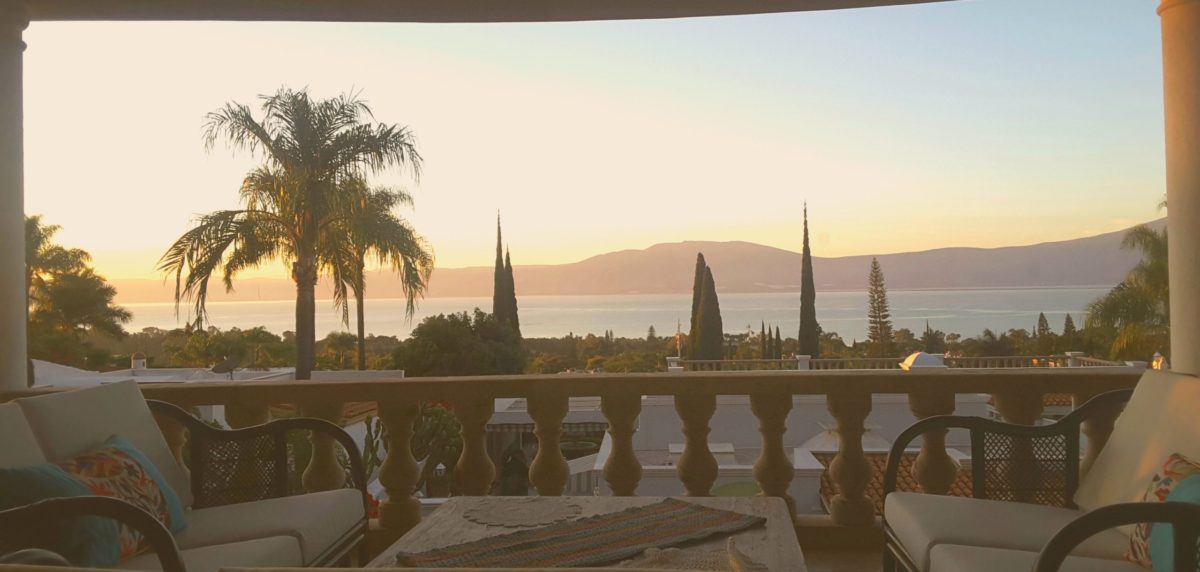
My very literate friends will immediately recognize the line from “The Waste Land.” T.S. Elliot began his epic poem with the line “April is the cruellest month, breeding. . .” With all due respect to the great poet, he must never have visited lakeside, for here all know that May, not April, is the cruellest month.

Brown up, Green down

Now in most of the rest of the world, if you ask for a “bad-weather month” you might likely receive December or January in temperate climes, maybe August in tropical ones. Most of the Northern Hemisphere is quite nice and Spring-like in May, the Southern likewise Fall-ish. Lakeside is famous–even if erroneously so, since National Geographic magazine NEVER called it the second best climate in the world–for having great weather. And that much is true. But among all those sunny, dry, comfortable months, May stands out as the worst.

You see, May is the last full month of the dry season. We have not seen measurable precipitation since October, which is the norm. June will herald the arrival of the rainy season, not to be confused with a monsoon. Rather, here it is simply an acknowledgement that it will rain. After seven months without it, it is always welcome. People wander outside during the first real rainstorm just to feel it, much as the MesoAmericans must have with great thanksgiving. No more human sacrifices, though. There might have been a day in those seven months with a shower; for example, the day before yesterday we had a few drops for a few seconds. But that is not rainfall. It was more like what you’d expect if you turn on your yard sprinkler and realize it’s aimed directly at you. Splash, and then gone.

A little green, here

The mountains are uniformly brown, with a splotch of green here and there, from some uniquely-evolved native plant or tree which resists nature’s regulatory palette. The yards and the gardens remain green with an explosion of well-watered and cared-for flora. There is an omnipresent thin coat of dust which settles on all horizontal surfaces, and which magically recreates itself after each sweeping/cleaning. Wearing white or black pants is a newbie’s mistake.

May is the hottest month lakeside. Our average daily high temperature is 85° Fahrenheit, with a low of 60°. May stretches that high into the mid-90s. Now it’s true that temperature is for full sun exposure in the middle of the afternoon, which is why the culture has a siesta: only mad dogs and Gringos go out in the noonday Sun, as it were. And it’s also true the temperature moderates quickly down to a comfortably sleepy level by early evening.

You’re reading this and thinking, “Pat, you’re whining” and you’re right. We are spoiled by a great climate, or as I prefer to say, we just don’t have weather here. Which makes the few negatives stand out all the more. I have transitioned into a local for climatic purposes. I still use Fahrenheit over Celsius, but I swear that the metric measurement for temperature is superior. Why? Because there is no reason for temperatures below zero. We should just stop at 0° Celsius and say, “enough, it’s too cold, stop measuring it.” I haven’t taken to wearing gloves and ski jackets below 6o° as the Mexicans do, but I can see it in my future.

Therefore May is the perfect month to venture out of the slightly uncomfortable paradise at lakeside to the far ends of the globe. Most of the United States is lovely now, although there is the occasional hail of bullets. Europe is in shoulder season and at bargain prices. Heck, even Canada has ice-free roads (for a day or two).

May also heralds the departure of the snowbirds, those semi-annual visitors from up north, who begin returning home in April and finish up in May, leaving us year-round expats with time to savor unclogged roads and restaurant visits without reservations. Like the rain, after seven months we’ll even miss them and want them back!

I admit there is something magical about the four seasons as one experiences them in northern climes. Spring is especially welcome, what with the signs of new life. But June and the rainy season play a similar role here: it is a different world once the rains come. They are eagerly anticipated. Local legend has it that once the rainbirds (aka cicadas) start singing, the rains will come too. Some overly-eager (or is it literal) types compete to announce the rainbirds’ song. Perhaps they confuse correlation with causation. We did have dark clouds, wind, and a few drops the other day, and the rainbirds are giving tinnitus a run for its money.

Or as Eliot later wrote,

Only a cock stood on the rooftree
Co co rico co co rico
In a flash of lightning. Then a damp gust
Bringing rain.

There is a green cactus in there, but that don’t count!

Progressivism: . . . and the Ugly

Today’s Progressives seem to have all the good intentions of their earlier believers, but they seem to have learned little from their history. What makes the outcome ugly is their stubborn insistence that ‘this time it will be different’ married to the quasi-fervor that their ends justifies the means.

Today’s progressives remain true believers in science, but that “faith” has edged over into scientism, the belief that science can settle all questions, and can in fact itself be “settled.” Science can’t unlock the secret of love nor can it explain the evil mind. Science is settled only until it’s not, and if the recent pandemic taught the average person anything, it was to be very careful about expert opinion. Science is great at explaining how (and sometimes why) things work. It’s not so good at determining policies affecting people’s lives.

Another place where Progressivism today is worse than its predecessor is in its adoption of another -ism: presentism. Presentism is the belief that people today are superior (morally, ethically, intellectually) to those who came before, and we should judge the past by our superior standards. While today’s technology is undeniably better, I see no data which suggest people today are superior. Where’s today’s Jefferson, Michelangelo, da Vinci? Ranchers one-hundred years ago knew ecology better than most ecologists today. Farmers two centuries past produced surplus crops without modern irrigation or drones. Common people during the Middle Ages spoke a vernacular language as well as Latin, and they mastered trade skills as a way of life. Humanity today has better tools, but human nature remains unchanged. Societies can be more or less humane, but progress there is not certain.

As an example of presentism, I often mention that family structures in the US were more stable in the 1950s. I barely can finish posting that on social media when Progressives will retort that I “long for the patriarchy” or “forgot Jim Crow” or want to send people “back into the closet.” That’s presentism rearing its ugly head. Yes, all those things happened in the 1950s, including stable family structures. Now there is no evidence to suggest that limiting anyone’s freedom contributed to more stable families. I would argue stable families happened despite those challenges. Especially for black families, who faced so much oppression, yet were remarkably stable. Not any more. What happened? If you’re a progressive today, the notion there was anything good in the past has to be rejected, as only today, and the better future, matter.

You can hear presentism whenever a Progressive talks about being on “the right side of history.” Christians believe history has a direction, which is what led the Rev. Dr. Martin Luther King Jr. to famously say “the arc of the moral universe is long, but it bends toward justice.” But that’s a religious proposition, not a progressive one. Ultimate belief in one’s righteousness about ‘the side of history’ has been at the core of many of the worst examples of inhumanity in the past century.

Finally, Progressives also retain their fondness for change. As they have seen their ideas rejected by the courts and the voters, they now opt to argue for changing the system in toto. Progressives are proposing eliminating the Senate (because it equalizes all States and thus currently favors Republicans), enlarging the House of Representatives (because, yes, everybody agrees we need MORE politicians in Washington), term-limiting the Supreme Court (not mentioned when the octogenarian RBG wore the robes) or simply ignoring its rulings when they are not consistent with Progressive values (did they not learn about the South’s Massive Resistance in the 1960s?).

“We’d all love to change your head”

Rather than learning humility from their failed history, today’s progressives double-down on their beliefs. I still don’t question their motives. The original progressives were just as self-righteous, but they had an excuse in that history had not yet shown them their follies. Perhaps Progressivism will learn, change itself, and survive as a movement. But there’s a difference between being blind, and refusing to see. That’s from a really old book, but most progressives wouldn’t want to read it.

Progressivism: The Bad . . .

If you thought my last post was my attempt to come-out as a Progressive, never fear, you’ll feel differently after this one. Or maybe the next.

My review of Progressive theory’s positives centered on its good intentions, its openness, and its vitality. To which I would now note:

  1. the path to hell is paved with the first
  2. no tent is ever big enough, and
  3. action in the wrong direction is not progress.

Why all the negativity? Well, as I alluded to in my first post, today’s Progressives act like they have never heard of their movement’s past. America tried Progressivism once before, and to paraphrase Dr. Malcolm, Progressives “had their shot, and nature chose them for extinction.”

He got all the best lines!

American Progressivism developed in the period 1890-1920. It grew rapidly, and by the time of the 1912 Presidential election, all three major party candidates (Democratic, Republican, and Progressive) identified as some form of Progressive. This was a period of profound social and technological change, which was fertile soil for Progressive beliefs. A person born in 1860 went from a society on horseback to railroads, automobiles, and even planes by the age of sixty. Communications went from letter and post to telegraph, telephone, radio, and silent movies. Medicine identified disease theory and greatly reduced infant mortality. And society went from farms and small shops to factories and mass production.

It’s easy to see why Progressivism would be attractive under such conditions. Technology seemed to be promising unending improvements. New groups of people were disadvantaged by all the changes: factory workers, miners, immigrants. The system (whether it was society, religion, or the government) appeared to be unequal to the task of adapting. Progressives held some form of power in Washington from 1901 (when Teddy Roosevelt replaced the assassinated McKinley) through the Republican Taft administration until 1920 (the end of Democrat Woodrow Wilson’s second term). At that point, a massive voter rejection of Progressive policies ended the movement’s influence for a century.

Progressivism scored some major victories: Woman’s suffrage, laws against forced labor and poor working conditions, and others for unionization and protecting the environment (including the National Park system). But it also led to over-reach, as in the case of Prohibition.

What happened to Progressivism? Many of those positive qualities I mentioned in the previous post had a negative side, too. For example, the belief that technology (especially science and medicine) always make things better proved to be disastrously false in the Great War. Mass production brought mass warfare. Flight brought aerial bombardment of cities. Chemistry brought gas warfare. TriNitroToulene (TNT) made better explosives. Even electricity and mass production led to child labor at sweatshops.

The drive to improve mankind also had consequences. Some doctors wrongly applied evolutionary concepts to biology and society, developing bogus concepts like eugenics and championing discredited phrenology. They furthered efforts to limit the growth of “unwanted populations” or uncivilized ethnic groups. Contraception led to mass sterilization, care for the mentally-ill led to mass involuntary hospitalization, and the apparent “superiority” of European cultures promoted paternalism at home and colonialism abroad.

Politically, Progressive’s Big Tent failed to screen out elements with whom they should not have allied. Communism seemed to be like-minded, even as it quickly showed its de-humanizing techniques. Racists and Nazis championed Progressive ideas, taking them to their logical extremes. International bodies like the League of Nations treated all countries equally, a recipe for inaction, while idealists put forward treaties outlawing “war” as if that had any significance.

This history, long established and not controversial, always made me wonder why certain liberals chose to brand themselves “Progressives” in the early 2000s. It would be like some new German party saying they were for National Socialism, not realizing the words had history with another meaning. Of course, Republicans spent decades besmirching “liberalism” which was the very essence of republican (note the small ‘r”) values, so perhaps self-proclaimed liberals had to come up with a better name. They didn’t.

Progressivism not only failed to deliver on its promise, it played a major role in setting the stage for some of the horrors of the 20th century, from the Holocaust to medical experimentation to racism to global war. By the early 1920s, Americans were already tired of it, yet they would suffer its consequences for almost thirty more years. And then it became a dirty word, buried in history for another fifty years.

When, like a political zombie, it came back. Next, part three, the Ugly.

Progressivism: The Good . . .

I have friends of every political, religious, and ethnic stripe. I like to think it reflects kindly on my inclusivity, although I admit it reflects poorly on my friends’ judgment of character. Be that as it may, I often irritate my Progressive friends with my persistent questioning of their beliefs. I make an observation about some trend or incident in the public space, they respond with a mixture of shock and disgust that anyone they know could think the way I do. Rinse-n-repeat.

Today I want to try a different tack. Part of the problem is we all assume that others must see the world as we do, which leads us to jump to conclusions when we see an opposing opinion. People think, “you must see the world as I do (since I’m objectively correct), so if you disagree with me you must be ________ (stupid, evil, etc).” To help break through this cycle, this post will cover what I believe are the positive aspects of Progressivism in its American form. The next post will be on its negative components. I’ll leave it to your imagination where the third post will go. Let’s get started!

Progressivism grew out of the Enlightenment. Its basic belief set is that mankind can do better: through technology, through good government, through better education, through being more inclusive. Thus Progressives are the most optimistic pessimists on the planet. They look at what is today, or what was yesterday, and think “how can anyone have let this happen? We must do better.” And they imagine a future–never that far off–when best will arrive. So the first point for Progressives is their passion. They really want to make things better, and they won’t rest until things are.

The second point for Progressives is their compassion. Since they are always looking to improve things, they focus on the least fortunate among us: the poor, the sick, the mentally-ill, prisoners, women, children, immigrants, anyone marginalized by the system. It bears repeating that everyone should be focused on these groups and what places them at a disadvantage. It is undeniably good to be a voice for the oppressed, the misused, the abused.

The third positive aspect of Progressivism is its willingness to change. If you believe things can be better, you must be willing to suffer change. Question things. Don’t accept “that’s how we always did it” or “That’s just the way it is.”

The Progressive Anthem?

Progressives will never be satisfied with the status quo, nor are they afraid of change. Their constant challenges bring vitality to any political environment.

Finally, the Progressive movement is inclusive and bipartisan. My Republican friends may be scoffing at this, but hear me out. Progressives are happy to have any group join in their quest for improvement, and they are willing to extend their ‘big tent’ to newly-identified groups who are marginalized by society or government. And while Progressives almost exclusively occupy the left-wing of the Democratic Party in America today, they originally grew out of a different wing of the Republican Party in the early twentieth/late nineteenth century. I’ll talk more about this in my next post, but Progressivism flourishes when there is broad social/technological change.

In summary, I truly believe Progressivist theory has society’s best interests at heart, that it wants to improve things, that it is open to new ideas and concepts, that it will work tirelessly to achieve a better world. Why am I not then a Progressive? Part Two!

Mexico City Tips & Tricks

My old college roommate (aka cellmate) Creatch and his lovely wife Tammy visited with us last week, and we all went off to see Mexico City, which was a return trip for Judy and me. Some hints and suggestions from a great trip:

Facade of St. Augustine, in Polanco

  • Uber works quite well in CDMX. We used it for short trips inside the city, as well as longer trips to Xochimilco and Teotihuacan. As usual, it is cheaper, faster, and more reliable than the taxis. The only drawback is it is still a car on a road, so it is subject to the congestion which is endemic to Mexico City. Which leads to this tip:
  • Visit during the holiday periods of Christmas and Easter. Our first visit was with Charter Club Tours during Christmas week, and we learned that while most of the attractions are open, many chilangos (residents of the city) depart for elsewhere, so there is much less traffic. I checked with a local, who confirmed the same happens Semana Santa and Pascua (the week before and after Easter). Both are ideal times to visit.
  • The Mexico City metro is extensive, reliable, cheap, and safe. We used it frequently, and at $5 MXP per trip (about $.25 USD, regardless of length) it is quite a bargain. While it can get crowded, we never felt uncomfortable or threatened. You navigate by the distinct symbols for each station, as well as directions (the endpoints for each line), and there are plenty of signs and people willing to help. There are even cars/areas set aside for women and children, to avoid even the possibility of anyone bothering you. Best of all, no car traffic or congestion.
  • One thing from which you can’t get away is smog. It’s better when there are fewer cars on the road, but if pollution bothers you, you need to come prepared. And since you’re at 7300 ft elevation, you may feel it even more!
  • If your stay includes a Monday, many museums, attractions, etc. may be closed, so plan the rest of your schedule around what you can do that day. The Soumaya museum, Carlos Slim’s art gallery and tribute to his late wife, is open every day of the year, and you can spend an entire day there, so it’s a great wild card to visit whenever you have extra time. Oh, and take the elevator to the top and work your way down the spiral levels (less crowded, easier on your feet).
  • We stayed at the Pug Seal Anatole France, a boutique hotel in Polanco. I can’t recommend it enough if it is in your price range. It had great customer service, very comfortable rooms, a central location, and a made-to-order breakfast to die for.
  • If you’re going to visit the Teotihuacan pyramids or Chapultepec castle/palace, go early in the morning. It is hot, there is a lot of walking, not that much shade, and the tours/busses start arriving around 1100.
  • Xochimilco. What to say? If you don’t know, when the Mexica ruled Tenochtitlan, it was an island city in the middle of a great lake. The Mexica created islands (chinampas) around the city to use as farms, and a tiny fraction of those islands are still around, although greater Mexico City has enveloped them. About thirty years ago, some enterprising Chilango started offering boat rides on the remaining canal, where a family could come and picnic on the water. It became a local custom, and now there are a thousand or more little party boats, and other boats with mariachi bands, floating cafes, floating bars, floating trinket stores, you name it. It runs almost everyday, it’s a tourist attraction and a great party. But it has nothing to do with the original chinampas. We found a private eco-tour using the same type of boat, but it went out of the crowded tourist canal to the remaining farm islands, where Ricardo showed us his farm and treated us to a fresh meal of blue corn tortilla chips, vegetables & guacamole, tamales, café de olla, and horchata. The visit was educational, delicious, peaceful, and supported the return of farmers to the chinampas. I highly recommend it: De la chinampa.
  • We were able to attend the Balet Folklórico,a rousing performance of pre-Hispanic and Mexican culture, music, and dance, at the Palacio Bellas Artes. Both the building and the performance are not to be missed!
  • If you want to eat at any of the legendary restaurants in CDMX, like Pujol in Polanco, you need to make reservations about two months early, even for lunch. It’s worth it, but you need to plan ahead. There are many just great restaurants in every neighborhood, so you won’t go hungry and don’t need to break the bank.
  • Among those “must-do’s” are eating at the Casa de Azuelas in Centro Historico, where Sanborn’s has its flagship restaurant, and getting churros at any of the several el Moro franchise locations. They will check your passport to see if you have before you can leave CDMX . . . not really, but they should, and so should you!
  • Also, you must visit the Zocalo, the main square of Mexico City, which functions as a combination of Times Square, the National Mall in DC, and the Smithsonian. It’s huge, and has the world’s largest Mexican flag (which has raising and retiring ceremonies at varying times around dawn and dusk). It also has government buildings where you can reserve a tour to see fantastic murals of Mexican history, and the top of the original Mexica great temple (Templo Mayor) and the crazy leaning Catholic Cathedral. Note for first-timers: Mexico City is sinking (it was built on a lake-bed in a seismically-active zone) as much a several centimeters a year. As you walk around, you will get a vague sense that “something I am looking at is not quite right” which is caused by the many buildings leaning at weird angles. It’s not you; it’s the city. When you visit the Templo Mayor, just know that there is probably no other place on earth where more people have died: the Mexica practiced mass sacrifice daily for several centuries!
  • On a lighter note, among the great places to take a break and a picture are the cafe atop the Sears store next to the Palacio Bellas Artes, the restaurant near the top of the Torre LatinoAmericana, and the cafe (la Terraza) overlooking the Templo Mayor in the Centro Historico. Spectacular views for the cost of a cafe and a snack.
  • Even if you’re not Catholic, if you just want to understand Mexico better, take a quick trip to La Villa, the suburb where Our Lady of Guadalupe appeared to Juan Diego (a Mexica) in 1531. There is a series of chapels and Basilicas there, built over the years, to hold the image of La Guadalupana (named for the hill) which miraculously appeared in Juan Diego’s tilma (or rough native cloak). Ignore the miraculous cures. Ignore the story of the anarchist who tried to blow up the image in 1921, destroying a golden crucifix but leaving the image unharmed. Ignore the fact that scientists can’t explain the image: the tilma should have disintegrated by now, the fact that the image is not painted on, in fact they don’t know how it is “there”, the fact that there are images within the image which are inexplicable. Instead, watch the faithful crawl across the stone and asphalt square on their knees to attend Mass. When Padre (later defrocked) Miguel Hidalgo y Costilla issued his grito to liberate Neuva España from Spain, his army marched under a banner of La Guadalupana. Regardless of faith, all Mexican revere her.
  • Finally, in Chapultepec park (much larger than Central Park, by-the-by), there is a cultural center called Los Pinos. It is the Mexican White House, and it is free to visit. The current Mexican President decided it was too pretentious, so he declined to move there and turned the various homes (several Presidentes build their own) into a museum open to the public. Undoubtedly the next Mexican President will move back in, and you’ll have visited while it was still available!

In the fullness of (another) time

“The fullness of time.” Sound familiar? It’s a Biblical phrase, referring to the fact that God allowed so many centuries between the fall of Adam & Eve and the birth of Jesus Christ, who came to save us from the effects of that first sin. Why Roman-occupied Judea, and why what we now call first century CE (Christian Era)? Only God Knows! I was always fond of the line from Judas’ closing song in Jesus Christ Superstar, where he asks “why’d you choose such a backward time and such a strange land?”

The 70s haven’t aged well, have they?

Small confession: I still pull up the Superstar soundtrack and listen to it every year during Lent. Andrew Lloyd Weber and Tim Rice could make great musicals, even if their theology was weak.

We’re approaching Holy Week, and that may mean little to you, or a lot, or it may seem a little stale (even to believers). What happened “in the fullness of time” was extraordinary and extraordinarily strange. But it can become background noise to the Easter Bunny, Spring Break, and other accoutrements which crowd out the message. I wanted to share a little thought experiment that might help put the events in a differnt light.

Imagine for a moment it never happened. No Jesus Christ, no Passion, crucifixion, and resurrection. Rome remains Rome, Pantheon and all. Eventually it falls and the rest of European history happens, with Enlightenment humanism and Deism playing the role Christianity actually did. So for the purposes of our thought experiment, the world is much as it is today, just without Christianity.

Now imagine God chooses the present times for “the fullness of time.” What might that look like? Somewhere off the beaten path in the greatest power of the planet, there’s a story developing: certainly not in Manhattan, but perhaps just outside Manhattan, Kansas. News of a local phenom arrives on social media. He’s a Jew, a former union card-holding carpenter, but he laid down his tools and started preaching and teaching and developed a small following. Next there’s a claim he turned water-into-wine at a friend’s wedding, and that merits eyeballs and internet scrutiny.

His name, Yeshua Bar Yosef, is familiar. Some Instagram sleuth points out Yeshua already had his fifteen minutes of fame: yes, you might remember him as the American adolescent who disappeared on a Jewish Youth Summer trip to Israel. He was found days later deep in conversation with some rabbis at the Haredi Shul, unharmed and apparently unaware of the international concern his disappearance had raised. Now he’s back in the spotlight.

TikTok has video of the wedding in Cana, Texas, but it’s a drunken mess. No one is sure if they really ran out of wine, or when, or how they got more. Yeshua isn’t giving interviews, but clearly he has a message that resonates with others. Fat checkers point out he still lives with his mother, Mary, although the man he called dad (but who wasn’t listed on his birth certificate) has died.

Yeshua has a preternatural ability to charm those he meets, and to irritate the powers that be. It seems like everybody takes sides, especially in a divided America, but the divisions aren’t along traditional political lines. Groups claim him, only to be confounded when he doesn’t conform to their ideas.

When he storms through the Wynn/Encore casino in Las Vegas one Sunday, overturning the roulette tables and chasing out the inveterate gamblers, family values types are cheered but libertarians are aghast. His refusal to show up for the arraignment brings praise from Antifa and the Sovereign Nation: strange bedfellows indeed! Yet he still pays his taxes and tells his followers to obey the law. Social liberals are with him until he tells them God made them “male and female”; social conservatives balk when he tells them they should love their brothers, and everyone in need is “their brother.” Almost no one in America likes it when he says marriage is permanent, and divorce another form of adultery. Of course the government has no idea what to make of him, so the FBI has an open case file and plans to infiltrate “The Way.”

Now things really get weird.

Near Magdalena, New Mexico, Yeshua joins a prayer group outside the Planned Parenthood center. But some of the crowd leaves, after he tells them to put down their bullhorns and just talk with the women. He meets one local woman named Mary, who has an appointment to abort her six-month along fetus because it has been diagnosed with anencephaly. Yeshua prays with her, lays his hands on her abdomen, and convinces her to have faith. She leaves without the abortion, and later has a sonogram showing a totally normal child, which she will bear. Skeptics point out doctors make mistakes, and that’s all that’s happening here.

But then there’s the drug addicts. Neglected and ignored by society despite being in their midst, they are outcasts, and they are drawn to Yeshua, and he to them. Numerous addicts, even those addicted to opioids and heroin, seem to walk away from an encounter with Yeshua free from addiction. Likewise with sex workers, gamblers, internet porn addicts, and the mentally ill. Some claim miracles, others say it just goes to show the power of true friendship.

As his fame spreads, the government becomes more concerned. An FBI informant prompts Yeshua to denounce the government as corrupt and to deny paying it taxes. He asks for a dollar and says “whose image is this?” “George Washington’s” the informant responds. “Then give to Washington that which is his” Yeshua scolds.

Progressives want him to denounce capitalism, private property, and embrace government programs to fight poverty. He tells them “doesn’t the farmer reap what he sows? First, take what God has given you and share with the poor.” Neo-conservatives want him to affirm America’s status as a chosen people and the right to amass wealth as sign of special favor; he demurs, saying “God loves all His children, and those who have more, have been given more, to do more, not to keep more.”

Yeshua gets run out of the synagogue in his hometown after suggesting He is the answer to what they have been seeking. The nerve of the man, as if YHWH would send a savior to Kansas! More tension builds as he suggests there is something beyond America which demands a person’s primary allegiance, a message which resonates around the world but crosses a red-line for the America First crowd. The healings continue, as do several near-scrapes with local authorities and mobs.

Large crowds gather to hear him speak, and he tells them stories of love and kindness which stand traditional logic on its head. Don’t hate your political opponents, love them! Help anyone in need beyond just what they need! Don’t worry about tomorrow, just focus on doing God’s Will today! Pollsters find a dramatic change in attitude among those attending his rallies: less conflict, less anxiety, greater charity. But those protesting around the events grow ever angrier and violent.

And then, a good friend of Yeshua’s dies from a drug overdose in Bethany, New York. Yeshua eventually shows up (four days later), attends the open casket showing, and raises his buddy Lazaro from the dead. Of course it was all staged (according to some), but others question “how?” since Narcan can’t do its magic days later. But what else is there to explain it?

Yeshua announces that he plans to march to The Mall in Washington, DC, and his followers swell to a huge crowd which lines the road, welcoming him. Just as many counter-protesters are marshaling, too. The DC government denies him a permit, and threatens to mass arrest his followers if he ignores their decree. He calls their bluff and the immense crowd marches peacefully to the Lincoln Memorial, where he gives a moving sermon about the poor, the peacemakers and those who hunger for justice “having their fill.” As he blesses some baskets of food to share with the crowd, a murmur goes up as they realize the food he provides is seemingly without end.

At the summit of all this emotion, police move in to arrest him, while a gang of counter-protesters storms into the event. All hell breaks loose, and gunfire erupts. People are trampled and a melee of violence ensues while his followers try to flee. Yeshua is seen extending his arms as if to welcome the assault as police and thugs reach for him, and then beat him to death: all live-streamed for the world to see.

No one is sure who exactly did what; the video is as indistinct as it is horrific. Days later, there are reports that Yeshua’s body has disappeared from the morgue where he was held pending the investigation. And now some of his followers are claiming he has been raised from the dead!

Extraordinary, no? What would you believe?

What Just Happened? The Trump Indictment

Sorry, but I had to wait for this one, as nothing was real or final until the indictment was unsealed. Did you watch the non-stop coverage? Pretty riveting. If you liked that, you’ll probably like televised Quidditch.

Let’s get one thing clear upfront: if you want to convict former President Donald Trump–in the court of public opinion–of being a lousy human being, you have my full support. I even know some MAGA-hat wearing people who admit as much. Bu that’s not a crime in the borough of Manhattan, so on to the charges and more importantly, the consequences.

Let’s start with what Manhattan District Attorney (DA) Alvin Bragg charged Trump: thirty-four felony counts. Ignore the number of counts, as they represent simply thirty-four iterations of the same crime: falsifying business records in 2017. Which is a misdemeanor under New York State Law, with a five year statute of limitations. Two problems here: Trump is charged with a felony, but the crime is a misdemeanor, and it is well past the expiration date. But wait, there’s an explanation: under New York law, this crime can be raised to a felony if the fraudulent action was accomplished to hide another crime. And, New York allows the statutory clock to be suspended when a defendant is out of the state (like, in the White House), so we’re on steady ground. Sort of.

But what’s the other crime Trump was hiding, you ask? Well, the indictment doesn’t say, but eventually DA Bragg will have to explain it in court. In a press conference, Bragg referred to both federal and state election laws, and state tax law. The problem with the first is there is legal uncertainty about a state prosecutor alleging a federal crime that no one has been accused of (although Trump was investigated by both the Federal Election Commission and the US Attorney for the Southern District of New York, and neither brought charges). There is precedent for crimes which were charged or tried, but none for allegations. Just as an example, imagine the DA tying the hush money to a UN law on corruption for which the DA had no jurisdiction, with which no one was charged, nor tried, nor found guilty. No one is yet clear how Trump may have violated New York state election law as part of a federal election, as federal law supersedes state law in federal election cases. That leaves state tax laws, which may be the strongest link Bragg has. If you have heard talking heads saying that the indictment rests on an untested legal theory, this is the part to which they are referring. It’s just not clear, and certainly not cut-and-dried.

Back to the title, what actually happened? Regarding an alleged affair, Trump used his attorney and fixer, Micheal Cohen, to funnel hush money to Stormy Daniels prior to the 2016 election. Trump fraudulently listed payments to Cohen as legal expenses, the heart of the charges.

Trump did exactly what the charges say he did. Cohen made the payments (before the election), Trump reimbursed him (after the election), and the paperwork showed a fraud. So why did the former Manhattan DA pause the investigation, and why did the Federal Election Commission and the US District Attorney not bring charges? The argument to charge this rests on the assumption Trump did what he did to win the election. This makes the payments into campaign contributions, which were not reported properly. Which raises the counterargument: did Trump do this to win the election, or to avoid embarrassing his family? After all, this was a man who said “I could stand in the middle of Fifth Avenue and shoot somebody, and I wouldn’t lose any voters, OK?” This was also a man who gave the infamous Access Hollywood interview with Billy Bush, wherein he was heard bragging he could “grab ’em (women) by the _______” and get away with it. He showed utter disdain for proper candidate conduct, and while he is beyond suffering embarrassment, he is very protective of his family. As always, motive is a difficult thing to prove.

The strongest parts of DA Bragg’s case are in the Statement of Facts. Here the DA relates the prior cases of Trump making hush money payments to Karen McDougal (a playboy bunny with whom he allegedly had an affair) and to the doorman of a Trump building (who thought Trump had an illegitimate child, but was incorrect). These actions, not part of the indictment, establish a pattern of behavior. Also, Bragg reportedly (no evidence has been released) has e-mails indicating Trump wanted to delay the payments to Daniels until after the election, and indicated he might not pay it then. This suggests the payments were about the election, not the family’s embarrassment. Both Cohen and David Pecker (CEO of a media conglomerate who owns the National Enquirer) were involved with and can testify to the payments and the overall scheme.

Beyond the novel legal theory, the weakest parts of DA Bragg’s case are first that Trump made the payments in 2017, after the election, regardless of what he may have said in an e-mail. So he still acted on the possible scandal when it could no longer affect the election, but could have embarrassed his family. Second, Cohen and Daniels are both poor quality witnesses: Cohen pleaded guilty to lying under oath (to Congress), while Daniels had to pay Trump’s legal fees after he won a civil decision against her.

Some are crowing “No one is above the law” and that is true. However, the law has always treated American Presidents differently. The Constitution specifies that Impeachment by the House of Representatives and trial by the Senate is the way to bring charges against a sitting President. Thus the Department of Justice (under both Republican and Democratic administrations) still holds that a sitting President can not be indicted under federal law; but the Constitution and the courts have never ruled whether this prohibition applies to state courts. Trump is a former President, not a sitting one, so this case is different, but the concept was the same: in America, we treat Presidents differently under the law.

Even history is illustrative here. Richard Nixon committed several felonies within the Watergate affair. After he was forced to resign pending a successful impeachment, newly-installed President Ford gave Nixon a blanket pardon for all crimes related to Watergate, ending the possibility of years of trials and appeals. Note that although Nixon was certainly guilty, and the pardon only applied to federal crimes, no state or local prosecutor sought to bring charges. While most people were outraged by Nixon’s amorality, this case exemplifies how America used to handle such things.

Some claim this is all political: a vendetta by a Democratic partisan against a Republican former President. It is true that Bragg campaigned on bringing charges against Trump, and while that may have been wise as a campaign tactic (he won, after all), it was foolish in practice. Bragg claims he has new evidence, suggesting he has more or better grounds for the indictment; we shall see. I don’t see this trial as political. Bragg is not indicting Trump because he’s a Republican, or a candidate for President. Truth be told, most Democrats relish another Trump candidacy since they feel he will not only lose, he will drag down the GOP with him (probably true). So this is not political, it is personal. Which is a whole ‘nother problem.

In addition to the claim “no one is above the law,” another putative principle of American jurisprudence is “justice is blind,” meaning the law treats all individuals the same: rich and poor, powerful and weak. The personal nature of this prosecution makes it unwise. Tell me honestly, if the defendant in this case was John Smith, that the Manhattan DA would be tying up the resources, stretching the statutes, and breaking the precedents. You can’t.

To further the point, note the glee with which the indictment has been received. The left in general hoped for a perp walk, a mug shot, maybe handcuffs. Notice how few mention that as a non-violent first-time offender, the most likely sentence even if he is found guilty is no jail time. This is about how Trump ‘needed to be got, and was got’ as one New York Times journalist said. Pamela Paul’s article revels in the karmic justice of the indictment, echoing morning talk shows and late-night comedians.

What are the likely outcomes? If you forced me to list them in order of probability, most likely is the judge will dismiss the charges for insufficiency, perhaps telling the DA to refile as misdemeanors and seek a settlement. Next likely is a trial resulting in a guilty verdict overturned on appeal. Least likely is trial and upheld conviction. But in any case, the damage will have been done. What we are talking about now is not a slippery slope; it is precedent.

We now know the answer to a famous trivia question: who was the first former US President indicted for a criminal act? Donald J. Trump. But we also know the answer to another trivia question? Who was the second such President? Joseph R. Biden, Jr. The third? His successor, regardless of party. The family Biden (Joe & Hunter & James) better get real good lawyers, and many, as there are vast swaths of Red America ready to play this game.

Ford did the the right thing; in our system, it is better to put even something as serious as Watergate behind us. It cost him re-election, but it was still correct. We have lost that lesson. Now it is all about blood lust. Perhaps New York Governor Kathy Hochul could end all this tomorrow by issuing a state pardon. Silly me, that would take thinking what’s best for the country. Something about Trump forces otherwise reasonable people ON BOTH SIDES to act crazy or against their interests. Think I’m wrong? Look at the Capitol on January 6th, or Manhattan, April 4th.

Putin’s Infinity War

No doubt my well-informed friends have kept up with the news of Russia’s invasion of neighboring Ukraine. The major media sources have done a fair-to-good job of reporting on this conflict, which has involved more public information than any previous conflict to date. I’ve refrained from blogging about it (except in passing), but perhaps it’s time to visit it with an eye to what’s really going on on the ground, and what it all means.

I must admit to some professional regret about this war, or as Putin calls it, his “special military operation.” I began my short military career facing off along the Iron Curtain in (then-West) Germany, and specialized in analyzing first the Red Army and second Soviet military doctrine. So I spent undue hours reading what the Soviets wrote, watching their military exercises, and preparing how to defeat them. Alas, I was blessed to not have to use my skills and expertise in actual war, the Soviet Union climbed aboard the dust-heap of history, and I moved on to other things.

What I learned about the Soviet Army remains true about today’s Russian Army. First, they are excellent theorists. In the 1960s, when computers weren’t really a thing yet, Russian military thinkers devised a concept called the reconnaissance-strike complex: an integrated set of command, sensors, and weapons which would enable immediate, accurate fire on any target. They were spot on, but never had the technology or leadership to attempt it. They were planning to employ the concept against Ukraine.

Second, when the Russians had tried to emulate the concept by discarding their mostly conscript force, they did it on the cheap, and kept the brutal discipline, lack of initiative, and willingness to suffer casualties which were their hallmark. There were signs that nothing had changed (Chechnya, for example), but there were successful campaigns, too, like those in Syria and later in Crimea. In the end, you can’t just add some technology to a rotten force and expect miracles.

The real wild card in the war was (and remains) the Ukrainian military. Now it evolved from the same Soviet sources, with similar equipment and doctrine. But in the most recent years, it had been acquiring western military equipment and training. How much had changed? How willing would they be to die (everybody is willing to fight; what matters is who is willing to die)? Most observers (myself included) didn’t give them much of a chance. All I can say is “Slava Ukraini!

The result? Russia sought a coup de main (in current US military parlance, a “thunder run“): a bold, lightning-fast strike at Kyiv, which would paralyze the Ukrainian forces, decapitate the government, and result in the enemy’s collapse. It sounds great, if it works. Instead, the Ukrainians fought, the Russians diddled, and it resulted in a slug-fest continuing still a year on.

The facts? Russia controls most of the Ukrainian territory where people consider themselves ethnically Russian or speak primarily Russian. This includes most of the Black Sea coast and a land corridor to Crimea (which Russia previously annexed: more on that later). The Ukrainians not only defeated the initial strike on Kyiv, they pushed several of the routes of advance back to the Russian border, but progress in the main battle area near the Don river is measured in meters, not miles. Both sides have settled into a grinding war of attrition using artillery and small infantry tactics. Which is to Russia’s advantage in the long run.

And this war will be a long run. In fact, I would argue it’s wrong to call it a war. It’s really a long, single campaign in what I would call Putin’s Infinity War. Putin began this war twenty years ago after speaking and writing about NATO’s betrayal of Russia. He was fundamentally wrong: NATO owed Russia nothing, and nothing NATO ever did threatened post cold-war Russia. But Putin could not stand the loss of Russian prestige which resulted from the collapse of the Soviet Union (he called it the “greatest geopolitical catastrophe of the twentieth century”), and he seized upon that to seek multiple opportunities to re-assert Russia’s prerogatives. Putin violently put down separatist movements and threatened neighboring Georgia. He sent military forces to prop up client states in Central Asia and Syria, support an ethnic Russian nationalist uprising in the Donbas (a region in Ukraine), and occupy the Crimea. The West never noticed, or when it did, it responded with desultory political moves. Putin told the Russian people that NATO was waging war against Russia, and now he has used NATO support for Ukraine as proof for his lie.

It is a lie, but it is a useful one. Putin acted the bully and when the West refused to respond to his provocations, they became worse (shades of Hitler, 1938). Putin sensed weakness in Western leaders: Germany’s Angela Merkel sought Russia’s gas via the Nordstream pipeline. France’s Macron wanted to negotiate Ukraine’s future. Joe Biden was Vice President to President Obama when Putin occupied Crimea and nothing happened. Putin misjudged Western resolve: Biden has done very well pulling NATO together, the Germans have done a verbal about-face (although they have yet to begin rearming), and even the French are staying in line.

Does the US have a vital national interest in a free-and-independent Ukraine? Yes. There is nothing wrong with questioning “why?”, “for how long?”, or even “with what?” about our support, but the answers are still convincing. America built an international system with a series of rules that served to keep the world largely free of interstate conflict during the very tense Cold War. This worked to our national advantage: fewer deaths, more development, better quality of life. Putin has directly challenged that system, and if his challenge stands, we return to a world where China thinks it can invade Taiwan, North Korea thinks it can invade the South, Iran thinks it can attack Israel. All of which would cost American blood and treasure. It’s our system, and we must be the leader in defending it.

I was very critical of President Biden’s initial policy regarding the invasion, as I saw it as too timid, and I believed it would only grow more lukewarm over time. During a long Washington career, Biden had the unique standing of having been wrong time-and-again on foreign policy: he was against the raid that killed Bin Laden (“better to wait”), he was against the first Gulf War (“What vital interests of the United States justify sending Americans to their deaths in the sands of Saudi Arabia?”), and he was for the second (“taking this son of a bitch down was the only way.”). I had ample evidence, but I was wrong. He has consistently responded with appropriate, increasing support, while deftly handling the NATO accession of Finland and Sweden, and not providing Putin the provocation he desires.

As to the sanctions, they are responsible, targeted, and meaningful . . . but not decisive. The shock which destabilized the Ruble has subsided. While the vast majority of UN member states vote with the US and against Russia on this issue, most of the world does not abide by the sanctions. China ignores them, as does India, North Korea, Iran, much of Africa and South America, even Mexico. They will hurt Russia, but in the end neither the Russian Army nor the Putin regime will fail because of sanctions.

Putin has been fighting us for twenty years; only last year did we realize it. Putin’s entire reputation as a strong leader is based on his continuing to enlarge the Russian sphere of influence, not whether he keeps McDonald’s in Moscow or even minimizes casualty lists. He has no fall-back plan: it is victory or death (for him literally, for Russia figuratively). He can pause, negotiate, even reduce his immediate goals, but only for a short time. The challenge is that NATO will never enter the conflict formally, so the actual battle for Ukraine is between Moscow and Kyiv. Ukraine will run out of ammunition, soldiers, and money before Russia does, even when including all the support the West has given Ukraine. That would not be the case if all current trends continue. But at some point, the costs (real and imagined) will begin to outweigh the benefits. If you doubt this, remember that the US withdrew from Afghanistan after twenty years, knowing what would inevitably happen (although we were surprised at how fast), and all because of military casualty totals which were less than the number of servicemen and women we lose annually to training accidents. National will is a fickle thing.

Where does that leave us? Russia’s current human-wave assault on Bakhmut has stalled, and now we await Ukraine’s promised counterattack. Whether they have the equipment, training, and manpower for a major attack is simply beyond telling right now. They proved resourceful by surprising the Russians last year, and they’ll need to do it again. They have fewer options now: the front line has settled along the Russian-Ukrainian border in some places, and do the Ukrainians dare attack across it? Elsewhere, the Russians have learned one lesson from last year and prepared defensive lines and belts behind their forward troops, to assist in repelling any Ukrainian incursions. Attacks are generally more costly for the attackers, and exploiting initial success requires even more forces. I would expect some tactical victories, but no major operational ones for Ukraine this year.

My prognosis? Remember, this war started years ago, and it will continue for years to come. Ukraine is not strong enough to end it, and Putin can’t and won’t. Putin still believes he has time on his side: Moscow is calm, the economy still functions, and there is no shortage of draftees, contrary to some reports. He was certainly surprised by the strength and resolve of NATO, but he still believes it will wane. Putin only needs a decline in NATO support, not a collapse. Ukraine requires complete commitment. Will Ukraine end up being like South Korea, where America (and the UN) still stay the course seventy-three years later? Or Afghanistan, where a mere twenty years was sufficient to cause a loss of affection (despite the certainty of the evil which would and did prevail)? I don’t know, but Putin certainly is not mad to believe it is the latter case.

Finally, what to make of Putin’s nuclear saber-rattling? Much of this is for show, intended to scare the Western public (and thereby freeze NATO) more than anything else. But as I noted earlier, Putin’s Infinity War is an existential one for him. If the Russian army were to collapse, I would not put it past Putin to use some tactical nuclear weapons on the battlefield. If his government looked set to fall, I would not rule out his lobbing a nuclear armed missile or two at the West (Berlin and New York, for the record). In his eyes, smoldering rubble would salvage a draw in the contest between East and West.