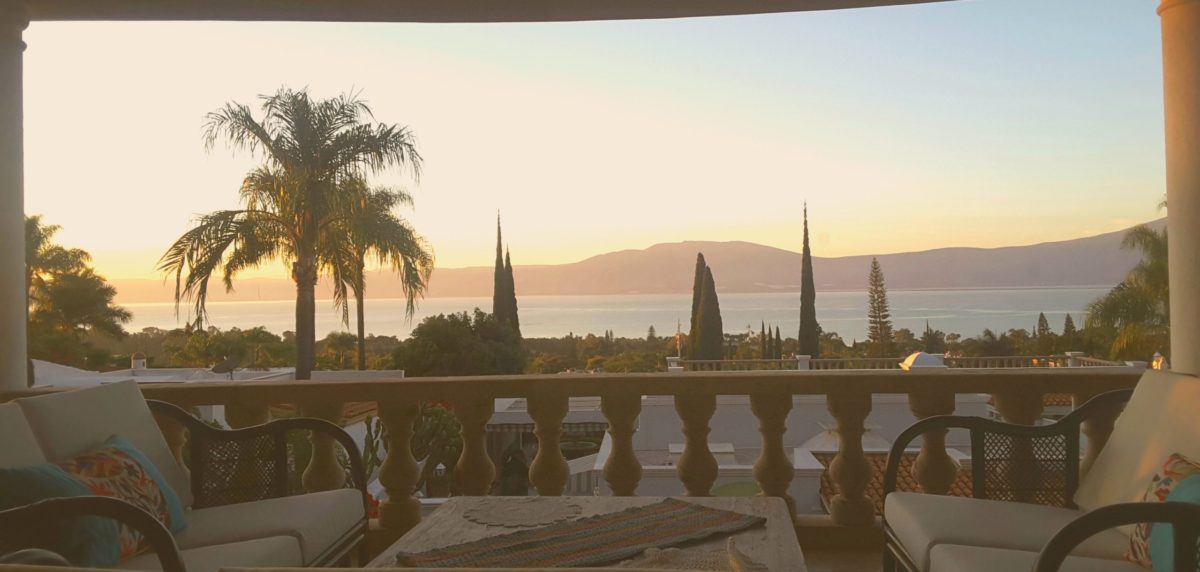
Views from the Lake

Friends kindly donated tickets to us for a cruise on Lake Chapala. The event was a fundraiser for a local dog ranch, but for us it was a unique opportunity to see lakeside from a different perspective.

Now with fewer words, more pictures!

The Batur, a three level floating fiesta
Storm clouds threatened as we departed the dock . . .
but cleared as we got further from shore. This shot looks toward the Racquet club.
The mountains are very brown here in the middle of the dry season.
By this point, we knew there would be no storm, but what about sunset?
Right on schedule; Anther picture perfect day lakeside!

Need to Know: The Coronavirus, or CoVid19

While sometimes tongue-in-cheek (better than sneezing-in-hand), here is a useful (I hope) compendium about the thing literally filling the air: CoVid19–with links to authoritative sites or solid opinions, as a figurative antidote to what I see and hear on social and mass media. 

Should I even care about CoVid19? Are you old or infirm (or especially a smoking man), then yes. Much like the flu, the virus seems to prey on those already at the edge of health. CoVid19 seems to be uniquely sexist, attacking and felling men far more often than women. I hope someone brings the appropriate lawsuit in the US Ninth District Court. If the virus gets into the US court system, it will never get back out. If you’re young or healthy, you should have the same view of coronavirus as you do of the seasonal flu: you don’t want it, you’ll be unhappy if you get it, and you’ll be angry at the friend who gave it to you. End of story.

Isn’t CoVid19 more contagious and more deadly than the flu? No one knows yet. See, the problem here is any analysis you see about lethality or contagion rates is based upon data from China. Data from China is similar in accuracy and precision to news from the National Enquirer: it’s not that it can’t be correct, just that even they don’t know if it is correct. China has a long history of doctoring data to fit the government’s line. Furthermore, there is the so-called denominator problem (sorry, I never promised there would be no math!). CoVid19 is not like a disease in the pandemic movies where people just drop dead (and are therefore easy to count) but rather the kind where eighty percent have a cough, a fever, and perhaps shortness of breath. Some will even be asymptomatic: infected with nothing to show for it! So the number of people infected may be far higher than even the Chinese can count–and they count in billions, remember–because millions of Chinese just thought they were a little hungover, or the smog was really bad last week, or whatever, and they never went to the hospital or were tested. Thus the denominator (the number below, in the fraction) may be far larger, which means the infection rate may be higher, but the death rate is probably lower than we think!

Right now the virus already looks more contagious than the seasonal flu. As I write, officials in Washington State are investigating whether it has been in their area for more than six weeks without being detected (or was mistaken for the flu). China originally estimated the mortality rate to be almost seven percent, which is many times more lethal than the flu. But, that estimate focused on the very sick, elderly folks who showed up at hospitals in Wuhan: later estimates have dropped (and will probably continue to do so) to below one percent (but still higher than the seasonal flu).

Should I buy/wear a mask? If you have chronic halitosis, or want to avoid putting on makeup, yes. Also, if you are already confirmed with a case of CoVid19, the little paper masks will keep you from literally coughing mucus on the healthy people around you. Otherwise, they are useless, as the virus can pass through them. The exception is for medical staff, who are trying to cut down on sick patients coughing on them, so leave the paper masks to the professionals! 

Now with respect to the N95 disposable masks: these run around US$30 each online and are good for eight hours. They can be reused if uncontaminated. They do filter out the coronavirus (and many other bad things). If you fall into the high risk groups and are really afraid, buy some and wear in public

What should I do to prepare if/when Covid19 becomes a pandemic? First, a technical definition: an epidemic is an increase in disease incidence beyond what is normally expected. A pandemic simply means a disease which has become epidemic in multiple countries/continents (hence global). It doesn’t mean the disease is especially deadly or even serious. When such a disease becomes part of the environment, in that it comes and goes all the time, it moves from epidemic/pandemic to endemic: you already know of one: the seasonal flu. So what do you do?

On the personal side, wash your hands frequently, cough into your elbow, and be alert for a fever. Stay away (literally, stand back) from anyone coughing/sneezing/etc. and minimize your exposure to crowds or public places. Do not follow information on social media, unless it links (like I do here) to sites like your State health agency, the CDC, or the WHO. A very good data site is available from Johns Hopkins. Others may simply be trying to get you upset!

On the societal side, sickness and quarantines can lead to a temporary breakdown in the global supply chain and/or services. Have a stockpile of one month’s supply of critical medicines (something you should probably always have as an expat!). Buy a week’s worth of non-perishable food items, a case or garrofon of bottled water, maybe an extra ration of eggs, rice or other things to fill out some meals. Don’t forget pet food! Any disruption is unlikely to last more than a few days to maybe two weeks, so there is no reason to go full “prepper.” You are just trying to make life a little less uncomfortable IF a supply problem arises.

As an expat, should I head back NOB? You should be wherever your most appropriate health care is. If you’re healthy and have confidence in your local doctor, stay. If you’re in one of the “at-risk” groups, you have to weigh the additional risk of public exposure in driving cross-country for days or flying (note: flying may not be as dangerous for infection as you may have been led to believe). Exposure is the key to infection, and when you are traveling, you are exposed (one way or another) to many more people.

What do I do if I get sick? Same as usual: check your symptoms, check with your doctor. The keys to CoVid19 are high fever, cough, and shortness of breath. If you have different symptoms, you probably have a different illness! If you get especially acute symptoms, or they persist, seek medical assistance immediately (sound familiar?).

Is my government prepared? In the US, Canada, and Mexico, yes. Contrary to some news reports, the US CDC budget was not cut (proposed cuts were not enacted). The sizable US federal bureaucracy which exists to identify and fight disease is just as robust and capable today as in the past. Some have made much of the elimination of the Ebola coordinator position on the US National Security Council staff: it was created to deal with Ebola and never intended to be permanent. This particular position was cut when John Bolton decided to reduce the NSC staff. This staff waxes and wanes in size under different administrations, and there is no right answer over how big it should be. People can have an honest disagreement about whether such a permanent position is needed, but it is hardly evidence of a lack of national preparedness.

Is there anything else to worry about? Coronaviruses don’t tend to mutate as much as flu viruses do. CoVid19 already seems to be good at spreading: viruses don’t necessarily become more lethal (except in the movies), because that means less spreading (if everybody dies, there is no one left to infect). As always, one major worry is people doing stupid things in overreacting: killing pets, attacking strangers, or not drinking Corona cerveza!

What is the most likely outcome? For healthy you, you might catch two (or more) bouts of flu-like illness this season. A disease blip which dominates the media and causes some minor disruptions (maybe the iPhone 12 comes out next January vice September: TEOTWAWKI!) and major hysteria for a time. Maybe your local supermarket will run out of some items, either due to hoarding or supply disruptions. Probably becomes endemic and joins the list of causes of the seasonal illnesses like the flu.

Oh, and don’t look at your 401(k) or stock portfolio. That may really make you sick.

The Ciclopista: A story of Mexico

The ciclopista, with different colors, green poles, and cars parked on it in Ajijic.

Lakeside is a world unto itself: a string of small Mexican towns with an equally large expat population. The villages lie along the north shore of Lake Chapala, and they are connected by a single road: the carretera or “main street” to those from NOB. This carretera is emblematic of small town Mexico: it is only two lanes wide with some parking as it runs through the village of Ajijic. Alongside most of the carretera there is also a paved strip called the ciclopista, or bike path. Except where it isn’t there.

West of Ajijic, where the ciclopista is either just an extension of the road or divided old-school by temporary concrete barriers

Locals use the path to bike to/from work, or to walk to catch the busses which run along the carretera. Expats walk their dogs on it, jog or stroll on it, and sometimes drive golf carts down it. Motorcyclists use it to pass on the right, when they aren’t just passing on the right six inches from your car door. People park their cars on it in front of businesses in town. Where it is wider, as in the shaded area in La Floresta, people in a hurry drive down it, passing the slow crawl of cars stuck in the single (legal) driving lane.

In their defense, before it WAS a parking lane

The local government got a grant from the State to refurbish and improve the ciclopista. Previously, there was a variety of things delineating the ciclopista: concrete barriers, simple poles with reflectors, some trash cans with signs, some speed-bumps to let you know you were crossing the lane divide. Yet these were mostly permissive, in that they told you not to–but didn’t actually stop you from–driving there (as confirmed by the legendary tapatios who got tired of waiting in line and zoomed down it!).

Of course, before the work began, there was little civic engagement: suddenly, work teams started tearing up the road under banners proclaiming a State-funded refurbishment. Workers broke up asphalt, laid pipes, dug trenches and generally made a hash out of the one road which connects the communities Rumors abounded: they were laying fibre-optic cable (no) or widening the carretera to four lanes (no).

Reminds one of Omaha beach, no?

Soon the refurbishment began to take shape: the pipes were electric lines for new streetlights (a welcome addition, if true). The lights would be positioned among large concrete barriers which vaguely resemble World War II anti-tank obstacles. Oh, and amidst the concrete, small indentations for (wait for it) . . . planters!

Nice barriers! and notice the small planters in the middle!

With predictable results:

Here we are, months into ciclopista reconstruction.

Maybe this will be a ramp someday. Maybe not. ¡Es México!

Traffic remains stalled, although quite manageable if considered in NOB terms. Barriers have been erected, removed, and replaced. The government decide to have a meeting with local businesses. The first session was postponed due to overly large attendance and much yelling. At the second session, the government decided to let people vent for awhile, then displayed a master plan which is still unreleased. At least there was a plan!

I have to imagine that someone is getting paid by the yard for concrete, as there is way more being poured than is needed. Sometime they pour it, set it, and tear it back out, all in the same week. In the end, we’ll have a brand-new reserved lane for bicycles, pedestrians, and the occasional gringo who will try to drive down it.

When the local government first extended the ciclopista through Ajijic by removing a parking lane, locals predicted doom and destruction. But as you see by the photos, people still parked on it, and businesses still survived. While a concrete barrier will cut down on that, there will be delivery spaces according to the government. And I have yet to see a concrete barrier at the ends of the cross streets, meaning drivers could still drive down the ciclopista and park on it, which in Mexico, means they will.

How will it all turn out? ¿Quien sabe? In Mexico, nothing seems to happen for ages, then suddenly everything changes. People adapt, normalcy returns, and the cycle resumes.

Going back to Ojo de Agua

You may recall my local rotary club, Chapala Sunrise Rotary, has an ongoing relationship with the village of Ojo de Agua to address their many needs. Much has happened over the past year, and the Rotary club went back out to Ojo de Agua to meet with the local government and people and take stock.

Affirming our past work with the locals in the village plaza

Over the past year, local and visiting (from NOB) Rotarians have regularly visited Ojo de Agua: to meet with the people and assess their needs, to plant fruit trees in yards, to tour and better understand the area, and to repaint the town plaza and refinish the roof of the gazebo. We did all these things with the active participation of the 300 or so people of Ojo de Agua, as well as our partners in Aipromades, a local multi-city health and environmental group.

Yet the big enchilada here is the need to replace the town’s water supply. Ojo de Agua means “spring” in español, and the town is unique in that while it lies on the shores of Lake Chapala, it has a natural spring which provides clean fresh water for the town. Or at least it did provide. Over the past five years, the spring has been producing less water over fewer months per year, leaving the townsfolk high and dry, dependent upon water trucks from the local government, buying garrafons from visiting vendors, or drinking coca cola. Coca cola, or coca as the locals call it, is the bane of Mexico, the drink of choice and a major contributor to obesity and childhood diabetes.

First the Chapala Sunrise Rotary Club helped the locals build a retention water tank near the village, hoping that storing water could help alleviate the occasional outages. Which it did, but it was clear the situation was deteriorating. At about the same time (a little over a year ago–yesterday in Mexico), the local government changed party control, and the new presidente (mayor) offered to work with the Rotarians for a more comprehensive solution.

That solution evolved into a full partnership: the Poncitlán government would drill a new well for the town, near the spring. Rotary would fund another retention tank and replace/extend the distribution pipe system. Aipromades coordinated with the villagers and provided clean water & health training. And the people of Ojo de Agua would agree to change habits and drink water.

The children preparing to demonstrate a lesson learned about clean hands; you can see the gazebo and freshly painted buildings in the background

Like any such effort, it all takes time. Poncitlan drilled a well and hit clean water, but the well hole didn’t hold up — it collapsed. So they are digging another well, better prepared to prevent another collapse. Rotary clubs from across the United States and Canada visited and sent monetary support: but we still haven’t secured the final approval and matching funds from Rotary International. As a federal bureaucrat of almost forty years, I have to say that the US federal bureaucracy has nothing on the Rotarians! Aipromades is completing the training for the vilagers, and the villagers are being patient (God bless ’em).

The architect, town delegado, and past rotary President (standing L to R) addressing the people

The locals were enthusiastic for the support. They are a marginalized community, geographically isolated from their local government and traditionally ignored. At the meeting, they implored the architect to have the only access, a dirt road, re-graded and a playground built: no sense holding back when el Hefe sends his rep to town! He made some phone calls, and promised to have the equipment on site soon, with the new well drilling to begin mañana (or next week).

All said, the kids had a great time demonstrating their knowledge of hand -washing and how germs spread, and the adults were satisfied our partnership continues to mature and progress. Patience is always a virtue; it’s also a necessity in Mexico and bureaucracy!

Doctors & Dentists

My wife and I bid a fond farewell to January, which saw us cooped up in the casa most of the month, not due to weather, but due to a variety of maladies. It started January 2nd, when I caught a very fast-spreading cold (sore throat, fever, lethargy) which put me down in bed for a week. Just a few days after I recovered, Judy encountered an ensalada contaminada–she literally “et something bad” as we used to say. Food poisoning lasted a good ten days and necessitated a few visits to the doctor/lab, some testing, and verged on a trip to the emergency room for treatment before she got better. And when she got better, I went in for a routine teeth cleaning. I mentioned some dental pain, and that led to two root canals and crowns. Here we sit in February, now returned to health. So what was it like, being sick and out in expat land?

For all the experiences, the costs were much less expensive, as I have noted before. For my over-the-counter (OTC) cold meds, we bought the same things we did in the States: Nyquil and Robitussin and the like, except generally at much less cost. If you’ve ever wondered why the same product is cheaper elsewhere, here’s the the secret. Most of the cost in any medicine is in the research: you need to recoup the cost of creating the medicine, and the cost of all the other medicines your company TRIED to make but didn’t work out. When you get to an approved, functioning medicine, generally the cost of production is low. So while you can set a profit margin of (let’s say) $5 USD on a medicine in the States, no one in a poorer nation will buy it at that markup. BUT, you can set a mark-up of 5 cents on it and sell it and still make money elsewhere. So that’s what they do. It works for all kinds of things beside medicine. As long as you cover your costs, you still make a profit.

Doctors are very approachable and easy to reach. Judy texted (WhatsApp) our doctor on Sunday evening when she had already been sick for three days without improvement. Our doctor responded quickly with a Monday noon appointment. She gave Judy a mild antibiotic and something to address the bowel symptoms (more on that later), but also a sample kit if we needed it later and promised a quick reaction if that didn’t do the trick. When it didn’t, she arranged (again, by text) another, stronger antibiotic. The doctor texted Judy daily to check on her improvement over the following days.

As I already knew, treatments really vary by nation. Here they try to go very light on the antibiotics (as our doctor did with Judy), but when it didn’t get quick improvement, the doctor went straight to ciprofloxacin, the nuclear option of antibiotics. While we use imodium in the States to battle diarrhea, our doctor suggested it was “too strong” and recommended Treda. Seems like Mexicans swear by it, and keep it handy when travelling. I had never heard of it. Turns out Treda is the brand name for a neomycin sulfate compound not used in the US (as far as I can tell). It’s an internal antiseptic used for bowel surgery, with a load of possible side effects. Yet it’s in every Mexican medicine cabinet. It worked for Judy, and was far less extreme than imodium.

In my limited experience, medical professionals here aren’t quite as used to explaining the why and how of what’s going on. I am used to a running dialogue about what they’re doing to me, what they expect to find, what they do find, and what it means. When I went for my teeth cleaning, the dentist told me my teeth looked excellent and she thought my mild tooth pain was probably due to a change in my bite causing two teeth to impact. She filed one down a touch and sent me on way way, with a reminder to come back if I felt any more pain. Two days later, the same teeth were more painful still, so I went back. A different dentist did a quick dental x-ray and told me that both teeth had serious decay under existing fillings. This tracked with what my American dentist had warned me, that someday those teeth, which he filled, would crack or decay and need more treatment, so I was prepared for it.

After some anesthetic, the dentist started drilling out the old fillings to see what she would find. As expected, one tooth probably needed a root canal, the other maybe just a crown. I scheduled a follow up for a day later with the endodontist, who worked on the better tooth but decided to do a root canal on it. He scheduled the other root canal for a week later. So I thought I would have two root canals and be done. But when I arrived in the morning the next week, I learned the endodontist had scheduled two afternoon sessions for crowns, too.

So three appointments in one day. But, at the end of the day, I had no tooth pain and two new crowned, root-canaled teeth. I wish they had been a little more communicative as they went along (all spoke perfect English), but the care and quality were still very good. Total cost for a cleaning, another visit to drill away the old fillings, then the two root canals and two crowns? $14000 MXP, or about $700 USD.

The technology still appears to me to be very advanced. The laboratory clinic sent us a detailed readout by e-mail within six hours. The dental x-rays were all the small hand-held kind with results on a display beside the chair, and saved to my records. The crown was 3D printed on site and installed the same day.

All things considered, pretty routine stuff, especially since we were out in expat land.

Outrage-Us!

Life is good. Very good, I would say. The global economy is sound, and the US economy is driving it forward again. In the States, unemployment is at record lows, even for disadvantaged groups who have usually not benefited from near-full employment. Inflation appears to be missing in action; economists are revising their economic theories to account for its absence. While there are numerous small wars, we have no big ones. While antibiotic-resistant strains of various bacterial infections are growing, we’re still a little ahead. Teenage pregnancy rates and alcohol use statistics are way down. Violent crime is at a sixty-year low.

Yet so many people I know are somewhere between deeply upset and very angry: and there is data to back that point too. US deaths of despair (including drug overdoses, suicides, and lifestyle-choice diseases like cirrhosis) have increased to a rate unseen since the 19th century! Almost sixty-four percent of respondents are dissatisfied with the way things are going in the States. What gives?

A major part of the explanation lies in the marketing power of outrage. Politicians, businesses, entertainers, athletes, activists, online influencers, and especially the media have discovered that exaggerating or hyping has few drawbacks and significant monetary rewards. Taking things to the extreme, whether in what gets covered or how it is described, results in more interest, more feedback, and more revenue.

This “Outrage-Us” approach is bipartisan and apolitical. If you try to isolate when it began, I guarantee you I can find an earlier incidence from the opposite faction (political, religious, or polemic). It occurs in major policy issues (immigration, opioids, war, racism) and in minor topics (weather effects, cultural issues).

How does it work? Always begin with some kernel of the truth: don’t simply make things up out of whole cloth, as that is too easy to refute. Someone in the country illegally commits a crime, and this becomes an “invasion” where ‘they’re sending us rapists.’ Push out statistics which favor one view without acknowledging other statistics or interpretations. Exaggerate policies by using inflammatory language without considering the full details of the issue. Play to a predictable point of view: the one your readers/listeners/friends are likely to enjoy. There are few rules other than never apologize, never explain, always rebut and in a LARGER VOICE.

Who does it? Nearly all politicians and activists, but even most forms of media, including social media. Watch how often “breaking news” interrupts the broadcast or streams across your screen. Watch for the word bombshell in coverage of any topic: more dud bombshells have “exploded” during the Trump administration than during World War II. Some media forms do it with their opinion sections, others even with with their news sections, but all do it.

Why do they do it? How likely are you to read an article entitled “Border agencies face unexpected challenge of child immigrants” versus “Trump puts kids in cages”? Think I’m kidding? Check out the New York Times subscription numbers before and during the Trump Administration. Cable news stations like MSNBC were literally dying prior to the Trump candidacy. And lest you forget, Fox News was born as a conservative alternative during the Clinton presidency, and rode the Obama administration to the top of the cable news marketplace. Outrage works.

It works in small, apolitical ways, too. Ever wonder why there is so much weather coverage on the local news? Because (1) it is cheap and easy to cover, (2) it is usually non-controversial, and (3) it is easy to hype. If the weather is not as extreme as predicted, no one will call you on it, because, well, we dodged a bullet, and that’s just the weather! Wonder why they cover windchill and heat indices today rather than actual temperatures as in the past? The latter drive the readings more to the extreme!

You see the “Outrage-Us” approach in stories about gun violence, hate crimes, infectious diseases and natural disasters. You find it is almost any story about social security, military spending, or marijuana use/”treatments”.

None of this is to claim there aren’t serious problems out there. Remember, “Outrage-Us” stories must start with a kernel of truth, but they go to extremes to get you to look and then get excited.

  • The coronavirus bears watching in case it mutates in a bad way. If you’re really interested, Johns Hopkins has a site tracking the spread in real time. But while this coronavirus is novel, coronaviruses have always been with us; they are one cause of the common cold. Remember MERS? SARS? They were both coronaviruses. MERS had a 33% fatality rate, while SARS was under 10%. Today’s novel coronavirus is running around 2%. Remember Swine flu? Bird flu? Zika? Dengue fever? Living in the tropics where it is endemic, Dengue is a personal favorite. Dengue fever is very real, but did you know that 80% of those who contract it have either no symptoms or a mild fever? Hardly as exciting as the “breakbone fever” covered by the media but experienced by only a tiny percentage of cases.
  • It’s more exciting to cover a poll on how bad US race relations are than report that interracial marriage rates are up almost fifty percent to all-time highs.
  • Seems like natural disasters are becoming more frequent? Nope. More expensive, yes, as we continue to develop areas that we know are vulnerable. (Beachfront property in Florida? California tree-lined canyon views? Anywhere in New Orleans?)

So be careful out there. On top of all the other groups trying to get you excited, there are armies of Russian trolls and bots specifically trying to set one group of Americans against another . . . and millions of Americans getting outraged and circulating the nonsense! Ever see an inflammatory post and find it’s years old: that is often the work of bots which recycle old news to new effect. Real problems deserve careful thought, not knee-jerk reactions or online emoticons. But that requires effort instead of raw emotion.

The only way to end this post is with a choice of dance-off music video. For those still angry, try on Nirvana’s ode to teen angst; for everyone else, a little Bobby McFerrin.

Challenge: New Year, New You

As I mentioned before, I am not a big fan of New Year’s resolutions. It seems silly to plan major changes or make big commitments based on the arbitrary turn of a calendar page. If you weren’t already committed to doing something new or stopping something old, why should the change of the last two numbers on the date make any difference? And my skepticism comes supported by the long line of “how I failed at my New Year’s resolutions” journalism.

Here’s another take on the concept: a challenge for everyone. If you like it, please share it with your friends.

David Brooks, the New York Times columnist, often comments on the lack of civility in our public discourse. He recently had a column with the title “Trump has made us all stupid.” Before my conservative friends go apoplectic: yes, he did (as always) criticize the President, but the point of his commentary was to criticize the President’s critics, who now seem to believe that they can say any wrong, ridiculous, or vulgar thing they want, because . . . President Trump.

I usually blog about once a year on being more civil, because I believe with all my soul that–first–civility is lacking, and–second–there is no excuse for lacking civility. No “but-racist” excuse, no “but-illegal” excuse, no “but-Nazi” excuse, no “but-hater” excuse. Have ever seen a police officer calmy apprehending a crazed drunk, who is spitting and swearing and swinging with abandon, while the officer gets the hands-behind-the-back-and-into-cuffs and puts the offender into the back seat of the patrol car? It’s exponentially more common than the videos of police brutality, and it is a portrait of civility in the most extreme case.

Unfortunately, many folks don’t recognize their incivility. It happens on social media, or in a crowd, and they feel anonymous or empowered, or just sooooo right, but hardly uncivil. Pleas for greater civility fall on deaf ears, because surely you don’t mean me?

Here’s the challenge: identify your social medium of choice, the one where you spend the most time. Pull up your active history: not what you read, but just what you post/share/comment/tweet. Review the last hundred or so entries (or the last year if less than one hundred). Now consider:

  • If the exercise took you more than fifteen minutes, you have too much material on social media. It’s not real, people. Spend more time with the real people in your life, and less with fake internet friends.
  • If many of your entries are on a single topic (hmmmm, let’s say “Trump”) you are dangerously close to being “that guy.” You know, the tedious bore who brings every discussion ’round to their obsession. Don’t be him, even on social media.
  • Use vulgarity much, even in abbreviations, leetspeak, or symbol shorthand (i.e., sh*t)? Lovely, it so strengthens your argument that the other side is, well, vulgar, right?
  • In one hundred entries, ever admit to an error or make a correction? You mean in all those posts, you hit for 100% accuracy? Wow!
  • How often did you concede a point to an opponent, or yield to an argument? Most of the time, both sides have some good points; did you miss them? Why? If you NEVER ran into a superior argument from the opposing side: you need some new friends, as you’re comfortably inside your echo chamber.

I did this challenge for myself. What did I learn?

I have an unhealthy obsession with Notre Dame football, and if you want to goad me into a nasty comment, just tell me (1) it’s all good, (2) I have unrealistic expectations, or (3) it isn’t 1988 anymore. Grrrrrrrr. I will work on that, right after they dump their (adjective deleted) coach.

I can ignore exaggerations, political spin, or even incredulous comments if they have no significance. I find it hard to let blatant errors or outright falsehoods go if they are used to inflame other’s opinions. These offend my sense of righteousness, so I spend some serious time correcting the internet, which is futile if momentarily satisfying.

I post and respond a little too often on political topics, but thirty years in DC will give one some insight and a little too much interest in the political realm.

I have about equal numbers of conservative and liberal/progressive “friends,” so I see a fair number of extreme views from both sides, although my friends à gauche are far more inflamed and likely to post something extreme. I would bet the opposite would have been true in the last administration, but that was before I joined social media.

I have had to correct myself a few times, generally when I respond too quickly without doing the necessary research, a lesson always worth remembering. No profanity, although I know there were a few in the first draft of my comments!

I generally spend about 30 minutes in the morning and another 30 minutes before dinner on social media. That means I miss a lot depending on the site’s algorithms; I recently almost missed a friend’s gofundme campaign for health care because my “feed” didn’t feed me! I spend about an equal amount of time (one hour) researching topics, because (1) I’m skeptical of most things I see posted, (2) I’m curious about the why-things-happen more than the what-happened, and (3) there is so much good information out there, if you look.

General lessons learned:

  • More reading (as in researching), less posting.
  • Stay gentle, even with the harshest comments.
  • People of goodwill can disagree on just about anything, but that doesn’t make one side evil.
  • The other side doesn’t know they wear the black hats.
  • If you’re going to rant, post RANT COMING before and END OF RANT, PLEASE DISREGARD after. Allies may enjoy your catharsis, and your opponents will know not to take it seriously
  • Civility is a virtuous cycle; the more you produce,the more others will produce. Incivility is a vicious cycle; your hate spurs even more hate. There are no exceptions!

Discounts

Mexico may be the land of discounts. Prices here almost always seem negotiable, for those who wish to do so. It even applies to things one normally would consider fixed, like taxes, and fines and the like. I don’t suggest you actually try to bargain with the government, or the policia, but prices do vary!

In Mexico, anyone who owns a property must pay an annual property tax, called the predial. The tax is very small to begin with, something between .1 and .01% of the property value, but there is a discount of 20% if you pay in January. I imagine the local governments like to get their hands on the income as soon as possible, even if it costs them a little in the process!

The same goes for “radared” speeding tickets. Mexico relies on a combination of radar speed traps and topes to control traffic speed and raise revenue. There is a helpful website from the Jalisco state government where you can check whether you have any speeding tickets. Better yet, if you pay them within ten working days, you get a 50% discount, and even 25% discount if paid in less than thirty days.

Your Mexican-plated car requires an annual registration, but you get a 10% discount (again) if paid if January, 5% in February or March.

Turn sixty years old and a world of discounts beckons. You are eligible for an identification card from the Instituto Nacional para las Personas Adultas Mayores, or INAPAM. It entitles Seniors to a 50% discount on buses, discounts on museums, movies, medicines, hotels, and even airlines. Yes, I will be applying for mine this year!

Showing the Mexican sense of humor, last year AeroMexico (slogan: “You HAVE to have a sense of humor to fly us!”) trolled the Estados Unidos with an ad featuring alleged DNA discounts to Americans with Mexican roots.

It’s just an ad, folks. Actually, America’s first destination IS Mexico!

Mexico has many student discounts, like anywhere else. And happy hours. And Buen Fin, a shopping holiday modelled on Black Friday. And of course, in the land of tianguis, the price on the tag is just a starting point for any small business.

¡Descuentas para todos!

Christmas Musings

Odds & ends and photos from Christmas in the Year of Our Lord, 2019:

Ever hear the one about Christmas being a basically pagan holiday that the Church appropriated to quiet wild pagan revelries? It is so common you’ll hear otherwise intelligent people repeat it. It’s bunk. First, the solstice is the 20th/21st, never the 25th of December. Saturnalia, a Roman feast, ended on the 23rd. The Roman emperor Aurelian did inaugurate a feast of Sol Invictus (“The Conquering Sun”) in 274 AD, but Christians were already celebrating Christmas by that time. The other celebrations are only coincidences in time.

Living Nativity scene locally: Mary is about right, but Joseph needs about 20+ years

But what about Christmas trees, didn’t the pagans bring freshly cut trees into their homes in the winter? True! However, the whole Christmas tree thing comes from 17th century Germany (some claim from Martin Luther) and was a very late Christian addition. Probably a borrow, that.

Saint Nicolas, Papal Noel, Santa Claus: didn’t the pagans have magical figures who sometimes delivered gifts (or tricks) to children. True again, but there was also a real Saint Nicolas back in the third century AD. And the jolly old elf Americans know comes from . . . the publication of the poem “A visit from Saint Nicolas” in the early 1800s. You know it by heart: “Twas the night before Christmas, . . .” and it gave us a fat jolly Santa, magical reindeer, and chimney deliveries. Again, hardly a case for Christmas derivative of pagan practices.

Real Baby Jesus here, but Joseph on a cell phone?

Some claim the Bible does not tell us much about the date of the birth of Jesus Christ. There are clues throughout the Gospels, from the census of Caesar Augustus, the reign of Herod, etc. Some theologians spent their entire lives trying to discern clues like “when would pious Jews travel?” “when were the shepherds keeping watch in their fields?” or “what celestial events align with the star the wise men followed?” It ends up with a variety of possible days and even years. Early Christians were unconcerned: so much else that Jesus did was critically important; when he was born, not so much.

I was happy to see several commentaries this year on the meaning of Christmas, decrying commercialism, pettiness, discrimination and other vices of the human condition. Still, these writers too missed the meaning of Christmas. “It is better to give than to receive” is a beautiful thought, but not the meaning of Christmas. So too “treat others as you would be treated” and “remember the less fortunate” and even “love one another.”

The winner, imo: Three Kings already visiting!

The meaning of Christmas is so simple, it can be stated in a single Word: Incarnation. That God became man and dwelt among us, a revolutionary notion unprecedented in human beliefs before or since. He didn’t appear as a man, didn’t possess a body, wasn’t a spirit masquerading as a man, but was like all of us in all things except sin . . . and still God. That voluntary movement, from eternal and on-high to lowly, ephemeral, mortal? That is love. And He did this for all.

Christmas portends much more. It unlocks the door, setting the stage for the possibility of redemption. Easter will (of course) show just how far Divine love will go–even unto death, death on a cross–and throw open the gate wide. For now, we may revel in the possibility, the hope.

Our Church after Christmas day Mass: if I had done a video, it would have needed one of those BBC-style “this video contains flashing lights” warnings!

When you hear the phrase “Merry Christmas,” remember it is salutary greeting: not a challenge, not a conversion, just a sharing of joy. If you feel that joy, respond in kind; if not, simply say thanks.

¡Feliz Navidad!

Pleiku, part two

I have a confession to make. I spent thirty years in DC. That makes me a swamp creature. I was part of the deep-state back when we just called it the bureaucracy; deep-state sounds so much sexier, no? Let me re-engage my deep-state, lizard brain and try to explain what’s going on.

Better tunes this time, yes?

The intersection between high-minded idealism and cynical political calculation exists at the power of position. You can have all the right ideas and best policies and accomplish nothing if you lack the power of office and majority. Likewise, the one who wins can implement even the most hare-brained schemes. You would like to think that the best ideas always win, but we know this is not the case.

Why would Speaker Pelosi change her mind on impeachment? Remember, she and Senator Mitch McConnell are among the most successful Congressional leaders in American history. People hate them for their ruthless pursuit of their respective agendas. What is she up to?

  • First, impeachment rallies the Democratic base, especially in the suburban districts which went from purple to blue in 2018. It might imperil some of the new members in districts which voted for Trump in 2016 but elected a Democrat in 2018; she left those members an out by allowing them to vote their consciences, but their fate is probably sealed. I believe she has read the tea-leaves, done the math, and thinks she has secured the Democrats a majority in the House after 2020. Think I’m wrong? Have you noticed all the red state, safe-seat Republicans in the House who are retiring (twenty at last count)? They don’t intend to sit around for another two years as powerless ranking members.
  • Second, impeachment plays for time and moves the spotlight off the party’s Presidential nomination. Yes, it does pull several Senators off the campaign circuit, but it also gives them a chance to shine during the Senate trial. Meanwhile, the party may be able to pare down the list and start to get behind a nominee. While Speaker Pelosi would prefer a Democratic President, arranging for one is not her job, so if impeachment retains the House majority but loses the Presidency . . . “Oh, well!” as my lovely wife likes to say!
  • Third, it lays a trap. The President will trumpet (sorry, couldn’t resist) his exoneration in the Senate, but the obstruction claim will only be considered by the Supreme Court between March and June next year. If they hold (as they did for Nixon and Clinton) that the President must release information, his refusal would come just before the election, and even if he won re-election, it would set the stage for another impeachment!
  • Finally, it pacifies the progressive Democratic members who have bridled at the Speaker’s reticence to impeach, and willingness to work (e.g., USMCA, appropriations, Space force) with the President. No Speaker wants a loud caucus constantly tweeting against her. She can tell them to sit down and relax–and if it doesn’t work, she can (figuratively) purge them as the cause of the disaster.

I will bet the Speaker has a few more political reasons up her sleeve: I have only a half-lizard brain, and she is a political genius. If you want to believe this is all about military aid to Ukraine, God bless you. I missed where all that fervor was when the Russians were actually invading Ukraine, and all we sent was non-lethal support. This was politics (first Trump, then the Democrats), pure and simple.

Why did the Democrats focus on impeachment? From the election night when the nightmare began, many Democrats could not stand the notion of another moment of a Trump presidency. That is why they started from the conclusion (getting him out of office) and looked for justifications. Remember the discussion of the 25th amendment (removing the President for incapacity)? Much the same thing.

What should they have done? Before I answer that question, I want to remind all my friends that I believe that President Trump should have resigned long ago, when he realized he was not suited to this peculiar job. Yes, he won the position, but it’s not El Jefe, it’s more the persuader-in-chief. He should have said this isn’t right for me (he probably would have said “it’s not good enough for me”) and moved on. As a businessman, he certainly knows that not every leader is right for every situation. But he didn’t.

So-o -o -o -o ? The Democrats should have made it clear his mafia-esque phone conversation with President Zelensky was beyond the pale. They should have censured him, a symbolic punishment which only Andrew Jackson received. Don’t knock this as only symbolic: this impeachment will end up being only symbolic. They should have passed a bill defining –using the President’s own language in the phone transcript–this type of activity as a “high crime or misdemeanor” as used in the Constitution, thereby notifying him (and his successors) that any repeat of such activity would result in impeachment. Imagine the latter scenario: forcing Congressional Republicans in the House and Senate to either support the Bill or explain why this behavior is ok with them! It’s one thing to vote against impeachment or conviction; it’s another thing altogether to vote defending unethical behavior in general. Imagine President Trump with that Bill on his desk, forced to either swallow his ego and sign it or veto it and face being overturned.

The Democrats lacked imagination, because they remain obsessed with a single thing: removing the President. It is not a condition unique to them: the Republicans did the same thing with President Clinton. For all the evil that Richard Nixon did, he had real respect for the office, and his resignation–short of impeachment–was laudatory even if forced. He did the right thing in the end. If Bill Clinton had a shred of human decency, he would have resigned when his affair with an intern became public. If he had any respect for the office, he would have resigned before lying under oath. If his Republican opponents had any imagination, they would have censured him and passed a Bill defining the reception of oral sex from an intern in the Oval Office as behavior so disgusting it qualifies as “high crimes and misdemeanors.”

After all, that is what Congress does: it makes laws. Imagine Congressional Democrats defending that one; picture President Clinton facing the same Hobson’s choice.

But no, here we are. The streetcar is pulling up to the station. The outcome is predetermined and will satisfy no one. We have set several terrible precedents: looking for reasons justifying impeachment, impeaching before the relevant court cases are completed, and simply making impeachment a more routine thing. Based on recent political history, I guarantee the next Republican-majority House under a Democratic presidency will be a real circus. Meanwhile, the morning news brings word that the House may simply hold on to the Bill of Impeachment and not forward it to the Senate. I wonder how many additional weeks of coverage they can get out of that move?

The Progressives’ singular focus on President Trump is misguided, if only because he is a symptom, not the problem. Impeachment, even if it succeeded in removing the President, would not resolve the issue. There is a political realignment going on in the Western world, and until it shakes out, there will be little tranquility. But that is a topic for another post, another day.

Some have complained that President Trump thinks he’s a king. Remember Emerson’s quote: “When you strike at a King, you must kill him.”