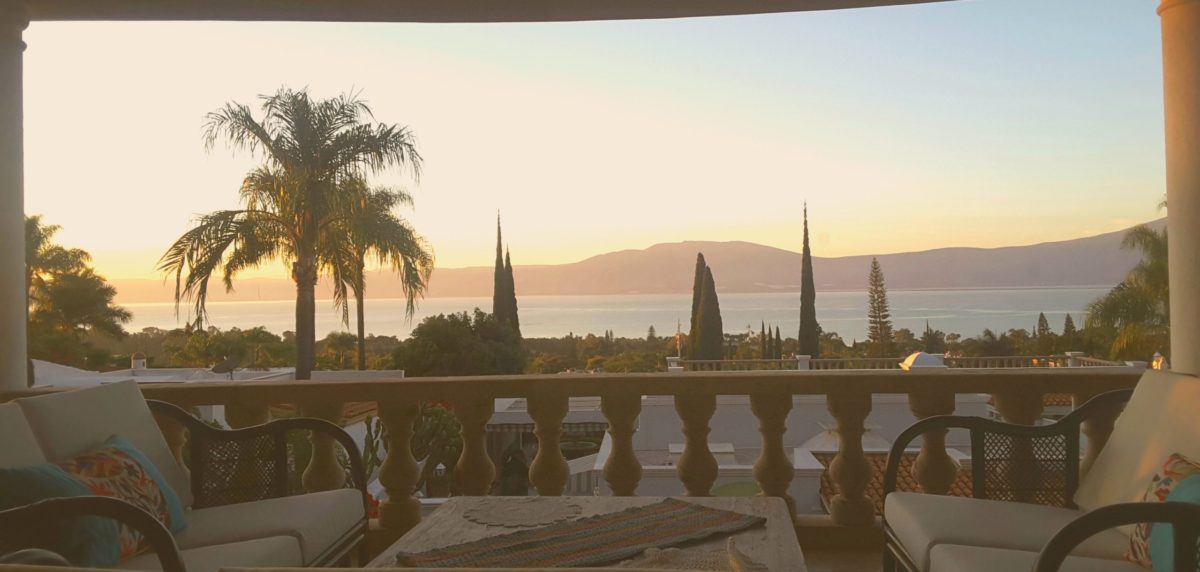
One challenge every expat faces is “what to do about the local language?” Do you just ignore it, speak English very loudly, and hope for the best? Do you learn a few phrases, so you can ask for another beer, or where the restrooms are, and just get by? Do you rely on Google translate and hope we get the Universal Translator before you croak? Do you just keep trying through experience and osmosis to pick up the language? Do you go online and try the free or pay language training sites? Do you take language classes in person?
We always assumed we would learn Spanish, just to be comfortable in our new home. We both have foreign languages in our past: I spoke German and some French; Judy also spoke German and had four years of high school Spanish. We thought we would find some immersion training in Guadalajara, since it has a major university and is known for immersive language training. However, most of the immersion training is aimed at college students, and we weren’t interested in moving into a dorm for six weeks (imagine that!).
We found many great language aids online. YouTube is full of decent instructional videos. We weren’t partial to Rosetta Stone, but we did like Synergy Spanish and look forward to following Destinos when we learn a little more vocabulary. We really like free apps like Memrise or sites like Spanishdict.com, which can really help with practice or training aids. Judy has done a great job putting new vocabulary words on flashcards on Quizlet.
In the end, we needed more structure: we learned many phrases and short questions/answers, but we weren’t learning the language. So we decided to try a local language school, Olé México. We meet three times a week, for 1 hour and 45 minutes each class. Our class is just four students and one teacher, so we get ample opportunity to practice speaking.
Class, L-R: Judy, Nadia, Darcy, Penny
We started with the alphabet and pronunciation drills, and then began conjugating regular verbs. We keep adding vocabulary by learning sets of words, like directions, or adjective pairs (strong/weak, short/tall), or noun groups (Mom, Dad, Son, Daughter, Family). We just tackled the ever-difficult “when to use Ser versus Estar” lesson. For those who don’t know, Spanish has two different versions of the English verb “to be”, and they are used for different qualities of “being.” Ser is for essential characteristics, and estar is for more transitory characteristics, mas o menos.
I always heard from language teachers that Spanish was the easiest foreign language for English-speakers to learn, because many words translate almost directly (like anything ending in -ion), and in Spanish the vowels and consonants have only one sound and you sound them all out.
Our teacher, Nadia, has done a great job. We enjoy lessons where she asks us to describe our favorite actor or singer, and the class has to guess who it is. We just finished describing our extended families. Or sometimes she asks us a basic question like “where were you born?” and then asks us to describe the differences between that place and where we live now. It is a lot of oral practice, but we can already see a difference in our language capabilities. We can hold basic conversations with merchants, exchange pleasantries with people we meet, and at least make ourselves understood, even if we don’t always know the correct terms.
Perhaps I will try out a dual language post in the not too distant future!
I thought about titling this post “leaks and dirty leakers who leak them” (apologies to Al Franken) but then I realized some might mistake the topic for something which goes on far too often in Washington, DC, and that’s not the case at all. No, today I am covering the neverending story which often accompanies life in the tropics: leaks during the rainy season.
Most people know that a tropical deluge can represent several inches of rain in a single day, followed by more of the same the next day in the rainy season. We’ve had several nights of rain in a row recently. We have a mostly flat roof, with a gently sloping surface that feeds run-off spouts which let the water fall directly next to the house; since we have no basement, there is no need to worry about flooding a lower level. The roof is treated with a water-proofing cover that resembles asphalt paper, and the more decorative sections (like the cupolas) have a painted stucco exterior over a waterproof fiberglass material covering the brickwork.
Over the course of time, that constant flow of water wears down the waterproofing, and cracks form, letting water into the house. This is not the major crisis it would be north of the border. The interior is brick and stucco, the floors tile; there is no wood, baseboard, or wallboard to absorb moisture, be ruined, and require replacing. So the key is to sop up the rain and get the crack sealed; too many leaks in the row are nature’s way of telling you to reseal the whole roof.
So I am sitting at the table, surfing the web one morning, and I hear the pleasant hum of rain outside. But in among the rain-sounds is an occasional “thump.” It sounds closer, and not at all natural. Unless you consider the sound of water dripping from your ceiling onto a custom-made Spanish leather storage chest “natural.” Yes, we had a small leak above the windows in our cupola, which was dripping on the furniture. It was in such an out of the way place, we even developed some mildew,
Arghhhh! Get the bleach!
since we did not discover the leak until several rainy days in a row generated enough moisture for it to leak down into the ceiling and fall. We called Jorgé the repair guy, who dutifully patched the cracks and resealed the cracked areas of the cupola.
New sealant around the cupola…and on the corners of the boveda ceiling
Several more days of rain revealed more cracks, and more repairs. Now we have been two rainy days without leaks, so perhaps we are done. We’ll re-evaluate whether to replace the entire sealant on the roof when the rainy season ends.
Looks like the neighbors are repairing, too
If you have ever had a serious roof leak, or worse yet water in your basement, you know what a drill it can be. Leaks are a fact of life here, but more of an inconvenience than a major deal.
I continue to experiment with this medium. I trust the photos I include are getting better, or at least they are all now “right side up!” Now I am tackling video. I apologize up front for the resolution: while I could take the video in HD, getting it uploaded to the cloud and then onto this site was impossible. I filmed it in HD and then retrofit it to a lower resolution to make it fit, but I think it is still pretty viewable.
For those considering visiting, consider this a preview. For those who aren’t, see what you’re missing!
When my dear wife and I travel, we often play a game where we look at some small, out of the way hamlet and ask “where do they get their groceries?” Sometimes the answer is just around a corner, where we pass a general store, but often there is no obvious answer.
SuperLake: Gringo favorite
Here in Mexpat land, there are several obvious answers. First off, we have mega-chains like Costco and Sam’s in Guadalajara. We also have traditional supermarkets, including a Walmart here in Ajijic and a Soriana next door in Chapala, and another called Mega near Guadalajara. All of this retail infrastructure would be very familiar to any visitor from NOB. While prices at these retailers are good, they are not the budget-friendly option in Mexico. Places like SuperLake stock the usual local foodstuffs but also exotic imports–at a mark-up–for the expat crowd.
Mr. Bull sells beef, natch
Next there are the small specialty stores: the butchers, the bakers, the tortilla-makers. These are generally small shops run by families and marketing a very specific product. Again, not unlike the American market 50 years ago, but here the small retailers were never run out of business like they were so often in the States. Today in the States, these small shops are usually high-end or boutique retailers, while in Mexico they are budget-friendly providers.
The Coffee Guy, Francisco…and the elusive Dairy Guy
One variation on the specialty shop is also one of the more unique retail operations in Mexico: the “guy-with-the-truck.” We can track the Dairy Guy, have heard rumors about the Beef Guy and the Fish Guy, and we absolutely rely on the Coffee Guy. These entrepreneurs load up their specialty wares and stop at specific locations on specific days, where you can walk up to their trucks and purchase your food. Somewhat like the food truck movement NOB, but for the raw ingredients, not finished meals.
Up casa, down tienda
Another retail form are abarrotes, literally grocers. These are mini-general stores, usually run out of the first floor of the home or even a room in the family’s casa, and they stock the usual suspects: things in constant demand by locals at very low prices. They are ubiquitous.
Finally, the most important retail operation in any village or town is the tianguis, or market. Usually set for a given day and deconflicted with neighboring towns (so if you miss your tianguis, you can take the bus down the road and visit the next village’s tomorrow), tianguis are a melange of fresh fruits and vegetables, snacks, toys, electronica, carry-out meals, pets, you name it. The tianguis is as much a social event as a shopping trip.
Tianguis street, normal day…Tianguis street, market day
The tianguis is a cross between a farmer’s market and a county fair. It sprouts up once a week, transforming the street in the process. Wonder how the stalls get the power to run their cooking or entertainment devices? If you enlarge my photos, you’ll see an multiplug stuck into an extension cord leading up the stone wall. Somebody climbs a pole and hacks into the overhead electrical wiring!
Need a freshly made breakfast?How about a jug-o-drink?How about some just finished art with your fresh coconut water?
We took a guided tour around our lake with Charter Club Tours, starting from Ajijic and going clockwise. I’ll let the pictures do the talking:
Chapala’s historic train station, which means no mas trainsMezcala island, site of battle in 1812One lane road into San Pedro Itzican…High above the town
Many Mexican towns have an ancient name (Itzican) with a Christian name attached (San Pedro).
We don’t need no stinkin’ guardrail!The eagle/snake/cactus melange, symbol of Mexico, andStained glass ceiling in Ocotlan city building
Painting of the earthquake of 1846, andthe miraculous sighting of the Christ crucified on the next day, which
led Ocotlan to build a new church. Note the the hedge spelling PRODIGO or miracleJamay likes Pope Pius IX, so they put this monument to him in their square
Most Mexican towns have a square that remains the center of town life. The squares were clean and full of people going about their business.
Why did the goats cross the road?To get to the birrieria, of course (don’t ask)
Lunch with our guide/driver, Hernan, and Chris and Fran, tour friends. Judy had birria for lunchMurals of the tianguis in La Morena house,in La Barca. The bladders are full of Pulque, a fermented drink similar to Mezcal or Tequila
Lakefront in Petatan: thousands of Pelicans overwinter here, but now those snowbirds have flownView of home, from across the lake. Our place is just below the small hill with a barren spot, lower right quadrant. Note how close the mountains are to the lake.Jocotepec lakefront, andview of the town
Here in the mile-high-desert-plain-beside-the-lake, we have a dry season (November-May) and a rainy season (June-October). While we are in the tropics, we don’t have a proper monsoon, just regular weather patterns with fronts that bring consistent rains. Many rain storms happen in the early evening, as the storms blow north across the lake and attempt to scale the mountains which hug the north shore communities. For you weather geeks, it is called orographic precipitation, and it happens often enough here to be local legend.
So for expats around Lake Chapala, May and the dry weeks in June are the most uncomfortable. It is desert-dry, and the sun can easily cook up 90 degrees. Many year-round expats plan their “vacations” or visits back NOB during this time. We had visited lakeside during this period, but coming from DC and only being here for a week or two, the dry heat seemed a relief in comparison. This time, we were here for the whole hot, dry mess. As Don Henley put it, “stuck here in limbo, tryin’ to say sane, ‘tween the end of the summer, and the coming of the blessed rain.”
On a clear day…mountains everywhere
We have neither air conditioning nor heating; they just don’t build many houses here with either. We arrived in February and brought along a bed-size heating pad, but we never used it: not cold enough. The hot/dry time got to us, mainly because it was so relentless. You could not escape the sun/heat during the day, although it did cool down at night. We eventually succumbed and bought a swamp cooler, a fascinating device which looks like a portable air conditioner but is just a water tank, a pump, and a fan. The pump pushes the water from the tank in front of the fan, where it evaporates, cooling the air which blows out of the unit. The air is not cold, just cooler. The unit is effectively a “humidifier” since it works exactly opposite those de-humidifiers some of you may have NOB. Swamp coolers have long been used in very dry areas; where the humidity is already high, they do not work.
Over the course of the dry season, the mountains get progressively browner, dust builds up, and it gets hotter… “yeah, but it’s a dry heat.” The lake level begins to fall as more of it evaporates in the very dry conditions. Sometime in May, you start to hear the shrill cry of the rainbirds, which are not birds, and have nothing to do with the rain. Rainbirds are incredibly loud insects (cicadas, I believe) which emerge at the end of the dry season and set out making a racket. They are loudest initially up on the mountains, but by the beginning of June you can hear them singing nearly everywhere during the day.
Adding to the sun, arid heat, ebbing shoreline, and the rainbirds, May is when local farmers start burning their fields to prepare the soil before planting once the rains hit. I use the terms “farmers” and “fields” advisedly, because they cover a gamut of situations from large, industrial berry fruit operations to locals planting in their backyards to ejidos planting corn and pasturing cattle on the mountainsides.You can smell a faint hint of smoke anywhere, and sometimes see the fires burning in the mountains at night. Lucky us, this year was also a record-setter for fires in the nearby Jalisco forests.
Look closely, there is a mountain missing in the distance
Just about the time you start to think that 10 and 1/2 months of perfect weather are not good enough to make up for all this, one afternoon you spy thick, ominous clouds coming over the far side of the lake. They seem to rush across in the afternoon, and then stall at the foot of the near-side mountains, like tired runners with a final hill to climb before the finish line. As they slowly climb they get darker, and begin to rumble and crackle. The deluge begins, all is forgiven. Happy Rainy Season!
Everyone had a good laugh when President Trump suddenly announced that “no one knew how difficult health care was going to be” but it may be (unintentionally) the most truthful thing he ever said. Obamacare was a partial solution that reduced the rolls of the uninsured by raising the numbers in Medicaid, creating state exchanges for some, and requiring health insurance for young, healthy individuals who did not want it (or “taxing” them, per the Supreme Court). The Republican’s AHCA is so full of holes in barely merits consideration.
The problems of Obamacare are obvious. Greatly increasing the number of people on Medicaid without increasing the number of doctors accepting Medicaid reimbursement meant theoretical health care, if at all, for many of the poor and sick. State exchanges turned out to be successful as long as federal reinsurance for providers and federal subsidies for consumers were guaranteed to continue to increase indefinitely. And counting young, healthy people as “insured” with a product they never wanted is a unique approach to accounting. So if all this was pretty predictable, why did the Obama administration try it? Why didn’t they go for a single payer option? Federalize healthcare? And why are the Republicans so unprepared to replace Obamacare, if they knew it wouldn’t work and had seven years to prepare to replace it?
“Facts are stubborn things,” as John Adams once said, and here are several facts about health care in America that must be faced directly if we are ever to make any real progress.
Insurance is not health care. Offering insurance where no health care providers participate is a sick joke. This is the challenge of enlarging Medicaid any further. It was also the challenge undermining the state exchanges, where health care providers are leaving because they can’t make enough profit to justify being in the market. Unless you are willing to “draft” our existing health infrastructure into federal service, you have to address the profit motive, and health care supply and demand. Doctors and hospitals (even non-profits) are a limited resource. Those who still desire to federalize health care need look no further than the VA for a probable outcome, and the TSA for a worst case scenario.
More Americans get their health care through their work…still. Many policy types hate this fact, and it does cause the complication that those who lose their jobs also lose their health care. But it is a stubborn fact that can not be ignored, and should not be changed just because it is inconvenient to the good ideas of policy makers. Health care has been, and remains, one of the various benefits employers use to attract employees.
Appeals for empathy are part of the problem, not part of the solution. Attempts to portray any new idea or policy as “killing grandma” simply ensure nothing will change. Hard cases like the “Jimmy Kimmel” challenge are a case in point. To remind, Kimmel’s newborn son had a congenital heart condition who required emergency surgery to survive. He cited this case as an example of the horror awaiting the poor who don’t have their children born at expensive, private hospitals. Perhaps he is unaware of the Emergency Medical Treatment and Labor Act (EMTLA) of 1986, which requires public hospitals to provide life-saving emergency medical care without payment/insurance. So his hard case is already covered in law. Such appeals only provide more smoke and heat, but rarely shed any light.
Americans are unwilling to adopt healthy lifestyles, and unwilling to accept anything that smacks of health care rationing. This is my most debatable “fact,” but one I think most would admit. Too many American’s approach to health seems to be “leave me alone to eat and drink as I like and do no exercise, but be there with a wonder drug when something goes wrong. If things get worse, continue trying to make me better or just keep me alive no matter what.” In some respects, this is like the economic concept of inelastic demand, in that the health consumer wants the best regardless of cost. Unfortunately, this results in poor health outcomes, elevated costs, and a miracle pill mentality.
Insurance is a tool that covers catastrophe, period. The concept is you get insurance to cover unforeseen costs which would otherwise be unpayable. If you try to use insurance for more than that, you are misusing the tool, which will backfire. Car insurance covers your catastrophic loss, or repairs if your car is damaged and unusable. It does not cover fuel, or oil changes, or new tires. These are all good things to have for your car, but not for insurance to cover. Why should health insurance cover routine or non-emergency health care issues?
Here is where those facts lead, pointing to the beginning of a solution:
Accept that many Americans will work, and most will get their health care through their jobs. Do not fight this legacy: treat it as a feature, not a bug. Plug the gap that exists when people leave a job by allowing them to continue their previous insurance at a greatly reduced rate for a period of one year (maximum, not extendable), with the government picking up most of the insurance tab, like a low-cost version of COBRA. This would also facilitate workers changing jobs and careers, which would enhance mobility. The federal government should also establish certain minimum standards for work-provided health insurance, so it does not turn into a bare bones offering which ends up sending workers to emergency rooms for treatment.
Promote policies which increase access to health care. Remove limitations on health care provided across state lines. Enhance tuition assistance for medical professionals, including reimbursing student debt for those who agree to work in high-need areas or accept Medicaid reimbursement. Provide tax breaks to groups sponsoring wellness and walk-in clinics addressing preventive medicine and routine care. None of these is a panacea, but they are a start at getting more points-of-service for more people.
Establish a national, catastrophic health insurance program. Everyone is automatically enrolled, but this is the ultimate safety net for those who are one day healthy and the next day near death, as well as those with lingering, debilitating conditions. If you have private insurance or can afford to cover your own costs, you are welcome to do so. Run it as an offshoot of Medicaid, with strict rules on what is covered and how service is rationed. Yes, I said it, rationed. Even those who laud health care in Canada or the UK must admit they ration care.
Attack health care cost inflation. Limit the opportunity to sue for medical malpractice and the potential damages, perhaps by direct legislation or placing a significant tax on law firms which profit from the same. Slap a windfall tax on excessive profits for health care providers, medical professionals, or pharmaceutical companies; they can avoid this tax by providing low- or no-cost goods/services to poor Americans. Incentivize average Americans to make full use of preventive care by offering a generous tax credit to those who complete a set of routine tests/services (blood test, flu shots/immunizations, blood pressure, physical, etc.,) annually. Consider additional incentives in the form of government payments into health savings accounts for those who address significant health issues (lose 40 lbs, get $ in your HSA). Empower hospital emergency room physicians to reject non-emergency cases; penalize Americans who use emergency rooms for such care by withdrawing their HSA incentives. The emphasis here is to get Americans to try to stay healthy, mitigating future costs for treatment/prescriptions.
Incentivize states to be the laboratories for new health care policies. Given all the preceding recommendations, there are still gaps for people out of work with health care issues that are neither life-threatening or debilitating. Different states may want to address that gap in different ways. Provide states with block grants that reward programs which identifiable health outcomes (not outputs). Encourage other states to copy successful programs, and defund programs which do not produce such outcomes. If California wants to provide single-payer for its residents, good for them; maybe we can all learn something from that.
Bury, once and for all, the notion of a US-wide single payer system. Countries which have such systems are struggling to pay for them, they ration care, and they have poor deployment of innovative medicine. While the existing US system is sometimes described as heartless and Darwinian, it still produces the greatest array of medical and pharmaceutical innovation in the world. The trick is to retain the benefit of such innovation, while finding a way to reduce the uneven access to good health care at a reasonable cost. Single payer is not the way there.
I have not submitted these concepts to the CBO for a cost estimate, but there is much here to chew on, and I believe it could be tweaked to come in at a reasonable cost. The status quo pre-Obamacare was morally unacceptable; the status quo today with Obamacare is financially unacceptable. The Republicans attempt to repeal and replace Obamacare is DOA mostly because they tried to do it through an obscure Congressional process known as “reconciliation” which limits what could be in the legislation. You can not fix a comprehensive issue with a limited tool kit. The Republicans need to leave Obamacare alone, fully funded as-is for the next two years, and start over with a complete re-work. During those two years, the successes and problems of Obamacare will be evident to even the most ardent partisan, and can inform the development of a bipartisan way forward.
On Wednesday I duly fasted and then headed to the clinic. I immediately saw the cardiologist, Dr. Salas, who reviewed my current health and family history. He took one look at my previous ECG and discarded it, saying that device was notoriously inexact. He even showed me on the computer print out where it said left ventricle when the data it showed as abnormal was about the right side of my heart. He told me based on my physical condition, he really doubted I had any heart issue, but he had his own ECG machine with him, so he wired me up and ran the test. He said it looked very normal, with just one reading slightly “off.” He suggested I come up to the hospital on Monday for a stress test, to put the issue to rest. I agreed, and he reiterated he felt confident the test would find nothing.
Next I popped into the surgeon’s office, who gave me another ultrasound. Sure enough, you could see my gallbladder very clearly. It is supposed to be a long oval; mine looked like a pair of connected golf balls. The surgeon told me this was probably a condition I was born with, but the small connection between the two parts of my gallbladder was probably closing from the gunk (my word) that goes through your gallbladder. This was causing the inflammation and other results noted in my blood tests. He said he has seen this condition many times, and most such patients eventually have their gallbladder removed. He said I could wait until I have severe pain, or I could just have laparoscopic surgery anytime. I scheduled the surgery and went home.
It didn’t take long for doubts to set in. I was so relieved by the cardiologist’s demeanor I probably would have agreed to a prefrontal lobotomy. Then I started to research gallbladder surgery, and I learned it is controversial NOB, as so many are being performed. Most gallbladder removal is related to gallstones, which are very painful, but could be treated by preventive measures and lifestyle changes. I had no physical symptoms, just blood work and an ultrasound showing an apparently congenital condition. No one had suggested any diet or lifestyles changes. While the laparoscopic surgery is fairly routine, it is still surgery with a potential for complications. Friends reminded me that doctors here are used to older patients with adequate resources, so there is a tendency to over test and quickly resort to surgery.
I e-mailed my surgeon and asked for a written diagnosis so I could get a second opinion via my insurance, and cancelled my surgery. I will send a detailed e-mail to the Cleveland Clinic, which has a program to give second opinions on surgery for my insurance program.
On Monday, I headed to Guadalajara for my stress test. At the Angeles del Carmen hospital, I met with a cardio technician (Carlos) and a nurse (Edna) who would administer a sonogram and then a stress test induced by Douramine. Basically they hook you up for a sonogram and an ECG, then administer a stimulant through an IV which causes your heart to accelerate up to your maximum heart rate. They monitor your vitals throughout, and constantly ask you to describe anything you feel. It was quite odd to feel one’s heart beating rapidly, without feeling the need to breathe quickly or pant, and while laying completely still. Other than that, I felt fine. It took about 30 minutes total time, and cost 5500 MXP (about $300 USD).
After they gave me a decelerant to get my heart rate back down, I went back to the waiting room. Carlos came out and handed me a portfolio with written reports on all my heart data, an annotated ECG chart, and a DVD with all the numeric and visual data (in case I want to entertain my friends?). I went back to Dr. Salas office, where he reviewed the data. He said my heart is perfectly normal! The unusual result that the earlier ECGs showed is something my heart consistently does, so while it is not textbook, it is normal for me. In my records, I had found another stress test done on me at National War College 20 years ago, and when I showed that to the Doctor, he pointed out even that result was consistent with the current ones. He told me to cut back on bad cholesterol, improve the good type, or he will prescribe statins for me. Other than that, all good.
So in the course of a single week, I went from feeling fine/eating whatever, to sick heart/bad gallbladder, to questionable heart/gallbladder, and back to healthy heart/need better diet. It was quite a ride, and a great dry run for dealing with doctors and hospitals in a foreign land, which is a major expat challenge. Lessons learned: be an educated patient, and research whatever your diagnosis is. Ask questions! Know what the doctors in your area are used to; it affects what they see and how they respond. There is an old adage for medical diagnosis: “when you hear hoofbeats, look for horses, not zebras.” It means look for usual causes first, not unusual ones. But what your doctor thinks is normal will be influenced by where they are and type of patients they see.
Sorry for the long post(s) and the unusual delay, but as you can see, I have been busy. Thanks for all the thoughts and prayers!
So you decide to move to Mexico for the healthy living, but you know that it requires more than exercise, good eating habits, moderation in drink, and adequate rest. It requires good preventive medical care, and if needed, good emergency care. We have been here a few months, so it was time to get started on picking a doctor, dentist, etc.
Dra Candy on the right
So the first thing we needed to find was a dentist. We heard good things from other expats about Doctora Candy Ugalde who has a small practice in our town…yes, I know, a dentist named Candy. Anyway, we made an appointment about a week out, and went in for an exam and cleaning. The office was clean with all the usual modern equipment, the staff bilingual and very friendly. We were seen on-time, and the visit lasted about 30 minutes. We did not receive any pressure to get x-rays or
Note the open doors…
whitening. My dentist, Juan, is Candy’s brother, and he said I will eventually need to get an x-ray, but no rush; when I asked about a whitening, he told me about a discount they are offering, but that was it. Total cost for exam and cleaning for two people: 600 pesos (a little over $30 US dollars). You can see why some expats bring their grandchildren down for dental (orthodontia) tourism. Overall experience: very good.
Before I get to medical care, first I need to explain something about our health care situation that makes us different from the typical expat. Based on my federal service, we have excellent health insurance, based on the US Foreign Service Benefit Plan. It is one of the thousand or so insurance programs offered by the US government to its employees, and it continues to cover us in retirement. This program was initially developed to support US foreign service personnel stationed overseas. As such, it is very familiar in dealing with foreign languages, foreign currencies, and working with customers anywhere in the world. When overseas, the program works on a reimbursement basis (100% for preventive, emergency, and inpatient services, 90% for office visits, surgery, and outpatient services), with all doctors and healthcare providers outside the US considered “in-network.” Deductible of $300 USD each per year. So while we are responsible for paying upfront for care, our health insurance is set up to immediately reimburse us via electronic document submission and direct deposit.
We decided we needed emergency coverage when we are travelling around Mexico, or around the world. Our Foreign Service Plan continues to cover us in these instances, but we wanted coverage that would give us the option to be medically evacuated at our own request (this last phrase is important). Most insurance, even emergency travel insurance, only approves medical evacuation when it is medically necessary, which is a decision of the doctor and the insurer, not you. We wanted a service which left that decision up to us. We signed up with SkyMed, which specializes in coverage for expats, covers our medical stabilization onsite in the event of a medical emergency, and leaves the decision to evacuate up to us. Many expats here in Mexico sign up for such coverage, so that in the event of a very serious condition, they can be evacuated back to the States to get care. Here’s where we differ: we got this coverage so we can be brought back to (drum roll) Guadalajara. We feel the care here in Mexico is so good, this is to where we would want to be evacuated, if we got sick or hurt out traveling in the wider world.
Nobody ever closes the door around here
For our family doctor, we chose Doctora Lupita at Integrity Medical Clinic. We had some false starts here. First, we made an appointment one day for the next morning, arrived, and found no record of the phone call or appointment we made the day before. The office called to postpone our second appointment, because the Doctora was having emergency dental surgery (ouch). When we were finally seen, we each had a nice office call with the Doctora, who ordered a standard suite of blood tests. We had these done at the lab across the street, and got the results by e-mail later the same day. Costs were 400 MXP each for the office visits, and a total of 2500 MXP for the lab work, or a total of approximately $230 USD for both of us.
We scheduled to meet back with Dra. Lupita to review our results, and here is where things got interesting, as they say. Judy’s review went perfect, with all normal results across the board. I knew I had a few lab results which were out of the normal ranges, but the trouble started as soon as the nurse came to take my vitals. She took my blood pressure/pulse four times, using two different machines. Any time the nurse asks you “are you having chest pain?” that is NOT a good sign. Then she asked the Doctora to come in and do it again. I felt fine: thirsty, as I had salty foods for both breakfast and lunch, and I had worked out at the gym for 90 minutes before lunch, but otherwise great.
The Doctora said my pulse was racing (over 100 bpm), and she wanted to do a ECG right there and then. They brought the cart in and hooked me up; a few minutes later, she shared my results, indicating left ventricular distress, possible a blockage. She said she wanted me to see the cardiologist in her clinic on Wednesday (two days hence) for another ECG and consult. Oh, and the lab results said I probably had a gallstone; her ultrasound could not confirm it, since I had just eaten lunch, so she wanted me to fast on Wednesday and she would have a surgeon follow up on that, too.
To say I was shocked would be a severe understatement; in shock would probably be spot on! Those who know me know I was a lifelong, daily runner, in very good shape, and rarely had so much as a headache. Since we arrived in Mexico, I even lost a few pounds, took up an every-other-day weightlifting/stretching/stationary bike routine and hiked once a week up the mountains. I never felt better. I just could not square the results staring me in the face with how I felt. I had 48 hours to kill until the cardiologist visit, so I dug up my old records and took to the internet.
First I learned that gallstones and even a ventricular irregularity could be asymptomatic; meaning feeling fine was not out of the ordinary. Gallstones, although painful, looked like the lesser concern: some never end up causing pain, and surgery to remove the gallbladder is practically routine. So I decided to focus on my heart’s ECG results. Amazing what you can find on the internet: full descriptions of how to read one and what it means in laymen’s terms.
Probably the most interesting thing I learned was that an irregular ECG could result from environmental conditions, such as an electrolyte imbalance. I noticed after I returned home from the Doctora’s office that I was very dehydrated, and Doctora Lupita mentioned that some newcomers have poor ECG results due to their heart’s difficulty in acclimatizing to the elevation here (5200 feet). I hung my hopes on this slender reed and prepared to see the cardiologist and surgeon on Wednesday.
A musical interlude, before we commence the blogging:
I know I am too old for teenage rebellion, but there is something about getting a new vehicle which just requires dipping into The Who’s “Who’s Next” album for a golden oldie.
We spent the last several weeks investigating our automobile options. We knew we wanted a new car, as my Toyota FJ is 11 years old, can not be nationalized for Mexico (damn that NAFTA), and is a hot deal on the stateside resale scene.
The new-car buying experience is similar between Mexico and the States. You work with dealers, in big showrooms with lots of salesmen, and they offer a standard suite of models with trim/option packages. So far so good. Now for the differences.
New car prices in Mexico are set by the manufacturer on a monthly basis and are uniform across the country. No haggling, no imaginary MSRP, no “INSANE” labor day sales. The only way you can change the total price is by varying the options or by using dealer provided financing (which is relatively new here). This is nice, since we didn’t need to wonder whether the dealer across town had a better deal.
At least in our area, the dealers were all in Guadalajara. In the States, it seems like every small town has a few car dealerships, who are often big fish in the local business community. Does not seem to be the case here. And that’s important, because in Mexico, when they say “you should use the dealer for all maintenance”, what they mean is “…if you want to maintain your warranty.” That’s right, any unauthorized (i.e., non-dealer) maintenance, or any missed maintenance, VOIDS your warranty.
What happens when the grass is greener on the other side of the road?
Now you may think that the warranty is not a big deal, but maintenance is a major factor in your Mexico driving experience. Roads here vary between normal pavement to cobblestones to dirt streets, often with massive potholes, accompanied by roadside livestock, cyclists and mopeds which pass on all sides, and of course, random pedestrians. Even if you are very alert, you’ll face the ultimate Mexican driving challenge: the topé.
Can you see the bump? ‘Cuz it is there!
Topés are a cross between speed bumps and the Czech Hedgehog. In place of frequent police radar traps, these silent sentries pop up everywhere to slow you down. Sometimes they are a series of rumble-strips on steroids, or metal bumps which rattle your frame, and the always popular undercarriage scraping raised platform. Sometimes they are foreshadowed by warning signs, sometimes not. Sometimes old, worn
Where ya’ gonna go now, ranger?
topés are left in place, and they no longer work, but you don’t know that! In general, the poor roads, erratic traffic, and topés = double your maintenance costs.
Sorry, topés brought on a rant, back to cars: dealers here don’t seem to be the cutthroat experience of the States. Apparently sales staff are NOT paid on commission, and are not necessarily expert on their product. Just-in-time inventory is not quite. We went to one Subaru dealer who was selling still new 2016 models because they had not received any 2017 models, and yes, this was as the 2018 models were coming out! When we asked about the turbo option on another car, we received the following answers: yes, no, never, of course, and finally, yes. Yes was correct.
We were looking for an SUV, and preferably a manual transmission with a sunroof. This is the unicorn of new cars, and we quickly realized we needed to compromise. Like in the States, manual transmissions are less than 5% of new car sales, and generally not even available on most models. Now if you know me, you know I love my manual transmission, but it was clear that requirement needed to go. Judy had a 2008 Subaru with a continuously variable transmission (CVT), but that really did not satisfy in the acceleration department. We did research, and learned that the CVT’s had become much more responsive; I also ran into Volkswagen’s dual clutch transmission, which intrigued.
We test-drove the Hyundai Creta, Kia Sportage, VW Tiguan, and Honda HRV. We found some models did not have cruise control (?), or lacked a turbo, which we found necessary for automatics. It came down to the Kia and the VW, and we ended up selecting the VW. There was only one left in stock: a special edition Wolfsburg.
Meet my new ride
We were taken on our test-drives and met with the dealer’s/sale staff accompanied by Spencer Shulman, who runs S&S Auto, a local car retailer who also serves as a buying-service for expats. Spencer also completed all the paperwork, helped us transfer money to the dealer (all electronically), got the car registered and plated, and delivered it to us. He will also assist us getting all the maintenace done. He was also invaluable in explaining how dealerships work here, what is and is not available.
You’ll see us driving our VW with Jalisco plates back in the States sometime. We’ll be passing you, maybe even on the left!
Czech Hedgehog: I hope the Mexican government never learns about these!